
Forty-Five Million Years of Stillness
The priority survey claim was granted three days later. The mining authority's assessment team, which had arrived at the deposit on the second day after the beach visit to find it cordoned with the official markers of an active scientific claim, was required by regulation to stand down pending the scientific committee's review. They were not pleased. But the regulations were the regulations.
Professor Volkov's formal survey team, assembled with the particular speed of scientists who know that time matters, arrived on the fourth day: two palaeontologists from the university, a geologist who specialised in Baltic amber formations, and a conservator who handled extraction and preservation. They brought proper equipment: a mobile field laboratory, extraction tools, a portable scanner.
Mila and Aleksei were permitted to observe, a concession that had been requested by the professor from his hospital bed and granted without argument by the team, who were all his former students and who understood that the boy who had found the deposit and the girl who had read the permit regulations deserved to see what happened next.
What happened was slow and careful and enormously satisfying to watch.
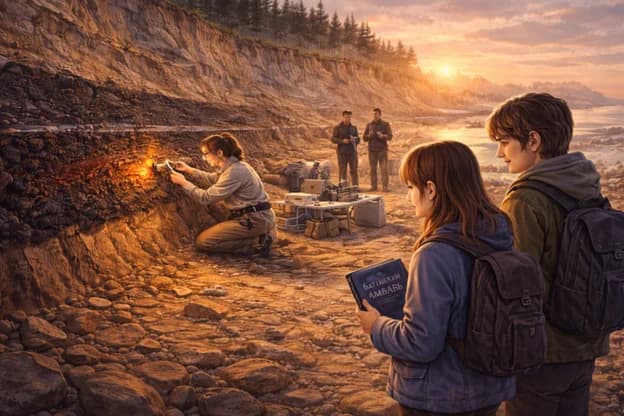
The conservator worked at the cliff face with tools that looked more like dental instruments than excavation equipment, removing the matrix around the amber band in thin, careful layers. The geologist documented each layer as it was exposed. The palaeontologists catalogued each piece of amber as it came free, entering it into the field database with its coordinates, orientation, and preliminary description.
On the first day of excavation, they extracted twelve pieces of amber from the deposit. Three contained insect inclusions. One contained plant material that the palaeontologists identified as potentially representing an undescribed species of Eocene conifer. And one, removed by the conservator from deep in the band with extraordinary care and held up in the afternoon light for everyone to see, contained a complete lizard.
Not like the one in Aleksei's piece, which was the size of a finger joint. This one was larger, perhaps seven centimetres, and it was oriented vertically in the amber as if it had climbed something and been caught mid-climb, and it was so perfectly preserved that Mila could see the individual scales on its back and the delicate membrane of its ear and the precise structure of its foot where it gripped an invisible surface.
The palaeontologists looked at each other with the controlled excitement of people who are trying very hard not to shout.
"Aleksei," said Mila quietly.
He was looking at the lizard in the amber with an expression that she thought he might not have been aware of, the expression of someone watching something they have hoped for and imagined and not quite let themselves believe in, finally becoming real.
"He would love this," Aleksei said. Not to Mila specifically. Just to the air.
"He's going to see it," said Mila. "They're going to show him everything tonight."
"I know." He was quiet for a moment. "He spent forty years on this. His whole career was built around the belief that this deposit existed. People thought he was..." He paused. "Not everyone believed him."
"But he was right."
"He was right," said Aleksei.
The two lizard specimens, Aleksei's piece and the excavation piece, were transported to the university that evening for proper conservation, and photographs were taken to the hospital for the professor, who looked at them for a long time and said nothing that anyone reported, which Aleksei said was entirely characteristic because his grandfather's deepest feelings were always the quietest ones.
On Mila's last full day in Kaliningrad, she went back to the beach alone in the early morning, before the collectors arrived. The excavation site was marked and monitored, and the cliff section was roped off, and everything was being managed properly, and she had nothing practical to do there. She went because she wanted to stand on the beach in the grey morning light and think.
She thought about the amber in her collecting bag, the small pieces she had found legitimately on the open beach during the week. She took them out and held them in her palm: yellow, orange, one piece of a cloudy white. She held them up to the thin morning light.
Forty-five million years. Before the Alps existed. Before the North Sea was a sea. Before anything she had ever learned about human history had happened, these forests stood and these insects flew and these trees bled their resin and the resin set and the forest compressed and the sea took it and the sea worked it and eventually, after all of that, it washed up on a beach in Poland and a four-year-old girl picked it up at a market and looked at it and found something inside.
She had been collecting things since she was four. She had been building towards this, she thought, without knowing that was what she was doing. Every labelled box in her bedroom, every piece of knowledge carefully gathered and filed and understood, had been preparation for a morning on a Baltic beach when a boy held out a piece of red amber and she knew, immediately and completely, what she was looking at and what it meant.
She put the amber pieces back in her bag.
Aleksei appeared on the beach path behind her, hands in his pockets, his serious face set against the morning wind. He had a small package under one arm, wrapped in paper.
He held it out. "From my grandfather," he said. "He asked me to give it to you before you go."
She unwrapped it. It was a book: the Russian-language textbook on Baltic amber palaeontology, the one Aleksei had said was not a bestseller, by Professor Ivan Volkov. On the title page, in the same precise handwriting she had seen on the notification form, the professor had written: For Mila Kowalski, who knows where to look. With thanks. I.V.
Mila closed the book and held it in both hands.
"I don't read Russian," she said.
"You will learn," said Aleksei, with a certainty that was not unkind. "You are the type of person who learns what they need."
Mila looked at the sea. The waves came in and went out in their ancient patient rhythm, and somewhere under the sand at the cliff base the amber band continued, west and east, still largely unexcavated, still holding whatever it held in its red and golden stillness. The survey team would be back today. The work would take months, possibly longer. Papers would be written. Species would be named.
Something would be named, she had been told by the palaeontologists, after the finder. There were two finders. The lizard in Aleksei 's piece was being formally designated as a new species, distinguished from known Eocene lizards by specific characteristics of its skeletal structure. Its scientific name would include both Volkov, for the man who had devoted his life to finding the deposit, and a word that meant amber in an old Baltic language, to mark the place.
There had been a conversation about whether to include a third name, and Mila had said no, with the directness she applied to most things, because she had found some amber on a beach and read some permit regulations, and that did not require commemorating. What required commemorating was the forty years of careful, patient, unfashionable belief that something was there.
The sea moved at the strandline and Aleksei stood beside her and neither of them spoke, and the morning light came across the water from the east and touched the cliff face above the cordoned section and made the exposed layers glow briefly, amber and ochre and the dark line of the band, like a painting of time.
"Will you come back?" Aleksei asked.
"Next summer," said Mila, without having consciously decided it until she said it, and then feeling entirely certain. "My father has a standing invitation from the field station. And the survey will still be running."
"It will be running for years," said Aleksei.
"Good," said Mila. "I have a lot to learn."
She put the book in her bag, beside the amber pieces, and they walked back up the beach path together in the morning light, with the Baltic at their backs and the fossil forest under their feet and forty-five million years of stillness going about its quiet, unhurried business in the stones.