The Forest of Frozen Time
Thirteen-year-old Mila Kowalski had been collecting things since she was four years old. Not randomly, not the way some children gathered interesting pebbles and forgot about them by teatime, but systematically and with great seriousness: first buttons, then stamps, then minerals, then fossils, each collection carefully labelled and stored and researched until she knew more about it than most adults she had met. Her bedroom in the family's flat in Gdansk was a controlled museum of her own making, and her mother had long since stopped trying to persuade her to clear some of it away.
So when her father, a forestry researcher, told her that his summer fieldwork was taking him to the Kaliningrad region of Russia's western enclave, and that she could come along, and that the region was one of the world's most significant sources of Baltic amber, Mila had packed her collecting kit before he had finished the sentence.
Baltic amber was not, strictly speaking, a stone. It was fossilised tree resin, forty to fifty million years old, formed from the forests that had covered northern Europe in the Eocene epoch. It washed up on the Baltic coast in significant quantities after storms, and the Samland Peninsula in Kaliningrad was the source of the richest amber deposits in the world. Mila knew all of this. She had known it for three years, since she had bought a small piece of Baltic amber at a market in Gdansk and looked at it under her father's microscope and seen, suspended in the golden resin, the perfectly preserved body of a tiny insect that had been alive forty-five million years ago.
That moment had rearranged something in her understanding of time.
They drove from Gdansk across the border into Kaliningrad in her father's research vehicle, a battered four-wheel-drive that smelled of soil samples and forest, and set up at a field station near a small town called Yantarny, which meant amber in Russian, because the town had been built around the world's largest amber mine. The mine itself was vast and strange, an open-pit operation that looked like a wound in the earth from which amber-bearing sand was extracted in industrial quantities.
But Mila was not interested in the mine. She was interested in the beach.
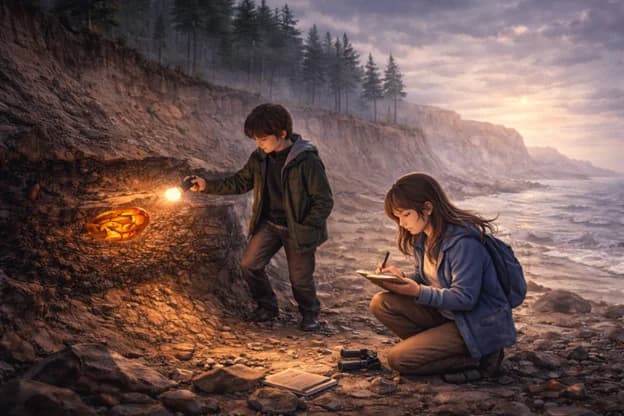
The Samland coast was dramatic: high sandy cliffs, thirty metres or more, dropping to a narrow beach where the Baltic came in in long, grey, determined waves. After storms, amber was deposited on the beach in quantities that drew collectors from all over Europe, people who waded into the surf with nets on long handles to scoop it from the water, or walked the strandline with their eyes down and their hands ready.
On her second morning, Mila was on the beach by six, before the other collectors arrived, walking the strandline methodically from south to north. She had been doing this for forty minutes, finding small pieces of amber in the kelp and gravel, when she found the boy.
He was sitting on a driftwood log at the base of the cliff, turning something over in his hands, and he looked up when Mila's boots crunched close enough for him to hear her. He was about her age, perhaps a year older, with close-cropped hair and a serious, watchful face, and he was wearing the layered, practical clothing of someone who spent a lot of time outside.
He looked at her collecting bag. She looked at what he was holding.
It was a piece of amber the size of a large egg, and even from two metres away she could see that it was unusual. The colour was wrong for a start: not the common yellow-orange of most Baltic amber but a deep, rich red, almost the colour of dried blood, with a quality of light inside it that was different from the translucency of normal pieces. It glowed in the grey morning as if lit from within.
"May I look?" she said, in English, which was the only language she had that might bridge the gap.
He hesitated, then held it out. She took it carefully and held it to the light. The red colour was deep and consistent throughout, which was rare. Red amber, called cherry amber or cognac amber, was among the most valuable varieties. But the colour alone was not what made her breath catch.
Inside the amber, clearly visible, was an inclusion. Not an insect, not a fragment of plant material, which were the common inclusions. Something else. Something that looked, unmistakably, like a small lizard, perhaps four centimetres long, perfectly preserved, its limbs extended and its head turned slightly to one side as if it had been caught mid-step.
Mila turned the piece over very carefully. The lizard was complete. Every scale was visible. The tiny claws on its feet were distinct and perfect.
She handed it back without speaking. She did not trust herself to speak immediately.
The boy had watched her face while she looked. "You know what it is," he said, in careful English with a strong Russian accent.
"A lizard inclusion in red Baltic amber," she said. "That's extraordinarily rare. I've never seen anything like it in person."
He looked at the piece in his hands. "I found it this morning. An hour ago. It came out of the cliff after the storm." He paused. "My name is Aleksei."
"Mila." She looked at the cliff face behind him, where a fresh section of sand had collapsed in the recent weather, exposing a dark band in the cliff face. "Where exactly did it come from?"
Aleksei pointed to a specific section of the exposed cliff, perhaps five metres up, where a horizontal layer of darker material was visible. "That band," he said. "I've never seen that layer before. The storm took the face off and it was there."
Mila looked at the dark band. It was clearly different from the sandy layers above and below it: darker, more consolidated, with a texture that she associated with ancient organic deposits rather than marine sediment.
"That could be a primary amber deposit," she said slowly. "Not washed material. In situ. Still in the original layer it formed in."
Aleksei looked at her. "I know," he said. "That is why I am sitting here working out what to do."
"What do you mean?"
He wrapped the amber piece carefully in a cloth and put it in his pocket. "This beach is state managed. Any in situ amber discovery is supposed to be reported to the mining authority. They will assess it and, if it is significant, they will extract it under their permit." He paused. "My grandfather has a scientific research permit for this section of coast. He is a palaeontologist at the University of Kaliningrad. But he is in hospital. He has been there for two weeks. His permit expires in twelve days."
Mila looked at the dark band in the cliff. She looked at Aleksei.
"If the mining authority gets there first," she said carefully.
"They will extract the amber commercially. They will not care about preservation or scientific documentation. The inclusions, if there are more like this one, will be sold to collectors or jewellers. The scientific data will be lost." He looked at the cliff. "My grandfather has been studying this coastline for thirty years. He has always believed there was an undisturbed primary deposit somewhere along this section. This is it. I know it is."
Mila looked at the dark band and then at the piece of amber in Aleksei's pocket and then at the grey Baltic moving steadily at the water's edge.
"Then we need to document it properly before anyone else finds it," she said. "And we need your grandfather well enough to file a scientific report under his permit before it expires." She paused.
"Tell me about the deposit. Tell me everything you know.
****