The Doll That Took Notes
By Raze Edgar
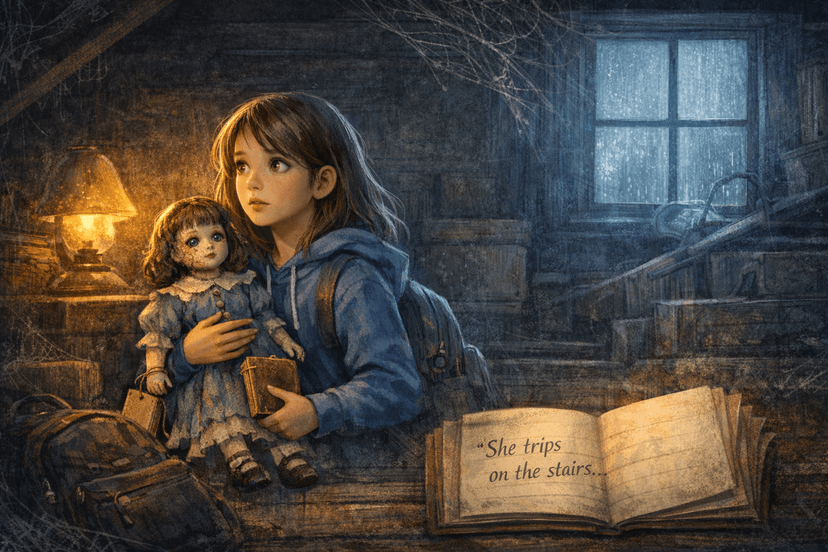
When Lily found the doll, it was buried beneath old blankets and dusty boxes in the far corner of the attic. The attic was a place she usually avoided, with its spider webs hanging like forgotten cobwebs and cold drafts that crept under the door. But today the rain was relentless, pounding against the roof and making the house feel smaller and quieter than usual. Curiosity pushed her up the creaky stairs and into the dusty shadows.
The doll looked like it belonged to someone a hundred years ago. Its porcelain face was cracked along one cheek, the edges faded and chipped. The glass eyes, cloudy with age, seemed to hold a secret. It wore a faded blue dress, frayed at the edges, and tiny button shoes that looked too delicate to touch. Around its wrist was tied a thin string, holding a tiny notebook, no bigger than Lily’s palm. The notebook’s cover was yellowed and worn, the pages edged with dust.
Lily picked up the doll carefully, cradling it like a treasure. She brushed some cobwebs away and untied the string to peek inside the notebook. It was blank. She slipped the doll and its notebook into her backpack, wondering what she would do with such an odd thing.
That night, after dinner and a mountain of homework, Lily sat on the edge of her bed. The doll rested beside her, its cracked cheek catching the soft glow of her bedside lamp. She opened the tiny book carefully and, to her surprise, found a sentence on the first page, written in neat, looping letters: “She trips on the stairs.”
Lily’s heart skipped a beat. The stairs in her house were old and creaky, but she had never tripped on them before. She closed the notebook quickly, trying to shake the strange feeling that crept up her spine. Maybe it was just her imagination. Maybe someone had written the note earlier and she hadn’t noticed. She tried to think about something else as she drifted off to sleep.
The next morning was rushed, as usual. Lily scrambled to get ready, brushing her teeth with one hand while grabbing her backpack with the other. She hurried down the stairs, thinking about the math test she had that day. Then, it happened. Her foot caught the bottom step. She stumbled forward, barely catching herself on the banister. Her heart pounded. For a moment, she stared at the bruised spot on her knee and then at the doll’s tiny notebook tucked safely inside her backpack.
Over the next week, Lily noticed the notebook filling up with more sentences each night. They weren’t written all at once, but appeared page by page: “She forgets her homework.” “She loses her favorite pencil.” “She spills juice on her notebook.”
At first, Lily thought it was a strange coincidence. But every time she read a note, something bad would happen the next day. One afternoon, she forgot her homework at home, just like the note had said. Another day, her pencil snapped right before a big drawing project. And once, she knocked over her glass of juice during lunch, soaking her papers. The predictions were always small things, annoying but not terrible. Still, they made her nervous.
One evening, Lily decided to test the doll’s power. The note said: “She will get a bad grade.” Lily had a spelling quiz the next day, and she was worried. That night, she studied harder than ever. She wrote out words again and again, quizzed herself in the mirror, and practiced until her eyes blurred.
The next morning, Lily sat at her desk, her heart racing. The teacher handed out the quiz. She answered carefully. When the results came back, Lily had an A. She opened the doll’s notebook. The page was blank. Her heart lifted.
The pattern was clear: the doll didn’t tell her what to do. It only told her what might happen. If she changed her actions, the note wouldn’t come true. But the more Lily tried to avoid the bad things, the heavier the notebook felt in her backpack. The predictions became more frequent and a little darker. Sometimes the notes predicted small accidents. Other times, they predicted hurt feelings. “She will be left out.” “She will lose a friend.” “She will say the wrong thing.”
Lily stopped climbing trees, stopped asking questions in class, and stopped trying new games. She became quieter. Her friends noticed. “Why are you so careful all the time?” Mia asked one afternoon, frowning as they sat under the big oak tree at recess. Lily shrugged, trying to sound casual. “I’m just being smart.” Mia didn’t look convinced. Lily wondered if she was losing herself in the doll’s predictions. Inside, a growing fear gnawed at her. The doll wasn’t just predicting problems; it was shaping her world.
One rainy afternoon, Lily took the doll and notebook to her grandmother’s house. Grandma smiled when she saw it, a faraway look in her eyes. “Oh, that old thing,” she said softly, brushing a strand of silver hair behind her ear. “I had a doll just like it when I was a little girl.” “Did it do magic?” Lily asked, eyes wide.
Grandma chuckled gently. “No magic, really. But it was special to me. Whenever I was scared or unsure, I’d write my worries down in a notebook like that one. Sometimes, just writing things helped me understand them better.” Lily looked at the doll’s cracked cheek and worn dress. “Do you think the doll is writing the notes?” she asked. Grandma nodded slowly. “Maybe it’s not writing them at all. Maybe it’s helping you see the choices you’re afraid to make.”
Lily thought about that on the way home. That night, Lily opened the notebook again. The page was empty. For the first time, something light and strange fluttered inside her chest, a quiet hope. She picked up the doll and smiled. Tomorrow, she decided, she would do something she was afraid of. She would try out for the school play. And if she stumbled? If she forgot her lines or missed a cue? Maybe the doll would write about it. But this time, she wouldn’t be afraid.
The next morning, sunlight spilled through Lily’s bedroom window. The doll sat on her bedside table, silent and still. Lily put on her favorite blue dress, the one Grandma said made her feel brave, and headed out the door, heart pounding. At school, she practiced her lines with her best friend Mia, who smiled and encouraged her. When it was time for auditions, Lily walked onto the stage, bright lights warming her skin. Her voice trembled at first, but she took a deep breath and kept going.
The teacher clapped softly when she finished. “That was wonderful,” she said. “You’ll do just fine.” Lily’s heart soared. That night, Lily opened the doll’s notebook. The page was blank. She closed it and whispered, “Thank you.” The doll’s glass eyes seemed to glimmer in the lamp light. Lily felt a smile tug at the corners of her mouth.
Maybe, just maybe, the doll’s notes weren’t warnings. Maybe they were invitations. Invitations to be brave. To make mistakes. To live.
In the weeks that followed, Lily stopped waiting for the notes. She still kept the doll nearby, but she wasn’t afraid anymore. She climbed trees, asked questions in class, and joined games she never would have tried before. Sometimes the doll’s notebook had a note. Sometimes it didn’t. And that was okay. Because Lily knew the most important choice wasn’t what the doll wrote. It was the choices she made herself.