

The Castle’s Secret
The morning air was crisp as Emil, Master Karel, and the young boy made their way to the castle’s western gate. The city below glimmered in the early sunlight, rooftops turning gold, and the Arno-like Vltava River winding silently through the streets. Emil’s hands clutched the brass key and the parchment tightly, both objects now symbols of responsibility, curiosity, and the lessons of patience he had learned in the observatory and the underground chamber.
“Remember, Emil,” Karel said quietly as they approached the gate, “the mechanisms here are older, more complex, and more protective. They were built to guard knowledge, not treasure. One misstep may seal the chamber forever, or worse, damage centuries of careful engineering. Watch, think, act, and above all, respect the work of those who came before us.”
The castle walls towered above them, ancient stones etched with centuries of wear and markings that only a careful eye could interpret. Emil approached a section near the gate where the parchment had indicated a small, nearly invisible indentation. Using the brass key, he pressed into the hidden slot, and with a soft, metallic click, a section of the wall shifted, revealing a narrow passage. The air inside smelled of earth, old stone, and candle smoke.
“This way,” Karel whispered, leading Emil into the dark corridor. They lit small lanterns, the flickering light revealing gears embedded in the walls and ceilings. Emil marveled at the intricate craftsmanship, tiny wheels, levers, and pendulums that seemed almost alive, poised to react to any motion, sound, or pressure. The parchment he carried was now a map, guiding them step by step through hidden passages beneath the castle.
At the end of the corridor, they reached a stone door, covered with faint astronomical markings and a small brass lock shaped like a gear. Emil carefully aligned the brass key with the lock, and the mechanism hummed softly as the gears inside clicked into place. Slowly, the door opened, revealing a circular chamber illuminated by a small hole in the ceiling. Dust danced in the sunlight, and in the center stood an ornate pedestal with a large, covered object resting upon it.
Emil approached cautiously. “This… this must be it,” he whispered. “The secret the parchment spoke of.”
Karel nodded, his eyes gleaming. “Yes, but remember, Emil, it is not the object alone that is important. It is the lesson it carries. Approach carefully, observe, and think. Let the mechanisms guide you.”
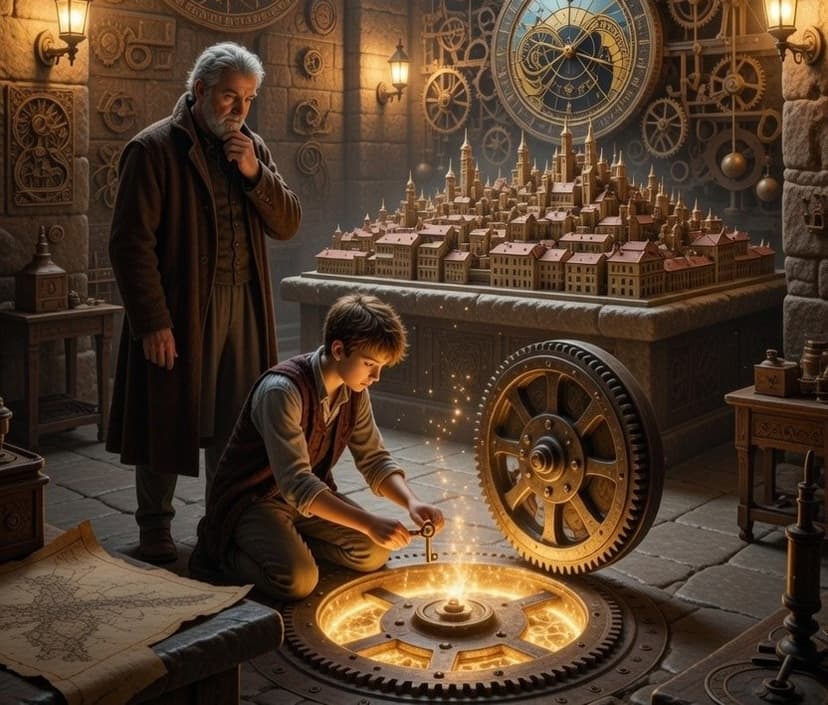
Emil reached forward, lifting the covering to reveal an intricate, miniature model of Prague. Every street, tower, and bridge was recreated in bronze and wood, complete with tiny moving figures and functioning clockwork. A small plaque at the base bore an inscription in Latin: “Those who understand time, stars, and craft shall learn the history that binds the city.”
He turned to Karel, awe written across his face. “It’s… the city itself, recreated in a clockwork model. Every mechanism we’ve encountered, observatory, river box, underground chamber, they all lead here.”
Karel smiled faintly. “Exactly. The model contains a hidden record. Every movement of the gears corresponds to events, decisions, and knowledge preserved over centuries. The apprentices who came before you designed this to teach careful observation, patience, and understanding. By following the steps, you’ve proven that you can see beyond the surface, interpret symbols, and respect the work of the past.”
Emil studied the gears and levers carefully, noticing small markings that indicated historical events, the construction of bridges, the founding of schools, even hidden alliances that had shaped the city. As he moved a tiny lever, a small compartment in the model opened, revealing a folded parchment. It contained detailed instructions, documenting the original creation of the mechanisms and a message from the master clockmakers of centuries past: “Knowledge preserved is power wisely used. Guide it well, apprentice, and let it teach what cannot be learned by haste or carelessness.”
Tears of excitement and reverence filled Emil’s eyes. “It’s incredible… they left all of this… for someone like me.”
Karel placed a hand on Emil’s shoulder. “Not for you alone. For any who follow the path of patience, observation, and understanding. You are the first to reach this stage, but the lessons extend far beyond a single apprentice. You must respect this knowledge and decide how it will guide your own work, and perhaps, the city itself.”
Emil nodded, absorbing the weight of responsibility. He realized that the apprenticeship had been more than learning to make clocks. It was a journey through history, mechanics, astronomy, and wisdom, a path that demanded respect, courage, and insight. The young boy who had accompanied them looked wide-eyed at the model.
“Do… do you think I could learn too?” he asked.
Karel’s eyes softened. “If you are willing to observe carefully, respect what is hidden, and learn without haste, then yes. Knowledge is preserved for those who can see it clearly.”
For hours, Emil explored the model, moving levers, observing gear alignments, and tracing symbols on the parchment. Each discovery revealed a new layer of the city’s history, a new connection between mechanics, astronomy, and the careful planning of generations past. The realization that knowledge could be hidden so cleverly, yet preserved so faithfully, filled him with both awe and determination.
As the sun began to set outside, casting long shadows across the castle walls, Emil and Karel carefully covered the model and locked the chamber. They ascended the hidden stairway, emerging once again into the fading light of Prague. The city seemed different now, alive with unseen layers, silent gears turning beneath the streets, and secrets waiting for those who could observe and understand.
Walking through the quiet evening streets, Emil whispered to himself, “I understand now… patience, observation, respect… that is the lesson. The city, the stars, the clocks, they are all connected. And I must carry this knowledge carefully.”
Karel glanced at him, a rare smile of pride crossing his face. “Well said, Emil. You have completed the first great challenge of your apprenticeship. The knowledge you have uncovered is vast, but remember, it is only useful if you continue to learn, observe, and apply it wisely. One day, the city may depend on apprentices like you to preserve what others cannot see.”
As night fell, the city of Prague glittered under the moonlight. Towers and rooftops reflected silvery light, the river shone like a ribbon of stars, and Emil felt the quiet thrill of being part of something far larger than himself, a legacy of learning, observation, and careful preservation of knowledge.
He clutched the brass key one final time, whispering to the silent streets and the ancient city below, “I will protect it. I will learn. I will remember.”
And somewhere in the shadows beneath the castle, the mechanisms ticked quietly, a testament to generations of clockmakers, scholars, and apprentices who had preserved not gold, but wisdom, for those patient and wise enough to uncover it.