

The Hidden Workshop
The streets of Prague smelled of damp stone, roasting chestnuts, and the smoke of countless chimneys. It was the late 16th century, and the city was alive with merchants calling their wares, children chasing stray dogs, and artisans hammering at their forges. Among the narrow alleyways and twisting lanes, fifteen-year-old Emil hurried, clutching a small satchel filled with tools his father had given him. Today was the day he would meet Master Karel, the famous clockmaker whose intricate creations were whispered about throughout Bohemia.
Emil had been apprenticed to Karel by chance, or perhaps fate. His father had a connection through the town council, and though Emil had never held a delicate hand at a clock before, he had an uncanny patience that made him a promising apprentice. Yet he could not shake the nervous flutter in his stomach. The clockmaker was said to be both brilliant and fearsome, a man who demanded perfection and punished carelessness harshly.
The workshop itself was tucked into a narrow lane near the Astronomical Clock, hidden behind a weathered wooden door with faded carvings of gears and stars. Emil paused outside, taking a deep breath before knocking.
“Enter,” a voice called from inside.
Pushing the door open, Emil stepped into a world unlike any he had imagined. The room was filled with clocks of every shape and size, some ticking melodiously, others silently measuring time with hidden mechanisms. Bronze gears gleamed in torchlight, delicate pendulums swung in hypnotic rhythm, and small glass orbs reflected the warm glow. On a workbench, a half-finished clock stood, its face covered with tiny, precise markings that must have taken hours, perhaps days, to engrave.
Master Karel emerged from the shadows, a tall man with sharp eyes and ink-stained hands. “You must be Emil,” he said, his voice calm but measured. “Your father spoke highly of your patience. Let us hope it is well earned.”
“I… I will do my best, Master Karel,” Emil stammered, bowing slightly.
Karel studied him for a long moment. “Very well. Your first task is simple in appearance, yet difficult in truth. Assemble the escapement of this clock.” He gestured to a small table with tiny brass gears and springs arranged meticulously. “It requires precision, steadiness, and understanding. One mistake, and the mechanism will not work. One moment of carelessness, and it could be ruined forever.”
Emil knelt at the table, spreading the pieces before him. He had watched clockmakers at the market, seen the delicate gears turn and swing, but to hold them in his hands and arrange them perfectly was far more challenging than he imagined. He took a deep breath, recalling the steady hands of his father and the lessons of patience he had been taught.
Hours passed as Emil worked. He adjusted a tiny gear here, aligned a pendulum there, and occasionally looked up at Karel, whose sharp eyes seemed to pierce every movement. “Steady,” the master said occasionally, “think of time itself as your guide.”
By late afternoon, Emil’s hands were stiff, and his eyes burned from concentration. Yet slowly, painstakingly, the escapement began to function. The small gear turned smoothly, the pendulum swung evenly, and the soft tick-tock filled the workshop. Emil’s heart leapt with a mixture of pride and relief.
Master Karel’s eyes softened slightly. “Well done,” he said, though his voice carried no warmth. “You have patience, Emil. But this is only the beginning. The workshop holds many secrets, some obvious, others hidden. A clock is not merely a measure of time. It is a keeper of stories, a recorder of events, and sometimes… a hiding place for knowledge. You must learn to see not only the mechanisms but the intention behind them.”
Before Emil could respond, a loud knock sounded at the workshop door. Karel’s expression darkened. “No one should disturb this place unannounced. Who is it?”
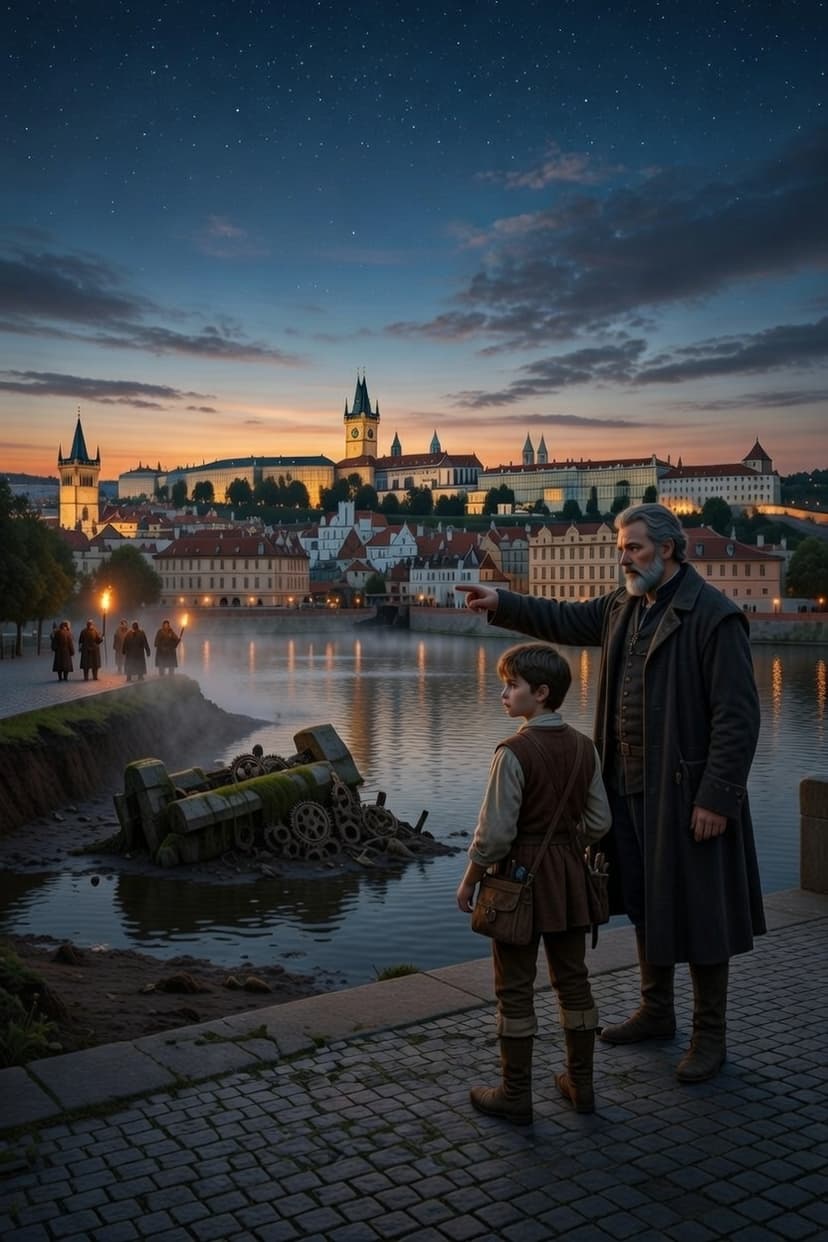
A voice called from outside: “Master Karel, it is the city council. We need your expertise immediately. Something unusual has been discovered near the river.”
Karel’s eyes flicked toward Emil. “It seems your lessons begin sooner than expected. Come, apprentice. There is much to learn, and some lessons can only be learned by facing the unknown.”
As they stepped into the evening streets of Prague, Emil glanced back at the workshop, its warm glow fading into shadows. The city seemed alive with possibilities and mysteries. Little did he know, the discovery by the river would lead him on a journey far beyond the measured gears of a clock, into secrets buried beneath the city, and into a challenge that would test his courage, intelligence, and understanding of time itself.
The bells of the Astronomical Clock tolled above, echoing through the alleyways, marking not only the hour but the beginning of Emil’s journey, a journey where every tick and tock might conceal a story, a warning, or a hidden truth.