
The Mystery by the River
The following morning, the sky over Prague was pale and still, with only faint wisps of cloud drifting above the red-tiled roofs. Emil and Master Karel made their way through narrow cobbled streets, the city waking around them with merchants setting up stalls and children chasing stray dogs. The river glimmered in the distance, reflecting the early sun in fractured gold. Emil clutched his satchel tightly, filled with tools, spare gears, and a few small sketches he had made the previous day. He could feel his heart racing. Something told him that today, the lessons would extend far beyond gears, pendulums, and the fine art of clockmaking.
They arrived at the riverbank, where a small crowd had gathered. People whispered in anxious tones, pointing to a section of stone quay where something unusual had been discovered. Master Karel’s eyes narrowed as he pushed through the onlookers. “Step aside,” he commanded, and the crowd reluctantly gave way, murmuring nervously.
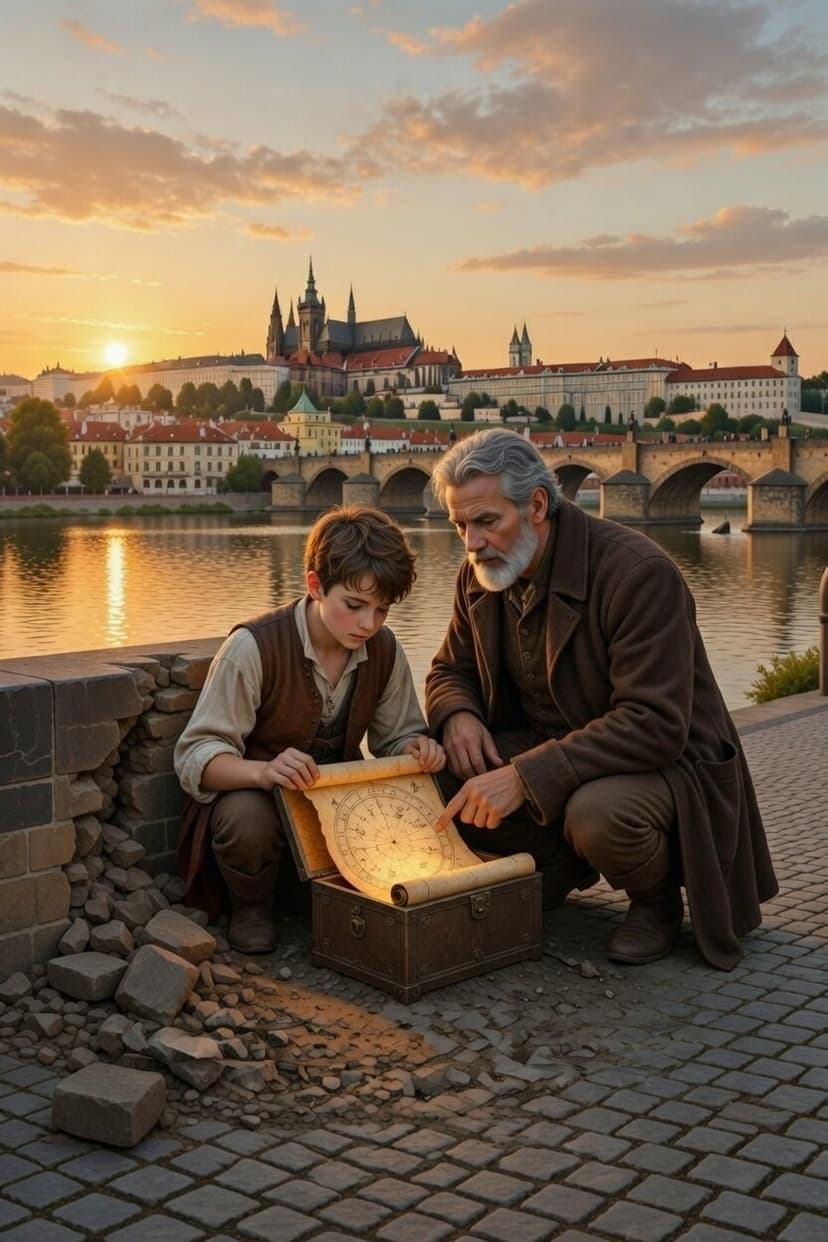
Emil followed closely behind, his eyes widening as he saw the source of the disturbance. A portion of the old river wall had collapsed during the night, revealing a hidden cavity beneath the stones. Within it, partially covered by dirt and mud, was an intricately carved bronze box, its surface etched with strange symbols, gears, and tiny astronomical markings.
“A clock,” Emil whispered, stepping closer. “But it’s… unusual. I’ve never seen anything like this.”
Karel knelt beside the box, examining the carvings carefully. “Not merely a clock, Emil,” he said. “This is a device designed to hide or protect something. Whoever created it did not want it discovered by ordinary hands. Observe the markings, there are patterns here, puzzles waiting to be solved.”
Emil knelt beside him, tracing the lines of the carvings with his fingers. Tiny gears were embedded in the surface, connected by minuscule pins and levers. The symbols resembled those he had seen on the Duke’s mechanisms in the workshop, though they were more archaic, older, and worn by time.
“What do you think is inside?” Emil asked, his voice barely above a whisper.
Karel’s eyes glinted with curiosity. “That, Emil, is what we must discover. But be warned: this will not be simple. Many devices like this were designed to deter thieves, spies, or careless hands. One wrong movement, and the mechanism may lock forever, or worse, be ruined.”
Emil’s pulse quickened, but he felt a thrill of anticipation. “I can help, Master Karel. I’ve been practicing with the workshop mechanisms.”
Karel nodded. “Good. Watch closely and think carefully. The first step is understanding the principle, not forcing it open.”
For the next hour, the two apprentices, Emil included, studied the box. Emil noticed that one side of the mechanism had a tiny series of gears that seemed to respond to light differently, catching the morning sun in subtle ways. Another section appeared to react to temperature, the bronze expanding slightly in the warmth.
“See here?” Karel said, pointing to a delicate lever embedded along the edge. “Many would attempt to pull or twist it forcefully. But the truth is, this lever only moves when the surrounding gears are in the exact alignment. Patience, observation, and precision will open it.”
Emil’s hands shook slightly as he adjusted a small gear to align with the lever. It was delicate work, requiring steady hands and careful thought. Slowly, the lever moved, clicking into place, and the surface of the box shivered as though acknowledging their success. The bronze lid lifted slightly, revealing a rolled parchment inside. Emil carefully extracted it, unrolling the fragile paper.
The script was written in Latin, accompanied by detailed diagrams of celestial bodies, small clockworks, and intricate geometric symbols. “What is it?” Emil whispered, scanning the diagrams.
Karel’s eyes sparkled with a mixture of admiration and caution. “This is a star chart, Emil, but not an ordinary one. Notice the annotations, they indicate hidden chambers, secret passages, and devices built centuries ago by clockmakers and astronomers who worked for the old city council. Whoever placed this box here intended for it to be found only by someone who understood both mechanics and astronomy.”
Emil traced the lines with his finger. “So… someone hid knowledge here, just like Master Karel hides lessons in the workshop?”
“Exactly,” Karel said. “Prague has always been a city of secrets. Knowledge, maps, and history are often hidden beneath streets, walls, and mechanisms. Those who can interpret them gain insight, power, or responsibility. And now, Emil, it seems you are part of that story.”
The crowd of onlookers murmured in curiosity, but Karel raised his hand. “Step back. This is not for the public eye.” He turned to Emil. “You will assist me in decoding this chart. Pay attention to every symbol, every line, and every hidden mark. The stars are guides, the clockwork is a key, and together they may reveal something the city has kept for centuries.”
As the afternoon sun climbed higher, Emil and Karel worked side by side. The other apprentice, a boy named Tomas, arrived with tools and notebooks, ready to assist. Slowly, painstakingly, they began mapping the symbols onto sketches of the city, comparing celestial markers with architectural features, bridges, and old streets. The chart seemed to point toward multiple locations, each possibly hiding objects, mechanisms, or knowledge long forgotten.
Hours passed, and Emil felt both exhilarated and exhausted. He realized that his apprenticeship had expanded far beyond clocks and pendulums; it now involved astronomy, history, and the careful study of puzzles created by minds long gone. The river, the bronze box, the hidden mechanisms, it all formed a tapestry of secrets, waiting to be understood by those willing to learn.
Finally, as the sun began to dip toward the horizon, Karel folded the parchment carefully. “We have discovered the first clue, Emil. But this is only the beginning. Each location marked on this chart may hold a mechanism, a hidden chamber, or a piece of knowledge. Your skills will be tested, not only as a clockmaker but as a seeker of secrets.”
Emil felt a mixture of excitement and nervous anticipation. He had entered the world of shadows and hidden wisdom, and he understood that every gear, every mechanism, every line in a manuscript could contain the lessons of centuries. He glanced at the river, golden in the late afternoon light, and whispered softly, “I’m ready. Whatever comes next, I will learn it.”
Karel’s gaze softened slightly, a rare sign of approval. “Good. The next step will take patience, courage, and ingenuity. Prague has been waiting for someone like you. And remember, Emil, time is both a guide and a teacher. Respect it, and it will reveal truths even the most careful eyes cannot see.”
With that, they returned to the workshop, carrying the chart, the bronze box, and the weight of new knowledge. Emil felt the thrill of discovery surge through him. The journey had only just begun, but he already understood that this apprenticeship was far more than learning to build clocks. It was a path into history, mystery, and the hidden heart of Prague itself.