
The First Clue
The next morning, Constantinople seemed both familiar and strangely mysterious to Levent. Sunlight danced across the tiled rooftops, the golden waters of the harbor shimmered, and the sounds of merchants and sailors filled the streets. Yet Levent no longer saw the city as ordinary. Every alley, archway, and shadow seemed alive with hidden paths and whispered secrets. The bronze lantern pulsed faintly in his satchel, as if urging him forward.
He paused at the edge of the Grand Bazaar, watching the crowded stalls. Merchants shouted prices, fragrant spices and dried fruits spilled from baskets, and the air smelled of fresh bread and sea salt. Levent felt a tug toward a narrow alley that led away from the noise, where sunlight barely touched the stones. Carefully, he entered, the lantern glowing slightly, illuminating faded markings on the walls. They were small symbols etched into the stone, almost invisible, but he recognized them from the chamber beneath the docks.
Following the markings, he came to a small door partially hidden behind crates of woven baskets. It was unassuming, but the glow from the lantern made a brass keyhole shine faintly. Heart pounding, Levent pulled the key from his satchel and inserted it into the lock. A soft click echoed, and the door swung open to reveal a narrow spiral staircase descending into darkness.
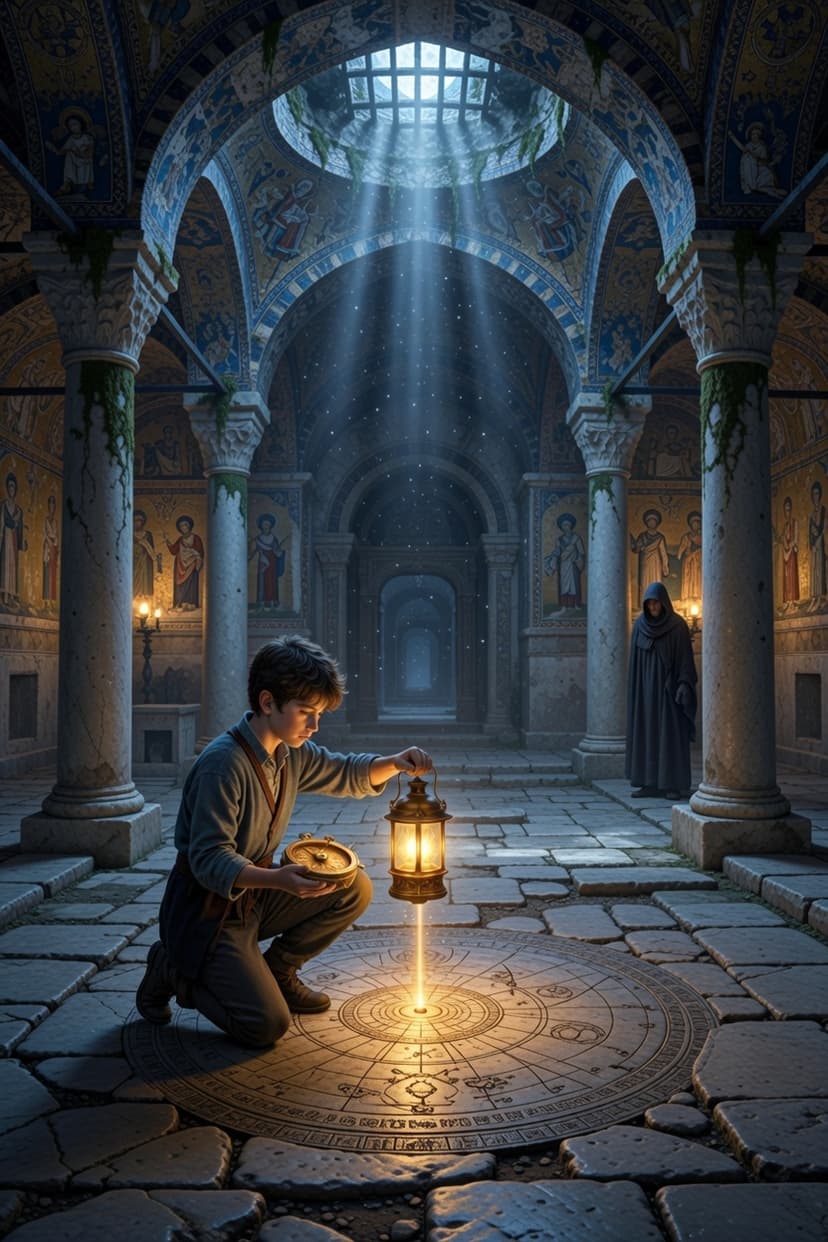
The air inside was cool and smelled faintly of dust and old wood. Levent held the lantern high, its light casting long shadows along the curved stone walls. At the bottom, he found a small chamber lined with shelves of scrolls, jars, and brass instruments. The room was silent except for the distant drip of water somewhere far below. In the center of the chamber was a pedestal with a small, covered object.
Levent approached cautiously and lifted the cover to reveal an intricately carved bronze compass. Unlike ordinary compasses, its needle spun slowly, then stopped pointing not north, but toward a tiny symbol on a map engraved into the compass itself. It was a star, the same symbol he had seen in the bronze map beneath the docks. He turned the compass over in his hands, tracing the engravings with his fingers. Around the edge, faint writing in Greek described the compass as a “guide to hidden knowledge and the preservation of the city.”
Levent realized that this compass was part of a larger puzzle, a key to uncovering secrets hidden throughout Constantinople. A soft sound made him turn. The figure in the dark robe emerged from a shadowed corner.
“You have found the first clue, Levent. Good. But remember, the city is full of traps, distractions, and challenges designed to test not only courage but patience and intelligence.”
Levent held the compass tightly. “I understand. But what am I supposed to find?”
“The compass will guide you,” the man said. “Its needle points to what must be discovered, but you must interpret its movements carefully. Not all paths are obvious, and not all doors should be opened at once. The city has been built layer upon layer. To understand it, one must observe carefully and think before acting.”
Levent nodded, a thrill of determination surging through him. “I will be careful. I will pay attention. I will learn.”
The man studied him for a moment. “Good. Your next step lies where the stars meet the earth. The Hagia Sophia is more than a building—it is a marker, a keeper of secrets. Follow the compass tonight when the moon rises. The light of the lantern and the guidance of the compass will reveal what is hidden to the ordinary eye.”
That evening, as the city quieted and lanterns were lit across the harbor, Levent returned to the hidden chamber. He traced the streets of Constantinople on a small map, marking the path from the docks to the Hagia Sophia and noting the symbols he had discovered. The lantern glowed softly, and the compass needle spun gently, finally settling toward a narrow, shadowed street near the great church.
As night deepened, Levent moved carefully through the streets, avoiding patrols and late-night merchants. The lantern’s glow seemed to grow brighter with each step, illuminating symbols etched into walls and arches, guiding him through alleys that seemed to vanish into darkness. Every corner he turned revealed small clues—an unusual pattern in the tiles, a carved symbol in the stonework, or a faint engraving almost erased by centuries of weather.
Finally, he reached the steps of the Hagia Sophia. Its grand dome loomed above him, towering over the city, bathed in the pale light of the moon. Levent’s heart raced. The lantern glowed brighter, and the compass needle quivered, pointing toward a small door at the side of the church, partially hidden by a column. He approached cautiously, studying the carvings around the door. Tiny stars and waves were etched into the stone, matching the patterns on the lantern and compass.
Levent pressed the lantern against the carvings, and faint lines of light traced along the engravings, forming a pattern that led his eyes to a small brass keyhole. Hands trembling, he inserted the compass key, turning it slowly. The lock clicked, and the door creaked open to reveal a hidden staircase spiraling downward into darkness. The scent of old stone, incense, and faint candle smoke rose to greet him.
Levent took a deep breath and stepped inside. The lantern’s glow illuminated the walls, revealing carvings of the city, the river, and tiny figures moving through its streets. As he descended, he realized that the Hagia Sophia, one of the greatest buildings in Constantinople, was not only a place of worship but also a keeper of hidden knowledge. At the bottom of the staircase, the chamber opened into a wide, vaulted room.
Stone columns supported the ceiling, and niches along the walls held scrolls, brass instruments, and small locked boxes. The lantern’s glow revealed a large bronze globe in the center of the room, engraved with constellations and the city’s streets. Tiny gears around the globe moved slowly, aligned with the phases of the moon and stars above. Levent approached the globe, feeling the weight of centuries of knowledge pressing on him.
The compass in his hand pulsed faintly, pointing to a tiny notch in the globe. He adjusted a small lever, and a hidden compartment opened, revealing another parchment with intricate diagrams and a short note in Greek: “Knowledge preserved is power guided by wisdom. Follow the path with patience, for haste will lead only to error.”
A shiver ran down Levent’s spine. He understood now that the journey ahead would not be easy. The city’s secrets were protected not by force but by puzzles, observation, and careful thought. Each step would test his courage, patience, and intelligence. From the shadows, the man in the dark robe stepped forward.
“You have done well tonight, Levent. The first clue has been found. You now understand the importance of observation and patience. The next stage will be more challenging, and the lantern will show you light, but not the way. That you must discover for yourself.”
Levent looked at the globe, the lantern, and the compass. The weight of responsibility pressed on him, but alongside it came determination and excitement. He knew that this was only the beginning. The city held many secrets, and he would uncover them, one by one, guided by courage, patience, and the mysterious lantern that pulsed with a life of its own.
He whispered to the glowing bronze lantern, “I will follow the path. I will understand the secrets. And I will protect what has been hidden for centuries.”
Above him, the moon shone over Constantinople, casting silver light across the domes and minarets. The city slept, unaware of the boy who had begun to uncover its hidden knowledge, guided by a lantern, a compass, and a courage that burned brighter than any flame.