

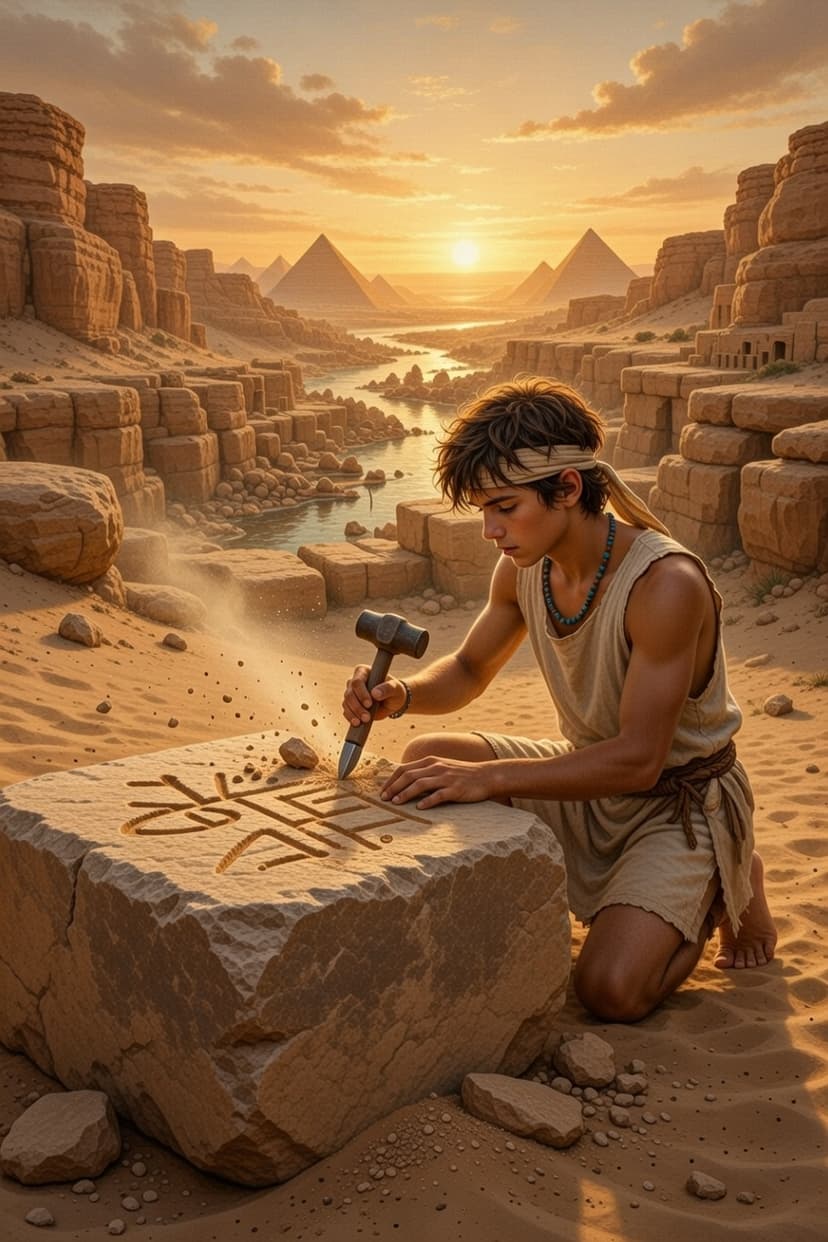
Echoes in the Quarry
The next morning, Kheti rose before dawn again, the chill of the early desert air still clinging to his skin. He had begun to notice that the quiet hours before the sun fully rose were the most alive. Birds flitted above the temple and along the riverbanks, and the soft murmuring of the Nile sounded almost like whispers meant only for him. He had started to imagine that the river spoke in subtle ways, like the marks he made on tablets, offering guidance to anyone patient enough to observe. The world felt larger than he had ever imagined. He had once believed that life was measured only in the rhythm of lifting and striking stone. Now he understood that life was also measured in observation, patience, and remembering.
Neferet had a new task for him that morning. She led him to the largest storage chamber in the temple’s yard, a place where hundreds of finished stones were stacked for transport. Each stone bore the marks of its journey: where it had come from, who had cut it, and when it would travel. It was a labyrinth of memory, a forest of limestone and sandstone pressed into order by human hands. The weight of it made Kheti’s chest tighten. He understood that the city’s future rested on these stones, on their correct placement and proper marking. One misplaced block could shatter a wall, a doorway, or a tomb that might hold kings and queens for eternity.
“Your task,” Neferet said, her voice soft but commanding, “is to check for flaws before they leave. Use the marks we keep to guide you. Learn to trust what the stone tells you.”
Kheti nodded. He began walking among the stacked blocks, running his hands across the rough surfaces, inspecting edges, listening to the subtle differences in tone when he tapped the stones lightly. Some stones felt hollow, others resonated like singing. Each one spoke in a language of cracks, weight, and texture that he had begun to understand.
Hours passed in this quiet work, and Kheti felt the sweat trickle down his back as he crouched, lifted, and examined. His hands were already blistered from weeks of labour at the quarry, but these marks required a gentler touch, the patience to watch and feel instead of simply acting. He realized that while he had learned to move stone with strength, he was learning to move stone with thought.
A sudden commotion drew him to the entrance. Messengers had arrived from upriver, bringing news of a construction project of unprecedented scale. The overseer had selected blocks for a royal tomb, one that would rival any built before. Kheti’s chest tightened at the thought. This was the largest responsibility he had faced so far. One mistake here could ripple down the Nile for years.
Neferet motioned him closer. “These stones are special,” she said. “Watch each mark. Record everything. One day, you may be responsible for stones that no longer have anyone to speak for them.”
Kheti swallowed hard. He knelt beside a massive block of limestone, its surface etched with faint lines from previous handling. As he pressed the stylus to the clay tablet beside him, he felt the weight not just of the stone, but of generations. He thought of the workers at the quarry, their sweat and hands shaping the rock. He thought of the overseers who had measured and weighed every decision. And he thought of the river, steady and flowing, carrying all of it forward.
When the sun reached its peak, the heat became nearly unbearable. Kheti’s clothes were soaked with sweat, and his lips were cracked from the dry air. But still, he continued, marking and inspecting, tapping lightly, listening for echoes.
It was then that he noticed a flaw on one of the blocks. A faint fissure ran along its side, almost invisible in the harsh sunlight. Had he missed it earlier, the stone might have shattered in transport, ruining months of work.
He called to Neferet, and together they examined the block. She nodded slowly. “Your hands are learning what the eyes alone cannot see,” she said. “The stone speaks to those who listen.”
As the afternoon wore on, Kheti began to feel the pull of fatigue, but he also noticed something new. He was no longer simply reacting to instructions. He was beginning to anticipate, to sense which stones needed extra care, which required closer attention. His mind had begun to read the patterns in the stone the way it read the flow of the river or the rhythm of the quarry. He realized he was growing beyond the boy who had only lifted and struck. He was becoming a recorder, a listener, a guardian of memory.
By late afternoon, a messenger arrived bearing an unusual request. A new block, larger and heavier than any they had yet handled, was to be transported upriver. It had come from a distant quarry, where stone was rare and valued for its strength and colour. The overseer had already measured its weight, calculated the number of men needed to move it, and prepared a list of workers.
But Neferet looked to Kheti. “You will mark it,” she said. “And check it for hidden flaws. No one leaves until you approve it.”
Kheti’s heart raced. He approached the block carefully, circling it, running his fingers along every surface. The block seemed almost alive, a silent presence that pressed its weight into him. He struck it lightly with his stylus, listening to the sound. Nothing cracked, nothing betrayed weakness, yet he sensed tension within it, faint and subtle, like a hidden breath waiting to escape.
Hours passed as he worked, and the sun began to lower, painting the chamber in orange and gold. Sweat mixed with dust on his hands, but he continued, refusing to leave until he was certain.
Finally, as dusk approached, he felt the faintest tremor under his touch. A hairline fissure ran along the edge, almost invisible to anyone not trained to see it. Kheti quickly recorded the mark, noted its location, and brought it to Neferet.
She examined the tablet and then the stone. “Well done,” she said quietly. “Had this gone unmarked, it could have ruined everything.”
Relief flooded through Kheti, but it was tempered by the knowledge of responsibility. The stone did not forgive mistakes. Memory did not forgive carelessness. But he had listened, and he had acted correctly.
That evening, as he left the temple and walked past the familiar banks of the Nile, he felt a sense of quiet triumph. He had begun to understand what it meant to work not just with hands and muscle, but with thought, patience, and observation. The river, flowing steadily beside him, seemed to approve silently, carrying his steps forward as it had carried the stone’s journey before.
When he reached the edge of the quarry on his way home, he paused for a moment to look at the stone that had first caught his attention weeks ago. Its surface gleamed in the fading light, shadows stretching across the sand. It had witnessed everything he had done and would continue to witness whatever came next. Kheti knelt and touched it gently.
“I am learning,” he whispered. “I will not forget.”
The stone remained still, unyielding, yet somehow patient. It had watched generations rise and fall, carried kings’ dreams and workers’ sweat alike. And now, it would watch him, the boy who was learning that memory, like stone, was heavier than it appeared, and that the marks left behind could speak for centuries to come.