

The Weight of the Stone
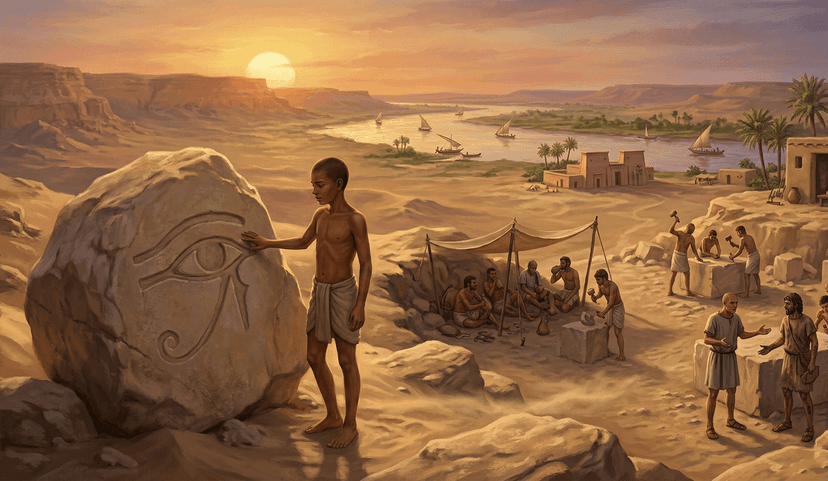
The stone had been there longer than anyone could remember. It rested at the edge of the quarry, half buried in sand, its surface worn smooth by wind and time. To most people, it was nothing more than another block of limestone waiting to be cut and hauled away. To Kheti, it felt like it was watching him.
Every morning, as the sun rose over the desert and painted the cliffs in pale gold, Kheti passed the stone on his way to work. He was thirteen years old, lean from labour, his skin darkened by years under the sun. His father worked the quarry, and so did he. The rhythm of stone and sweat had shaped his life since he was old enough to carry water to the men. Now, he lifted tools, cleared debris, and learned where to strike rock so it split clean instead of crumbling.
“Hurry,” his father called as Kheti slowed near the stone. “The overseer will not wait for daydreams.”
Kheti nodded and followed, though his eyes lingered on the stone’s surface. There was a mark on it, a shallow curve that looked almost like an eye. He had traced it once with his fingers and felt a strange calm, as if the stone carried a memory older than words.
The quarry was already alive with sound. Metal struck rock in steady rhythm. Men shouted instructions. Dust rose into the air and clung to skin and hair. Beyond the quarry, the Nile shimmered in the distance, a thin ribbon of life cutting through endless sand. Everything they did here fed the river’s cities, the temples, and the tombs that reached toward the sky.
“Work clean,” the overseer barked. “These stones are for the king.”
The king. The word carried weight. Everyone knew the stones were being shaped for a great project upriver, something meant to last forever. Kheti had never seen it, but he imagined walls so tall they touched the sun.
As the morning wore on, Kheti worked beside his father, learning to read the stone. His father believed stone had its own rules, and those who ignored them paid the price. “Do not rush,” his father said, guiding his hand. “Stone remembers every strike.”
Kheti nodded, repeating the motion carefully. Each blow echoed through his arms. Sweat dripped into the dust.
At midday, the workers rested in the thin shade of a canvas shelter. Kheti drank from his water skin and glanced back toward the edge of the quarry. The watching stone sat alone, unchanged by the noise and effort around it.
“Why does that stone remain?” Kheti asked suddenly.
His father followed his gaze. “It is too large and oddly shaped. Hard to move. Perhaps it will be cut later.”
“Or perhaps it is waiting,” Kheti said without thinking.
His father gave him a sharp look. “Stone does not wait. People do.”
But that afternoon, something changed. A messenger arrived from the river, his sandals coated in mud, his voice urgent. The overseer gathered the workers, speaking in low, serious tones. Kheti caught fragments of words. Temple. Record keeper. Selection.
Later, as the men returned to work, the overseer stopped beside Kheti and his father. “The boy,” he said. “He reads the stone well.”
Kheti froze.
“He has good hands,” the overseer continued. “And patience. He will assist the record keeper for a time.”
His father stiffened. “He is needed here.”
“This is not a request,” the overseer replied.
That evening, Kheti walked along the Nile for the first time without tools on his back. The river smelled of reeds and wet earth. Boats drifted past, heavy with grain and stone. He felt small beside the water, uncertain of what waited ahead.
The record keeper’s dwelling stood near a small temple, its walls covered in faded carvings. Inside, scrolls and tablets lined the shelves. The air smelled of ink and papyrus.
“You are Kheti,” said a woman seated near a low table. Her hair was streaked with grey, her eyes sharp and observant. “I am Neferet. You will help me.”
“With what?” Kheti asked.
“With remembering,” she replied.
The next days were unlike anything Kheti had known. He learned to measure stone, to record its origin, its flaws, its purpose. He learned how each block was tied to a place, a time, a worker. Stone was no longer just something to lift and shape. It was part of a larger story.
One evening, as Kheti returned past the quarry, he stopped at the watching stone. The sun was low, and shadows stretched long across the sand.
“They see you now,” he whispered, unsure why he spoke.
The stone remained silent, heavy and still. But Kheti felt something settle inside him. For the first time, he understood that his life might be shaped by more than labour alone. Duty could take many forms, and identity, like stone, was carved slowly, strike by careful strike.
The desert wind rose, carrying sand across the quarry floor, erasing footprints but leaving the stone unchanged, watching as it always had, waiting to see what the boy would become.