

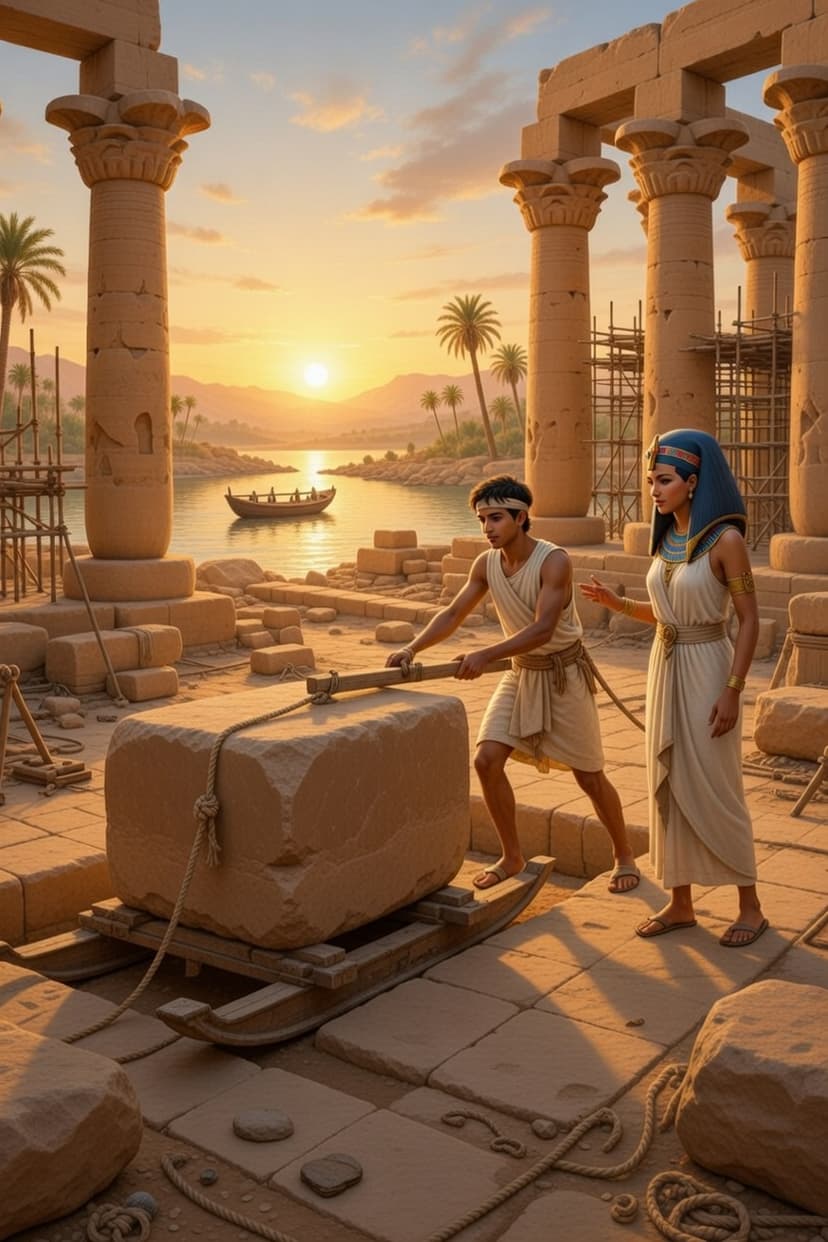
When the Stone Finds Its Place
The sun had barely risen when Kheti awoke, the desert air still cool against his skin. Even before his eyes opened fully, he could hear the river flowing steadily, its murmur carrying over the sand and palm groves like a voice he had come to understand. Today was the day. The largest and heaviest limestone block he had ever inspected would be moved upriver to the royal construction site. For weeks, he had prepared—studying the stone, marking its hidden fissures, recording every detail, and observing its weight and balance. Now it would leave the temple yard and become part of something far greater than anything Kheti could yet imagine.
Neferet appeared at the doorway, her robes brushing the dusted floor. She held a small bundle of scrolls, the overseer’s instructions, and a list of men assigned to transport the stone. Her eyes, sharp and unwavering, found Kheti’s.
“You are ready,” she said. “Remember everything we have practiced. Watch the stone. Listen to the men. Do not assume anything. The stone does not forgive mistakes.”
Kheti swallowed, feeling both excitement and anxiety swirl in his chest. He nodded, tightening his grip on the stylus in his hand, a small comfort that reminded him of his responsibility.
The workers gathered around the massive block, chanting and coordinating as they prepared ropes, rollers, and levers. Kheti moved alongside them, clipboard in hand, checking the measurements and marks he had recorded for days. He felt the weight of the stone pressing not only against his body but against his sense of purpose. One miscalculation could send it toppling, damaging not only the precious block but also the men’s efforts. He reminded himself to breathe, to act with patience and attention, just as Neferet had taught him.
“Lift slowly,” Kheti called out, though he was not one of the men. He was the observer, the recorder, the guardian of the stone’s integrity. Yet even in that moment, his voice carried authority. “Check the ropes. Do not rush.”
The men shifted, muscles straining, groaning with effort. Sand crunched beneath their feet, dust rising in soft clouds around the block. Kheti’s eyes followed every movement, counting turns of the rollers, listening for the slightest tremor or hollow sound. He could feel the stone almost as if it had a heartbeat of its own, steady and silent, waiting to be placed in the world.
Hours passed under the blazing sun. The sweat ran down Kheti’s back and stung his eyes. He wiped it away and continued observing, recording every adjustment on his tablet. When the stone finally began to move, inch by inch, the air seemed to hold its breath with him. Every rope pulled, every hand placed carefully, every stone under the rollers counted. The river, visible beyond the temple walls, glimmered in the distance as if approving the effort, flowing steadily and endlessly.
“Careful, careful!” Kheti called again, his voice rising above the chorus of men. “Shift it slightly to the left. The vein will catch!”
The men paused, adjusting their stance, and the stone responded. It moved more smoothly, gliding over the sand and rollers, carrying centuries of earth and memory with it. Kheti felt a surge of satisfaction and relief, but he knew the work was far from over. The stone was alive with potential energy, and the journey upriver would test it further.
As the block reached the riverbank, a small boat had been prepared, reinforced with wooden beams and bound with thick ropes. Kheti helped guide it into position, watching carefully as men leveraged it onto the vessel. He inspected every support, every rope, every plank, and recorded it all meticulously. The river would carry the stone, but it was their care, attention, and patience that would ensure it arrived intact.
“Steady,” Kheti whispered, almost to the stone itself. “I am watching.”
The boat began to drift, the river swallowing it slowly into the currents. Kheti stayed on the bank, watching every movement. The stone did not falter. It did not break. Inch by inch, it glided forward, a silent testament to the labor of hands, the patience of observation, and the weight of responsibility carried by a boy who had learned the language of stone.
After the boat disappeared around a bend upriver, Kheti finally exhaled, feeling the tension leave his body. Neferet approached, her eyes soft but serious.
“You have done well,” she said. “Not just because the stone moved safely, but because you understood it. You listened. You observed. You respected it. That is the work of memory, of knowledge, and of duty. Remember this. Not all lessons are written on clay or stone. Some live within the patience of those who care.”
Kheti nodded, feeling a quiet pride settle over him. He thought of the quarry, of the stone that had first drawn his attention, of the river carrying the royal block forward. He realized that the lessons of patience, observation, and responsibility were now part of him. He had begun to understand that his actions, however small, could shape the world around him.
As the sun dipped low in the sky, Kheti walked back to the edge of the temple yard, past the familiar watching stone. He knelt beside it, pressing his hands against the cool limestone.
“I have learned,” he whispered. “I will remember. I will not forget what you taught me.”
The desert air was calm, carrying the scent of the river, reeds, and earth. The stone remained still, patient and unyielding, as it always had been, witnessing the boy’s growth, the labor of the city, and the passage of generations. Kheti realized that he would return often, not only to observe but to learn, to guide, and to remember. The stone, like the river, would remain long after he had grown older, long after the hands that lifted and carved had turned to dust. It would carry memory, patience, and the story of a boy who understood that life, like stone, required care, attention, and respect.
That night, Kheti sat beside the river, watching the water shimmer in the moonlight. He felt a deep connection to the laborers, the record keepers, the overseers, and even the stone itself. The river whispered to him softly, carrying echoes of voices, efforts, and dreams from upriver to downstream, past villages and temples, across the desert. He thought of the royal block, now gliding toward its destiny, and he realized that he had helped shape history, in a small but lasting way.
“I am part of this,” he whispered to the river, his voice calm and certain. “And I will not forget.”
The river continued its endless flow, carrying stones, stories, and memory through time. And the watching stone at the temple yard, patient as ever, held its silence, witness to a boy who had learned that wisdom, responsibility, and care were marks that endured far longer than the hand that left them.