
The River That Remembered
The river always spoke first in the morning, long before the city woke up. It whispered against the clay banks, slid between reeds, and carried the smell of wet earth into the narrow streets of Uruk. Tarek heard it even before he opened his eyes. He lay still on the woven mat, staring at the low mudbrick ceiling of his family’s house, listening as the river told its quiet stories. His mother said the river was alive and older than all people, and that it remembered everything. Tarek believed her. He believed the river remembered him too.
“Tarek,” his mother called softly from the hearth. “The sun is rising.”
“I am awake,” he replied, though he had not yet moved. He liked the moment just before the day began, when the city was still gentle and the world felt wide open. Outside, a donkey brayed, and somewhere nearby a pot cracked as it cooled. The smell of barley bread drifted into the room.
Tarek finally sat up and rubbed his eyes. He was twelve years old and already taller than most boys his age, though he still felt small when he looked at the tall temple towers or watched the scribes walk past with their clay tablets tucked under their arms. He tied the simple cord around his tunic and stepped outside, where the sky was turning pale gold.
His mother handed him a piece of bread. “Eat quickly. Your father will need help at the canals today.”
Tarek nodded, though his heart sank a little. The canals meant work, and work meant rules. His father was a careful man who believed everything had its place and time. Tarek respected him, but the river did not have rules, and Tarek liked that better.
As he chewed, his younger sister Ina tugged at his sleeve. “Will you tell me a story tonight?” she asked.
“If you listen,” he said with a grin.
She laughed and ran off, her bare feet kicking dust into the air.
The canals lay just beyond the city walls, cutting through fields of barley and dates. Water was life here, and everyone knew it. Without the river and the canals, the land would dry and crack, and the city would fade like old paint. Tarek’s father worked as a water keeper, checking the flow and repairing the banks where they weakened.
“Watch closely,” his father said as they walked along the canal. “The water is calm now, but it changes quickly.”
Tarek nodded, though his eyes kept drifting toward the river itself, wide and slow beyond the fields. He wondered where it went and what it had seen.
As they worked, Tarek noticed something strange. The water level near the eastern gate seemed lower than usual, the current weaker. He crouched and touched the surface. It felt wrong, like a breath held too long.
“Father,” he said, “the water here is different.”
His father glanced at it and frowned. “We will look later. Finish packing the bank first.”
Tarek did as he was told, but the feeling stayed with him. The river was speaking, and no one else was listening. By midday, the sun burned hot, and his father sent him back to the city with a bundle of tools.
“Go straight home,” he said. “Do not wander.”
“I will not,” Tarek replied, though he already knew he would.
Instead of heading home, he followed the canal east, where it curved toward a section few people visited. The reeds grew thick there, and the ground was soft underfoot. The sounds of the city faded until only insects and water remained.
“Tarek!”
He turned to see his friend Luma running toward him, her dark hair tied back with a strip of cloth.
“I thought that was you,” she said, breathing hard. “You are going the wrong way.”
“Not wrong,” he said. “Just different.”
She rolled her eyes. “You will get in trouble again.”
“Maybe,” he said, smiling. “Come with me.”
Luma hesitated, then nodded. “Only for a little while.”
They walked until the canal narrowed and nearly vanished into the reeds. There, half-hidden by mud and grass, was a broken wooden gate that controlled the water flow. One side had collapsed inward, blocking part of the channel.
“That should not be like that,” Luma said quietly.
Tarek knelt and examined it. “If the water cannot pass, the fields behind the city will dry.”
“Then we should tell someone,” she said.
Tarek looked at the gate, then at the slow-moving water pressing against it. He felt the same pull he always felt near the river, a strange sense that it was waiting for him.
“If we clear it,” he said slowly, “the water will flow again.”
Luma’s eyes widened. “We are not water keepers.”
“But we know what is wrong,” Tarek said. “Is it not worse to do nothing?”
She bit her lip. “If we break it more, it could flood the fields.”
Tarek stood, torn between fear and excitement. The river whispered louder now, or maybe that was only in his head.
“I will be careful,” he said. “Help me move the wood.”
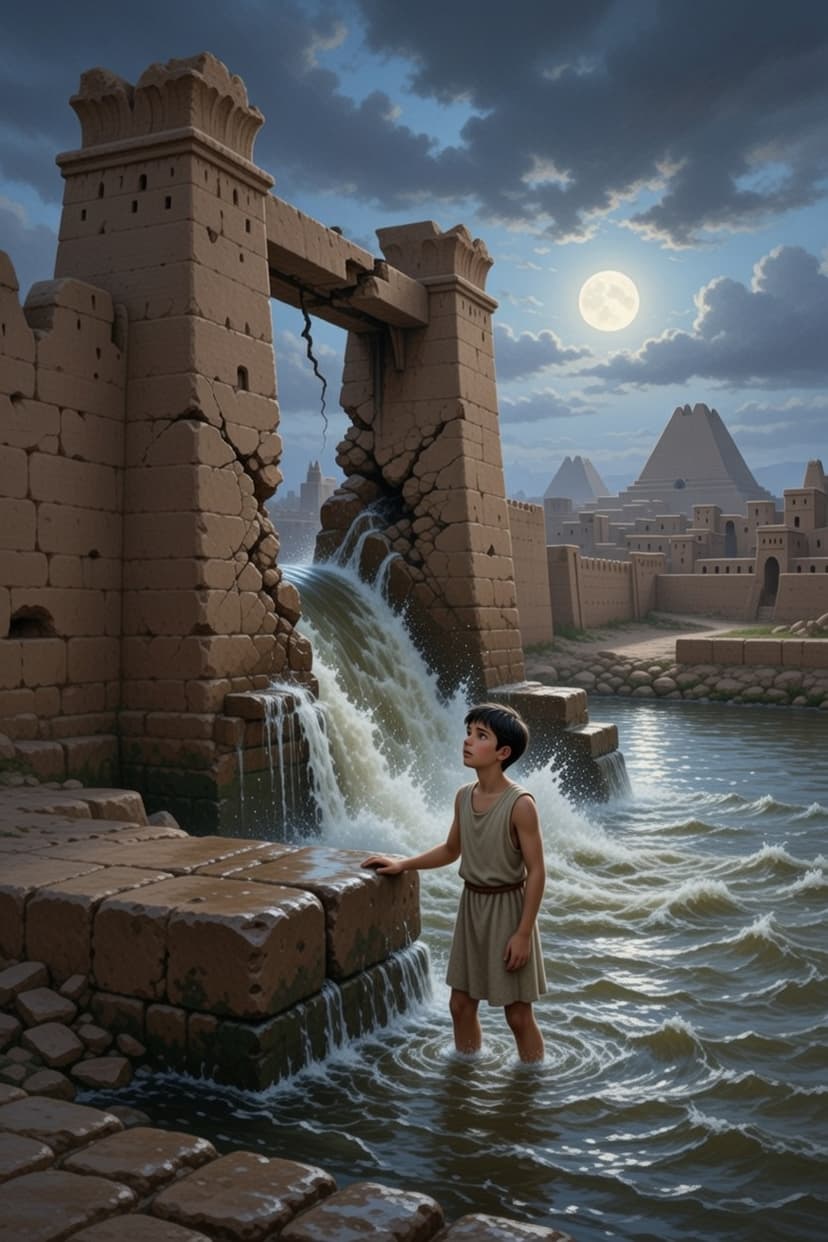
They worked slowly, tugging at the heavy beam. Mud sucked at their feet, and the sun beat down, but at last the beam shifted. Water surged forward, stronger than before, splashing over the banks.
“Tarek!” Luma shouted. “Stop!”
But it was too late. The current rushed through, carrying loose earth with it. For a moment, it seemed fine. Then a section of the bank collapsed, sending a wave of water into the nearby field.
They stood frozen, staring at the damage.
“We should run,” Luma whispered.
“No,” Tarek said, though his heart pounded. “We should tell my father.”
By the time they reached the canal path, men were already shouting. Farmers pointed at the flooding field, and water keepers hurried toward the broken gate. Tarek’s father arrived last. He took one look at the scene, then at Tarek’s muddy hands.
“What did you do?” he asked quietly.
Tarek swallowed. “I tried to help the river.”
Silence followed. Then his father sighed, a sound heavier than anger. “The river does not need help. It needs understanding.”
That evening, Tarek sat outside his house, staring at the dark ribbon of water under the moonlight. He expected punishment, and it would come, but something else troubled him more. The river was quiet now, as if it were thinking.
“I listened,” Tarek whispered to it. “But I did not listen enough.”
The river flowed on, carrying his words away, and for the first time, Tarek understood that curiosity could build a city or break it, depending on how it was used.