
When the River Tests the City
The days after the storm felt uneasy, as if the land itself was waiting. Although the fields had survived and the city stood unharmed, a quiet tension settled over Uruk. People spoke in lower voices, and even the market seemed less lively. Tarek noticed it most in the way people watched the river. Where once they passed it without thought, they now paused, studying its surface, searching for meaning in every ripple. The river had shown its strength, and it had also shown that it could be guided, but only when people worked together and listened carefully.
Tarek continued helping his father and the water keepers each day. His tasks grew more important. He was no longer sent away when discussions began. Instead, he stood nearby, listening as men debated where to strengthen banks or widen channels. His father sometimes asked his opinion, not because Tarek was the most experienced, but because he had learned to observe without rushing to act.
One morning, Bel-Enna called for Tarek to join him near the eastern edge of the city. The old scribe held several tablets wrapped in cloth.
“There is something I want you to see,” Bel-Enna said as they walked.
They stopped where the river curved sharply, pressing close to the city wall. The water here moved faster, biting at the bank.
“This bend has always been dangerous,” Bel-Enna explained. “Many years ago, it broke through and flooded the lower streets.”
Tarek examined the ground. The soil near the edge looked soft, darker than the rest.
“The earth is weak here,” Tarek said.
Bel-Enna nodded. “And yet people have built too close to it.”
As if summoned by his words, a woman approached them, her face tight with worry.
“My house is near this bend,” she said. “The water is closer than it was last season.”
Bel-Enna listened carefully. “You must prepare to move if needed,” he said gently.
“But that is my home,” she replied, her voice trembling.
Tarek felt a familiar pull in his chest, the urge to fix the problem quickly. He forced himself to breathe and remember what he had learned.
“Could the bank be strengthened?” he asked, looking at his father, who had joined them.
“It can,” his father replied, “but it will take time and many hands.”
By midday, word spread through the city. A meeting was called near the temple, and citizens gathered in the open square. The heat was heavy, and the murmur of voices filled the air.
Bel-Enna stepped forward, leaning on his staff. “The river has given us signs,” he said. “It does not threaten without reason. We must choose how to respond.”
Some argued that the danger was small and not worth the effort. Others feared another flood and demanded immediate action. Tarek listened, his heart pounding. He understood both sides. Work meant sacrifice, but inaction carried its own cost.
When Bel-Enna asked if anyone wished to speak, silence fell. Tarek surprised himself by stepping forward.
“I acted once without thinking,” he said, his voice steady though his hands shook. “I learned that listening alone is not enough. We must also act together. If we prepare now, the river will not take more than it must.”
Murmurs rippled through the crowd. His father watched him closely, pride and concern mixed in his eyes.
After a long pause, a farmer spoke. “The boy is right. We all depend on the river. We all share the risk.”
Slowly, agreement spread. Plans were made. Houses closest to the bend would be reinforced or temporarily abandoned. Workers would gather at dawn to strengthen the bank with clay, reeds, and stone.
The next days were hard. Under the blazing sun, men and women laboured side by side. Children carried water and tools. Tarek worked until his muscles burned, shaping clay and pressing it into place. Luma worked nearby, her hands coated in mud.
“You speak differently now,” she said during a brief rest. “Like someone older.”
Tarek smiled faintly. “I feel older.”
At night, he returned home exhausted, his dreams filled with flowing water and shifting earth. The river seemed closer than ever, its presence pressing into every thought.
On the fourth day, clouds gathered again. Wind swept across the fields, bending the grasses low.
“The river will test us,” Bel-Enna said quietly.
Rain fell through the night, steady and relentless. Tarek lay awake, listening to it drum against the roof. When dawn came, the river had risen, its surface dark and fast.
People gathered along the reinforced bank, watching anxiously. Water lapped against the new clay walls, testing their strength. Tarek stood beside his father, holding his breath.
The river surged, pushing harder, then harder still. For a moment, fear seized him, and he thought of the broken gate and his past mistake. But this time, the bank held. The water slowed, spreading into prepared channels and fields beyond.
A cry of relief rose from the crowd.
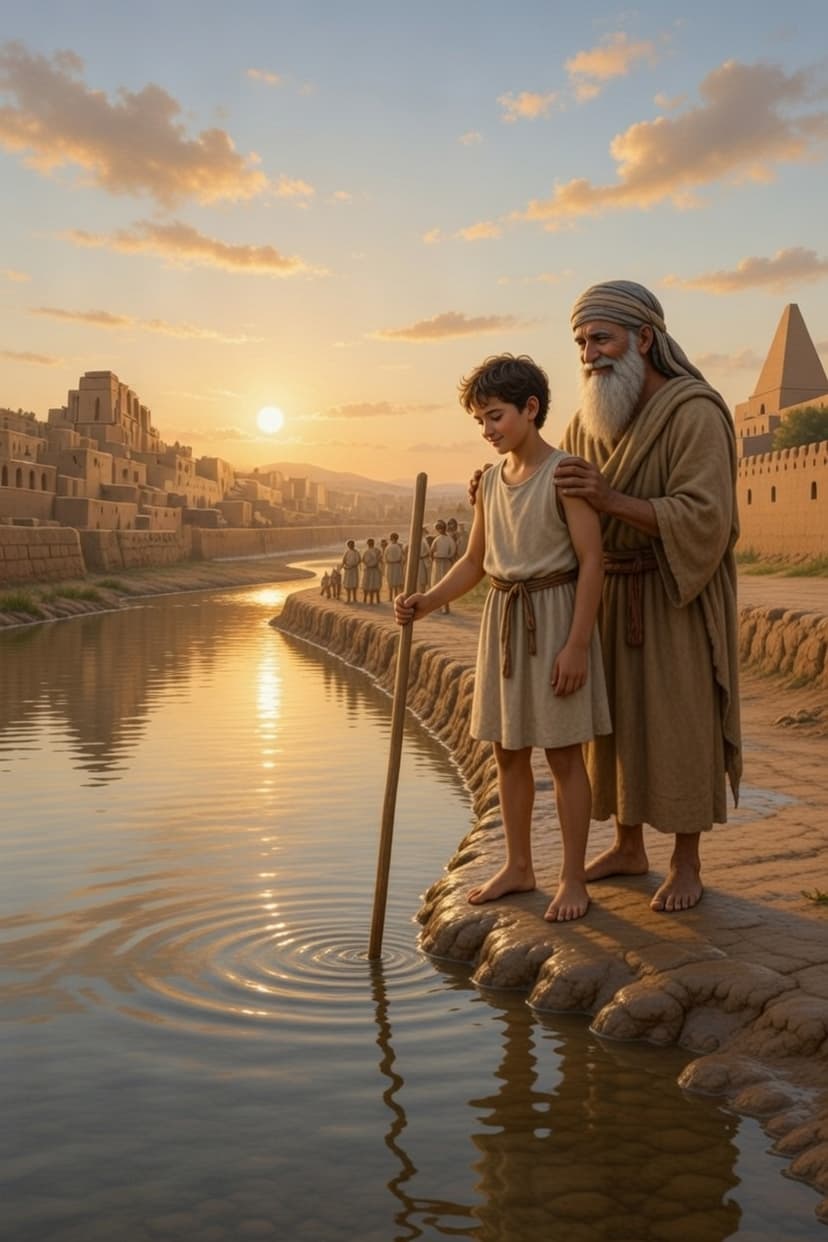
Bel-Enna placed a hand on Tarek’s shoulder. “This is what it means to walk with the river,” he said. “Not ahead of it, not behind it, but beside it.”
As the rain faded and the sky cleared, sunlight broke through the clouds, casting a warm glow over the city. The river flowed on, powerful yet contained, a reminder of what respect and patience could achieve.
That evening, Tarek returned to the riverbank alone. He watched the water settle back into its familiar rhythm.
“We learned today,” he whispered. “All of us.”
The river answered only with its steady movement, carrying the memory of the city’s choice into the future, just as it carried everything else.