

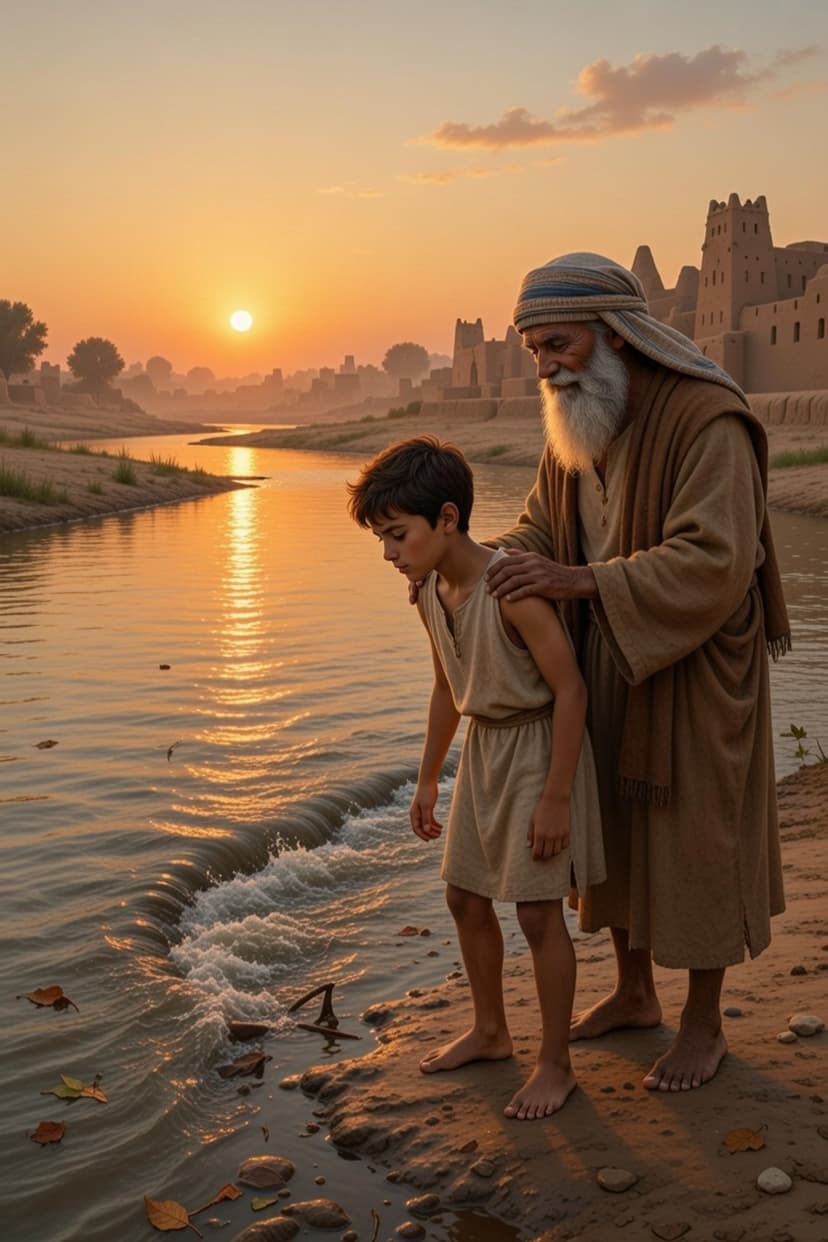
When Water Becomes a Witness
Morning arrived without kindness. The sun rose red and heavy over Uruk, and the air already carried heat as if the day itself was holding its breath. Tarek barely slept. Each time he closed his eyes, he saw the water breaking through the bank, heard the shout of farmers, and felt the weight of his father’s disappointment settle deeper into his chest. When he finally rose from his mat, his limbs felt slow, as if they belonged to someone else. Outside, the city stirred as usual, but to Tarek everything felt changed, as though the river had shifted not just the land but his place within it.
His father was already awake, sitting near the doorway and tying his sandals. He did not look at Tarek at first. That silence hurt more than shouting would have.
“Eat,” his father said at last, pushing a piece of bread toward him. “You will need strength today.”
Tarek hesitated. “Am I going to the canals?”
“Yes,” his father replied. “You will see what your choice caused.”
They walked together through the city, past merchants opening their stalls and children chasing one another through the dust. Normally, Tarek would have greeted them, but today he kept his eyes down. The closer they came to the fields, the louder the noise became. Voices rose in anger and worry, blending with the sound of rushing water.
The damage was worse than Tarek had imagined. The field nearest the canal lay half submerged, young barley flattened under muddy water. Farmers stood in groups, their faces tight with fear and frustration.
“That field fed my family,” one man said sharply. “If the roots rot, we lose everything.”
Another shook his head. “The river has always been strong, but this was sudden.”
Tarek’s father stepped forward. “The river did not choose this alone,” he said. “A gate was weakened.”
Several heads turned. Eyes followed him until they landed on Tarek.
“That is the boy,” someone muttered.
Tarek felt heat rush to his face. He wanted to speak, to explain that he had only meant to help, but the words stayed trapped inside him.
A senior water keeper approached, his beard streaked with grey. “Is this true?” he asked Tarek’s father.
His father nodded. “My son acted without knowledge.”
The man studied Tarek closely. “The river teaches patience,” he said. “Those who rush it often learn the hard way.”
Tarek finally found his voice. “I did not mean to harm anyone.”
“I believe you,” the water keeper replied. “But meaning is not the same as wisdom.”
They spent the rest of the morning repairing the bank, reinforcing it with clay and reeds. Tarek worked until his arms shook, lifting baskets of mud and pressing them into place. No one spoke to him except to give instructions. Luma appeared once, standing at the edge of the field. When their eyes met, she gave him a small, worried nod before turning away.
By midday, the water slowed, held back once more by the repaired gate. The fields beyond were saved, but the damaged one would take time to recover.
As they rested under a date palm, Tarek’s father finally spoke again. “You saw something wrong,” he said. “That is not a fault. Acting alone was.”
Tarek stared at the ground. “The river felt like it was calling me.”
His father sighed. “The river speaks to many. Listening is good. Understanding takes years.”
That afternoon, Tarek was sent to assist an elder scribe named Bel-Enna, a man whose duty was to record water levels, crop yields, and the slow passing of seasons that shaped the lives of everyone in Uruk. It was meant to be both a punishment and a lesson, though no one said that aloud. Tarek understood it clearly enough. While others returned to their homes to rest from the heat, he was guided toward the temple quarter, where the air seemed quieter and heavier, as if the walls themselves were holding centuries of memory.
Bel-Enna lived near the outer edge of the temple grounds in a modest house built of sun-baked bricks, its doorway shaded by a woven reed mat. Inside, the house smelled of damp clay and old dust. Clay tablets lined the walls from floor to ceiling, stacked carefully in rows, each one marked with symbols pressed long ago by hands that were now dust. To Tarek, it felt like stepping into a place where time itself had been captured and stored.
Bel-Enna sat cross-legged near a low table, his back slightly bent but his hands steady and sure. His hair was thin and white, and his beard reached his chest, bound loosely with a cord. He did not look up at first when Tarek entered, but continued smoothing the surface of a fresh tablet with practiced movements. The only sound was the faint scrape of clay under his fingers.
“You are the boy who moved the gate,” Bel-Enna said at last, his voice calm and even, as though he were stating the time of day.
“Yes,” Tarek replied quietly, lowering his head. His voice echoed strangely in the small room.
“Good,” the old man said, finally lifting his eyes. They were sharp and dark, far more alert than Tarek had expected. “Sit. You will help me today.”
Tarek sat where he was told, folding his legs beneath him. A lump formed in his throat, but Bel-Enna showed no sign of anger or disappointment. That unsettled Tarek more than scolding would have. The old man handed him a small stylus made of reed and placed a soft tablet of clay in front of him.
“Watch first,” Bel-Enna said. “Then you will try.”
They worked in silence at first. Bel-Enna demonstrated how to hold the stylus, how to press without tearing the clay, how to leave marks that would still be clear when the tablet hardened. Tarek watched carefully, copying each movement with care. His fingers trembled at first, and his first symbols were uneven, but Bel-Enna corrected him without words, simply guiding his hand until it steadied.
After some time, Bel-Enna reached for an older tablet, its surface hardened and darkened with age. Along one edge were shallow lines and markings.
“This was made many seasons ago,” the old man said. “It records the highest water mark of the river after a heavy flood.”
Tarek leaned closer, studying the marks. “The water reached that high?”
“Yes,” Bel-Enna replied. “And it stayed for many days.”
Bel-Enna then placed a fresh tablet beside it and carefully measured the difference between the old marks and the new ones he was adding.
“Do you know why we record this?” the old man asked without looking up.
“So we remember,” Tarek answered, repeating what he had always been told.
Bel-Enna paused and turned his gaze toward him. “And why must we remember?”
Tarek hesitated. His first answer felt too small. He thought of the broken gate, the rushing water, the flattened crops, and the frightened faces of the farmers. “So we do not make the same mistakes,” he said finally.
Bel-Enna’s lips curved into a faint smile. “Yes. That is part of it. The river remembers everything. We write because we forget.”
The words settled into Tarek’s chest like a weight and a comfort at the same time. As the afternoon stretched on, Bel-Enna began to speak more, telling stories as his hands continued their steady work. He spoke of years when the river rose gently and fed the fields just enough, and of years when it came without warning and swallowed homes, animals, and lives. He told of villages that ignored signs and were lost, and of others that studied the records and prepared their banks, saving themselves through patience and care. Each story carried the same quiet lesson, woven into the words without force.
“The river is not cruel,” Bel-Enna said at one point. “But it is honest. It does not change for our wishes.”
Tarek listened closely, feeling something shift inside him. He realized that he had loved the river for its freedom, but had never truly respected its power. When the sun dipped low and shadows filled the room, Bel-Enna set aside his tools.
“That is enough for today,” he said. “Go home. Think about what you have seen.”
Tarek stood and bowed his head in thanks. As he stepped outside, the evening air felt cooler against his skin. The city glowed softly in the fading light, and the river reflected the colors of the sky, gold and purple and deep blue. He walked slowly, his mind full of tablets, stories, and the quiet strength of the old scribe’s words.
When he reached the river’s edge, he stopped. He did not step closer, remembering Bel-Enna’s lessons. He watched the water flow, smooth and steady, carrying leaves and reflections alike.
“I hear you,” Tarek whispered. “But I will listen better.”
The river gave no answer. It flowed on as it always had, steady and silent, a witness to his promise and to all promises ever made beside its banks.