

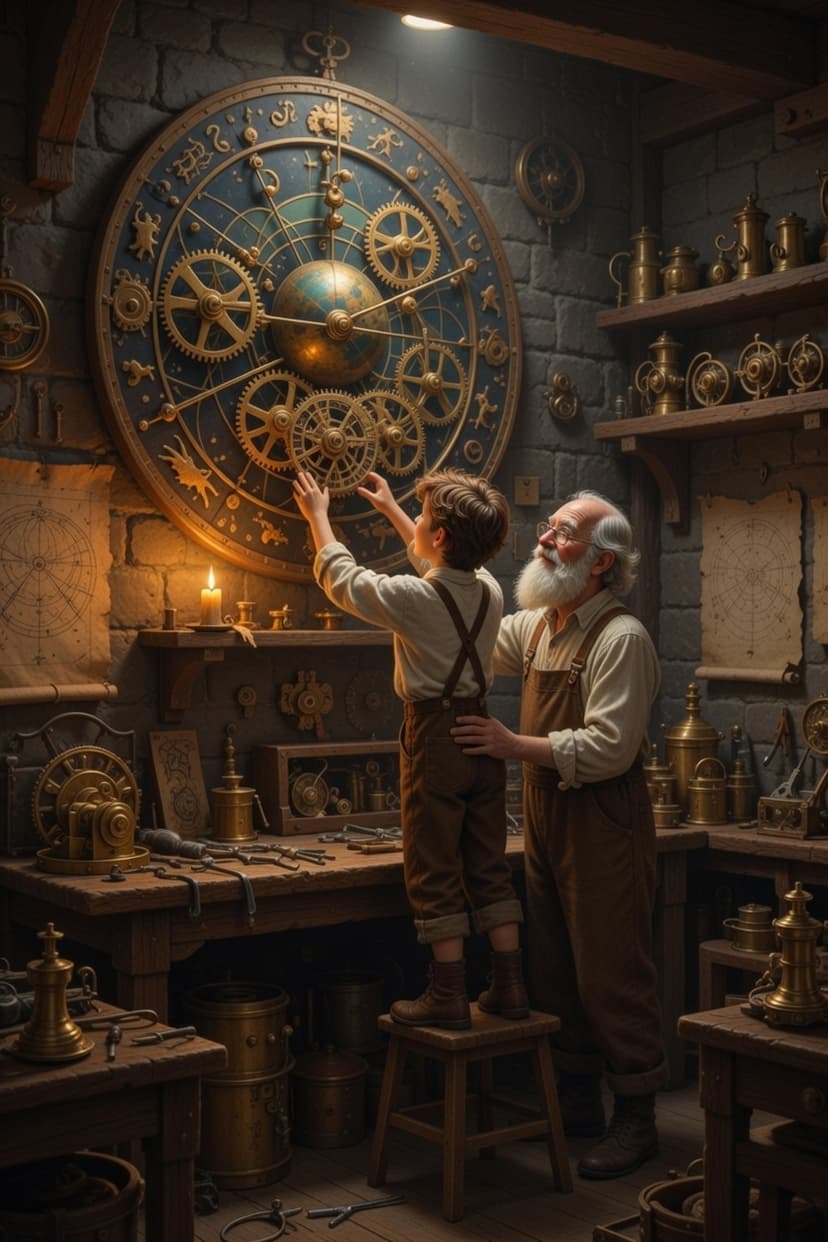
The Celestial Puzzle
The morning sun filtered weakly through the tall windows of H. Graf’s workshop, casting long, thin beams across the dust-filled air. Vienna was stirring outside, the sounds of carts on cobblestones and the distant call of street vendors faintly reaching the workshop, but within, time seemed to exist on a different plane. Every tick, every whirl of gears, every faint hiss of springs moving was amplified in the vast, hidden space. Lukas Weiss arrived earlier than usual, carrying a small satchel filled with tools he had prepared the night before. Today, he knew, the clockmaker would reveal something more challenging, something that would require not just careful hands but patience, focus, and perhaps even imagination.
The old man was already at the central table, his fingers moving deftly over the partially assembled Celestograph. Gears spun in interlocking harmony, tiny metal rods shifted, and the whole device seemed almost alive, humming with quiet energy. As Lukas approached, the clockmaker looked up, his sharp gray eyes twinkling beneath heavy brows.
“Ah, Lukas,” he said, voice raspy but firm. “You arrive ready. Good. Today, you face the first true challenge of your apprenticeship: the celestial puzzle.”
Lukas’s stomach tightened. He had no idea what that meant, but the weight of the phrase immediately pressed upon him.
“The Celestograph,” the clockmaker continued, “can predict the alignment of stars, the tides, and certain… rare occurrences. But its function is incomplete. There is a sequence of gears hidden deep within, each one dependent on the other. Place them incorrectly, and the entire mechanism fails. Today, you begin to understand the intricate balance of cause and effect, patience and observation.”
He handed Lukas a small gear, etched with intricate lines that formed patterns resembling constellations. The metal was cold, almost unnervingly smooth, yet delicate beyond measure. Lukas held it carefully, his gloved fingers trembling slightly.
“Where does this go?” Lukas asked, uncertainty creeping into his voice.
“That,” the clockmaker replied, “is what you must discover. Look carefully. Study the patterns. Observe the alignments of the rings, the engravings, and the movement of the other gears. The Celestograph speaks to those who listen.”
Lukas swallowed hard. He knelt before the device, his eyes tracing the faint etchings along the gold and silver rings. The interlocking gears above and below spun in perfect rhythm, their motion mesmerizing. He noticed that one set of gears moved slightly differently depending on the position of the central ring. A faint vibration ran through the table, almost imperceptible but noticeable if he paid attention.
“Patience,” the clockmaker reminded him, leaning on the edge of the table. “Do not rush. One hasty move can undo hours of work.”
Lukas took a deep breath. He remembered the lessons from the previous day: observe first, adjust carefully, and always respect the mechanism. He tilted the gear, examining it against the engraved constellations. Slowly, he aligned it with a small notch that mirrored a star on the outer ring. With a careful push, he set it into place.
The gear clicked softly. The entire Celestograph shivered for a moment, then resumed its motion, perfectly synchronized. Lukas exhaled, a rush of relief and pride washing over him.
“Very good,” the clockmaker said, nodding. “You are learning to listen to the machine. But the puzzle is only beginning. There are three more gears that must be placed before the device functions fully. Each one requires observation, deduction, and courage. Do you think you are ready?”
Lukas nodded, his fingers steady despite the pounding of his heart.
Hours passed. The workshop was filled with the quiet symphony of gears, ticking clocks, and the soft scratching of tools against metal. Lukas worked under the clockmaker’s watchful eye, examining each gear, comparing patterns, and testing the movement of the device with delicate adjustments. Sometimes, a gear would not fit, and he would have to remove it, examine the alignments again, and retry. Other times, the Celestograph would shiver or stutter, warning him that a mistake had been made.
During a brief pause, the clockmaker handed him a magnifying glass. “Look closely,” he said. “Even the smallest imperfection can affect the largest outcome. Notice the slightest variation, the smallest difference, and act accordingly. Precision is not optional, it is survival.”
Lukas peered through the lens, tracing the tiniest grooves etched into a silver gear. He adjusted it slightly, fitting it into a position that seemed almost invisible to the untrained eye. The gear clicked, and the Celestograph spun smoothly once more, the rhythm of its motion almost musical.
“Excellent,” the clockmaker murmured. “You see? Observation, patience, and careful action bring harmony. Rushing only brings chaos.”
But just as Lukas began to feel confident, a faint grinding sound emerged from the Celestograph. One of the larger rings trembled, and a small gear above it wobbled dangerously. Lukas froze.
“What did I do wrong?” he whispered, panic rising.
“Step back,” the clockmaker said calmly. “Do not panic. Observe first. Panic leads to error. Every problem has a solution if you watch carefully.”
Lukas studied the device. He noticed that one of the inner gears had not aligned perfectly with its neighboring teeth. Slowly, carefully, he adjusted it, using the smallest possible movements. The grinding ceased, and the mechanism resumed its smooth motion.
Lukas exhaled deeply, his hands shaking slightly from relief.
“You see?” the clockmaker said, a faint smile on his lips. “Even when things seem to falter, careful attention can restore balance. The world is full of such puzzles. Learn this well.”
By late afternoon, Lukas had successfully placed all four critical gears. The Celestograph spun in perfect harmony, the rings aligned, the tiny hands moving with a rhythm that seemed almost alive. The faint etchings of constellations and celestial bodies reflected the lanternlight, creating a miniature galaxy on the workbench.
“You have done well,” the clockmaker said, placing a hand on Lukas’s shoulder. “But this is only the beginning. The puzzle has layers yet unseen, challenges that will test not only your hands but your mind. Today, you have proven patience and observation. Tomorrow, we will test your ability to think ahead, to predict consequences, and to navigate the hidden mechanisms that even I only partially understand.”
Lukas felt a surge of pride and determination. The challenge had been immense, yet he had succeeded. He had learned the importance of patience, careful observation, and thoughtful action. And he knew that the Celestograph held even deeper secrets, waiting for him to discover them.
As evening fell, the workshop quieted. The faint ticking of clocks echoed softly through the room, mingling with the distant sounds of Vienna at night. Lukas cleaned his tools, carefully replaced the gears, and prepared for the next day. He felt a sense of quiet satisfaction, but also an awareness that the real challenges lay ahead.
Before leaving, he approached the Celestograph once more. Its motion was mesmerizing, the delicate gears interlocking in perfect harmony.
He whispered softly, almost to himself, “I will learn. I will be patient. I will understand.”
The clockmaker watched from his seat at the corner of the workshop.
“And in doing so,” he said quietly, “you will unlock secrets that have remained hidden for generations. But remember this, Lukas: every solution brings a new question, every discovery leads to a new mystery. That is the way of knowledge, and that is the way of the Celestograph.”
Lukas left the workshop that night with his mind buzzing. He had uncovered a fragment of the clockmaker’s secret, but he knew that the true test was yet to come. Hidden gears, cryptic mechanisms, and the faint whisper of time itself awaited him, and he felt a thrill of both fear and excitement. He understood that this journey was not just about building clocks; it was about learning to think, to observe, and to act with care in a world full of hidden challenges.
The streets of Vienna were quiet beneath the stars, but Lukas’s mind was alive with possibilities. He walked home slowly, imagining the intricate gears spinning, the constellations etched in silver and gold, and the hidden chambers beneath the workshop. He knew that the Celestograph was only a beginning, a door into a world of secrets that demanded patience, courage, and careful thought.
And somewhere in the shadows of the workshop, the clockmaker smiled faintly, knowing that Lukas had taken his first true steps toward understanding the mysteries of time, the art of careful action, and the hidden puzzles that shaped both machines and men alike.