

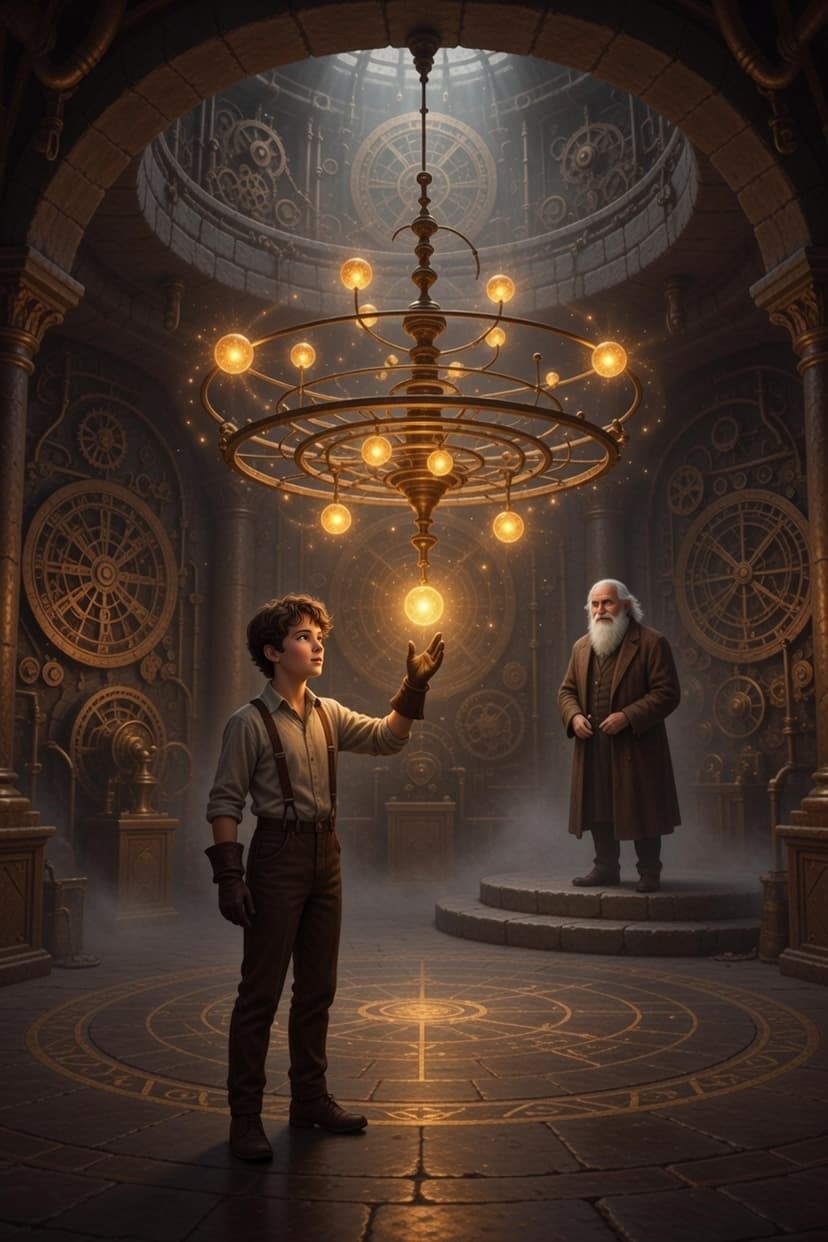
The Hidden Chamber
The following morning, Vienna awoke to a soft drizzle that slicked the cobblestones and carried the scent of wet earth and fresh bread. Lukas Weiss hurried through the narrow streets, his coat pulled tightly around him, his boots splashing through puddles. He felt a nervous excitement in his chest as he approached the small alley where the brass sign of H. Graf swung in the wind. Today, he thought, he would see more of the workshop, and perhaps uncover the secrets that had been hinted at the previous evening.
The door opened as if by magic, just as yesterday, revealing the warm glow of candlelight and the faint scent of oil and metal. The clockmaker, small and hunched, was already at work, his thin fingers moving with astonishing speed over a delicate device. Gears clicked and spun in harmony, a miniature orchestra of precision and care.
“Ah, Lukas,” the old man said without looking up. “You are punctual. That is the first quality of a true apprentice: respect for time. Come, we have much to do today.”
Lukas stepped inside, his eyes widening as he noticed a section of the workshop he had not seen before. A wall of tall shelves hid what appeared to be a wooden panel embedded in the floor. The clockmaker motioned toward it.
“This,” he said, voice low, “is the entrance to a hidden chamber. Few have seen it, and fewer still have entered. But today, you will help me explore it.”
Lukas’s heart raced. “A hidden chamber?” he asked, almost breathless. “What is inside?”
The clockmaker smiled faintly. “Patience, Lukas. All will be revealed in time. First, you must learn to prepare. Hidden places are delicate; one wrong step could damage what lies within.” He handed Lukas a pair of soft gloves and a small lantern. “We work with care, observation, and caution. Do you understand?”
“Yes, sir,” Lukas replied, tightening the gloves over his hands.
Together, they moved toward the floor panel. The clockmaker pressed a sequence of buttons and levers, almost invisible to the untrained eye. With a soft creak and a muted thump, the panel slid aside, revealing a narrow staircase descending into shadow. A faint scent of old wood, dust, and oil rose from below, and Lukas shivered with anticipation.
“Stay close and follow my instructions,” the clockmaker said. “Every step is important.”
They descended carefully, the lantern casting tall, dancing shadows on the walls. The stairs ended in a room larger than Lukas had imagined, filled with gears, cogs, and mechanisms of every conceivable size. Some hung from the ceiling, rotating slowly as if alive. Others were set into the floor or walls, connected by chains and rods that pulsed with quiet energy. Lukas’s eyes roamed over the machinery, marveling at the intricate designs. He had never seen anything like this. It was as though the workshop above was only a single layer of a much larger, secret world.
“This chamber contains devices that measure more than time,” the clockmaker explained. “It is a place where precision meets imagination. Here, clocks can track the stars, tides, and even unusual celestial events. But each device requires care. One misalignment could ruin months of work.”
He led Lukas to a central table where a large contraption rested, partially assembled. It was circular, with rings etched in gold and silver, tiny hands moving in ways that did not resemble ordinary clocks. Small gears and levers jutted out in every direction, and inscriptions in Latin and German ran along the edges.
“This is the Celestograph,” the clockmaker said. “It maps the heavens and their influence on the world below. Many have tried to understand it, but few have succeeded. Today, you will help me continue its construction.”
Lukas felt both awe and fear. The responsibility was enormous. One wrong move could ruin the device and months of meticulous work. He took a deep breath and nodded.
The clockmaker handed him a delicate gear, smaller than a coin. “Place this in the upper ring,” he instructed. “Observe its position carefully, align it with the engraved markers, and do not rush. Patience is more valuable than speed here.”
Lukas leaned close, using the lantern to illuminate the tiny etchings. He adjusted the gear minutely, watching as it clicked into place with surprising harmony. The device rotated smoothly, and he felt a thrill of accomplishment.
“Good,” the clockmaker said, his eyes twinkling. “You have the patience and focus necessary. But there is more to this chamber than gears. There are secrets hidden in the walls and floors. Some are knowledge, some are warnings. You must learn to recognize both.”
Lukas followed him to a corner where a series of drawers were embedded in the wall. Each drawer was secured with a small lock, and strange symbols were carved on the front. The clockmaker handed Lukas a tiny key. “Open the first drawer,” he said.
Inside were sheets of diagrams, sketches of devices that Lukas could barely comprehend. Some appeared to be variations of clocks, while others seemed impossible, with interconnected rings and spirals. He felt a thrill of discovery but also a weight of responsibility.
“These are designs passed down for generations,” the clockmaker said. “Some have been tested, some remain theoretical. Your task is to learn from them, but more importantly, to respect them. Never take risks without understanding the consequences.”
Lukas nodded, absorbing every word. He realized that this work demanded more than skill; it demanded careful thought, respect for the past, and a willingness to learn. Hours passed as they worked, adjusting gears, testing mechanisms, and studying diagrams. The chamber seemed alive with quiet energy, each device humming in harmony with the others. Lukas’s hands grew steady, his mind sharp, and his understanding deepened.
During a brief pause, the clockmaker spoke again. “Lukas, do you see how every part depends on the others? The smallest gear can influence the largest mechanism. Life is much the same. Small actions, careful decisions, and attention to detail shape outcomes far beyond what we can see.”
Lukas nodded slowly. He felt the weight of those words settle in his mind. He understood now that patience, observation, and careful action were more important than speed or reckless courage.
As evening approached, they prepared to leave the hidden chamber. Lukas felt a mix of pride and exhaustion. He had learned more in a single day than he had in years of wandering the streets of Vienna, and he sensed that the chamber held many more lessons yet to be discovered.
The clockmaker led him back up the narrow staircase, the panel sliding into place behind them. The sounds of the city filtered in once more, the horses, the chatter of merchants, and the laughter of children, but Lukas felt changed. The hidden chamber had shown him a world of precision, care, and hidden potential, and he was eager to return and continue learning.
“Tomorrow,” the clockmaker said, “we will explore the next secret, a mechanism that can influence the world in subtle, unexpected ways. You must prepare your mind and hands, Lukas. The challenges ahead will require focus, bravery, and the patience you have begun to show.”
Lukas nodded, excitement and determination burning in his chest. He left the workshop and walked home through the misty streets of Vienna, feeling the city in a new way. Every clock tower, every shop, every shadowed alley seemed alive with hidden mechanisms and secret possibilities. He carried with him a sense of responsibility, a thirst for knowledge, and a quiet determination to prove himself worthy of the clockmaker’s trust.
That night, as he lay in bed, he traced the lines of the hidden chamber in his mind, the gears, the Celestograph, and the tiny intricate details that had so captivated him. He whispered to himself, “I will learn. I will be careful. I will uncover the secrets.”
And somewhere in the depths of the workshop, the clockmaker watched from above, a faint smile on his face, knowing that the boy had taken the first true steps toward mastery of time, of patience, and of discovery.