

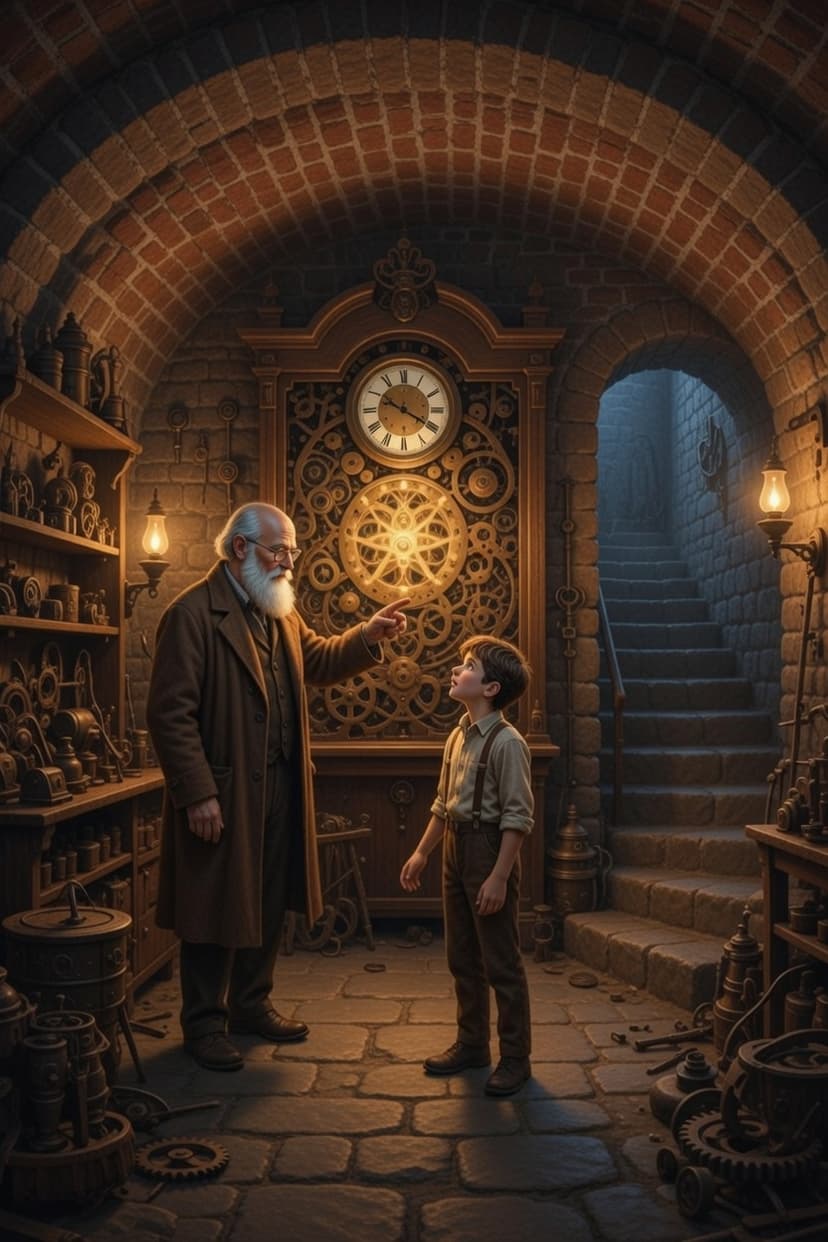
The Hidden Workshop
The streets of Vienna were a maze of cobblestones and narrow alleys, twisting in unexpected directions, their surfaces worn smooth by centuries of foot traffic. It was the spring of 1845, and the air carried the scent of fresh bread from bakeries, horse manure from the stables, and the faint tang of the Danube river that flowed just beyond the city walls. Children ran through the streets, shouting and laughing, their wooden clogs tapping on stone as they played games of tag, while merchants called out, trying to attract buyers to their stalls, selling everything from bolts of fabric to shiny brass trinkets.
Lukas Weiss, a boy of thirteen with a mop of dark hair that constantly fell into his sharp gray eyes, walked quickly through one such alley. He clutched a folded piece of parchment tightly in his hand, his knuckles white with nervous energy. He had been warned not to go near this part of the city, yet curiosity and a strange sense of destiny drew him forward.
The alley narrowed further, walls leaning as if whispering secrets to each other. In the shadow of an old building, a small brass sign swung in the wind. It read, “H. Graf – Clockmaker.” Lukas’s heart leapt. He had heard rumors among the children of the city about the clockmaker’s mysterious workshop, hidden deep behind a door no one ever noticed unless they were meant to. Some said the clockmaker had created devices that could predict the future, while others whispered that he had discovered secrets of the stars themselves.
Lukas took a deep breath and knocked on the weathered wooden door. It made no sound, yet moments later, the door creaked open on its own. He hesitated but stepped inside.
The air smelled of oil, metal, and old wood. Gears of every imaginable size were stacked along the walls, and hundreds of clocks ticked in an almost chaotic symphony, yet somehow, the sound felt harmonious, like a heartbeat that resonated throughout the room.
An elderly man, small and hunched, emerged from the shadows. His eyes were sharp, gray, and lively beneath bushy white eyebrows. A long, faded brown coat hung loosely from his thin frame. He regarded Lukas for a long moment before speaking.
“You are the boy who carries the letter from Herr Weiss?” he asked, voice raspy yet calm.
Lukas nodded. “Yes, sir. He said you would know what to do.”
The man studied him for a few more seconds, then motioned for him to follow.
“Very well. Come into the workshop. But mind your step. Many things here are more fragile than they appear.”
The interior was vast, larger than Lukas had expected, filled with workbenches, tool racks, and strange mechanisms whose purposes he could not guess. Pendulums swung slowly, clock faces spun, and delicate gears clicked and whirred, forming a living puzzle that made Lukas feel both excited and nervous.
The old man guided him to a corner of the workshop where a wooden table held a half-finished clock. Its casing was engraved with stars, planets, and intricate runes that glowed faintly in the candlelight. The clock’s hands moved not only in circles but also along tiny etched paths, marking something more than hours. Lukas had never seen anything like it.
“This is what I call the Astrarium,” the man explained. “It shows more than the time of day. It can measure tides, the positions of the planets, and even predict certain… rare events. But it is unfinished. And that is where you come in.”
Lukas’s eyes widened. “Me? But I’m just a boy. I don’t know anything about clocks.”
The man smiled faintly, a glint of mischief in his eyes.
“Ah, but you have something more valuable than knowledge. You have curiosity, patience, and careful hands. Those qualities are often rarer than skill itself.”
He handed Lukas a small, delicate gear. “See this? It is fragile, yet it must fit perfectly. If it is off by a fraction, the Astrarium will fail. Can you do that?”
Lukas hesitated, feeling the weight of responsibility pressing down on him. He had never held something so important, never felt the consequences of a mistake so clearly. But he remembered his father’s words: “Sometimes the smallest hands can achieve the greatest work, if guided by care and thought.”
He took a deep breath and nodded. “I’ll try,” he said.
“Good,” the man replied. “Then try, and do not be afraid to ask questions. Every question is a step toward understanding.”
For the next hour, Lukas worked under the clockmaker’s careful supervision. He learned to fit gears together, to adjust springs, and to oil tiny pivots. Every mistake caused the pendulums to stutter, every success made the clock sing. Lukas’s hands grew steady, his eyes sharp, and his mind alert. He realized that this work demanded patience and focus, qualities that could guide him through more than just clockwork, it could guide him through life itself.
During a brief pause, the old man handed Lukas a magnifying glass. “Look closely,” he said. “The smallest details are the most important. Life, like this clock, is full of details. Never overlook them, for the consequences are greater than you imagine.”
Lukas peered through the glass, examining a tiny gear etched with delicate symbols. He marveled at the precision, the artistry, and the care required to make something so small function perfectly within a vast mechanism. The lesson was clear: attention, patience, and careful observation were as important as courage and action.
As evening fell, the workshop was bathed in golden candlelight, and Lukas felt a sense of quiet pride. He had been trusted with something important, something that required him to be attentive and thoughtful. He understood, perhaps for the first time, what it meant to be responsible for more than just himself.
“Tomorrow,” the clockmaker said, “we will continue. There are hidden chambers in this workshop, secret devices that no one outside this city has seen. You will help me uncover them, and in doing so, you will learn more about the world, and yourself, than you might imagine.”
Lukas’s heart raced. He felt a mix of fear, excitement, and determination. He knew that this was the beginning of something extraordinary, a journey that would challenge him, teach him patience, and reveal secrets that had been hidden for generations.
As he left the workshop, the streets of Vienna seemed different. The river sparkled in the moonlight, the cobblestones glimmered, and the city felt alive with possibility. He held the letter tightly in his hand and whispered to himself, “I will learn. I will be careful. I will discover.”
And somewhere in the shadows of the workshop, the old clockmaker watched him leave, a faint smile on his lips, knowing that this boy had the curiosity, courage, and care to unlock the secrets of the clocks, and perhaps even the secrets of time itself.