

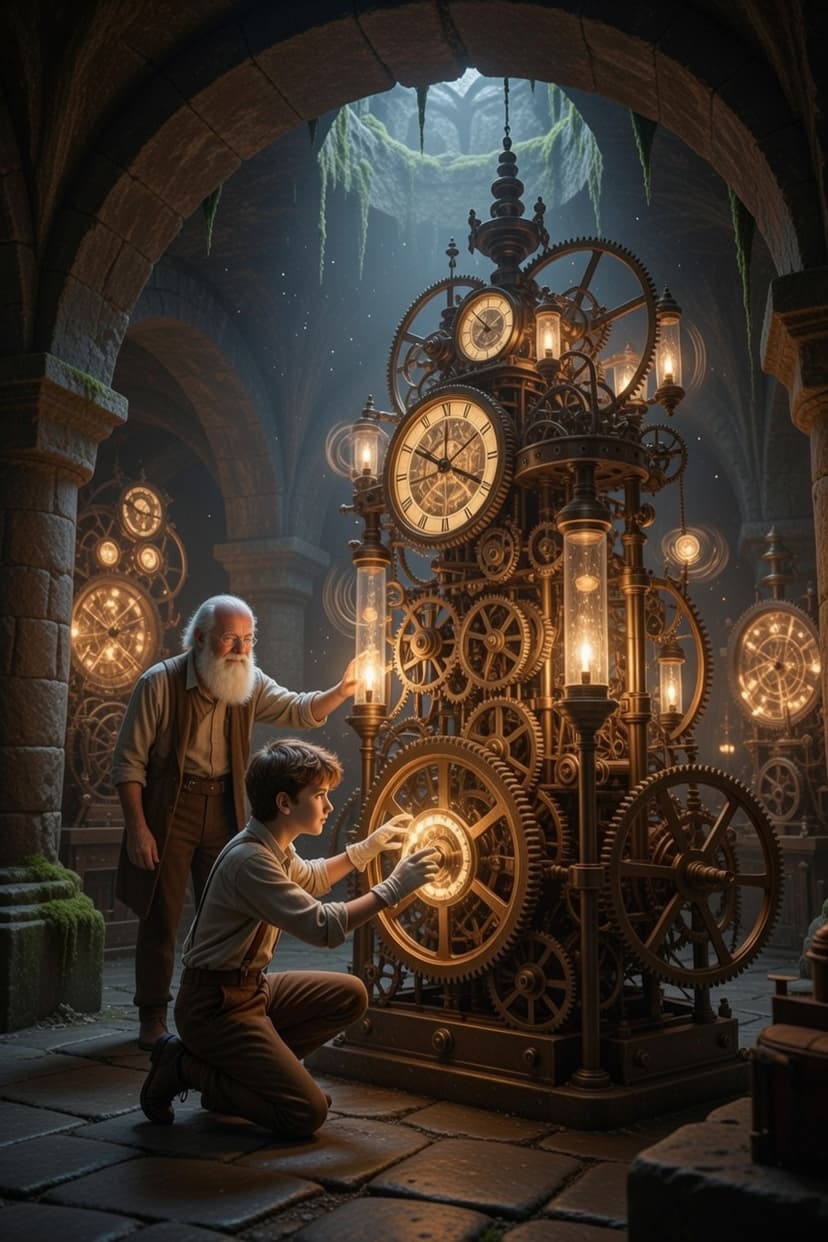
The Whispering Gears
The day began with a faint mist curling through the streets of Vienna, softening the edges of the tall buildings and lending the city an air of quiet mystery. Lukas Weiss hurried through the damp alleys, his breath forming small clouds in the chilly morning air. He carried with him a small leather satchel filled with tools, a notebook, and a heart full of both excitement and unease. The Celestograph had been partially completed, but the clockmaker had warned him that today’s work would be unlike anything he had faced before.
Inside the workshop, the scent of oil, wood, and aged metal hung heavily in the air. Hundreds of clocks ticked in near-perfect harmony, yet beneath the regular rhythm, Lukas thought he could hear something else: faint whispers, subtle vibrations that seemed to echo through the floorboards. He shook his head. He was certain it was only his imagination, the excitement of discovery playing tricks on him.
The clockmaker was already at the central table, adjusting a small assembly of gears that glimmered in the morning light. His thin fingers moved with the precision of a surgeon, each motion deliberate and confident.
“Ah, Lukas,” he said, not looking up. “Today, you face a test not only of patience but of perception. The gears will whisper their secrets, but only to those who listen carefully. You must learn to read their subtle messages.”
Lukas knelt beside the Celestograph, studying the complex interlocking mechanisms. The previous day had taught him much about patience and careful observation, but this new challenge seemed different. He noticed that some of the smaller gears, previously overlooked, moved slightly out of sync with the larger assembly. A faint vibration traveled through the table with each rotation, almost like a pulse.
“The whispering gears,” the clockmaker said softly, as if reading Lukas’s thoughts. “They are delicate, and their motion is subtle. But they contain information crucial to the Celestograph’s full function. You must place them with precision. Any mistake, and the device may fail entirely.”
Lukas nodded, trying to calm his racing heart. He reached for the first small gear, examining the faint engravings that ran along its edge. The symbols resembled stars, waves, and tiny arcs that could only be deciphered by someone willing to pay attention to the smallest detail. He tilted the gear under the lantern light, noticing that its alignment with the adjacent ring altered the rhythm of the surrounding mechanisms. He adjusted it slowly, rotating the gear millimeter by millimeter. The subtle pulse beneath the table stabilized, and the Celestograph’s motion resumed a smooth rhythm.
Lukas exhaled, relief washing over him.
“Excellent,” the clockmaker murmured. “Now you must continue with the remaining gears. Observe their movement carefully. Listen to their whisper. Learn what each rotation tells you.”
Hours passed. Lukas worked steadily, removing and replacing gears, noting the faint vibrations, the subtle clicks, the almost imperceptible stutters in the mechanism. Every adjustment revealed a new pattern, a new rhythm, a new piece of the puzzle. He realized that the Celestograph was not merely a machine; it was a language, a system of messages conveyed through motion, alignment, and resistance.
During a brief pause, the clockmaker handed Lukas a small magnifying glass. “Look closely at the edges,” he said. “Notice even the smallest imperfection. It may be a flaw, or it may be a message. The machine communicates, but you must learn its language.”
Lukas peered through the lens, tracing faint scratches and symbols etched into the metal. Some were purely decorative, but others seemed deliberate, tiny markers guiding his adjustments. He traced them carefully, aligning the gears according to the patterns he discerned.
Suddenly, one of the larger gears above began to stutter, grinding faintly. Lukas froze, heart hammering in his chest. The vibrations beneath the table became irregular, almost urgent. He glanced at the clockmaker, who was watching silently, his eyes calm but intense.
“Breathe,” the old man said softly. “Observe first. Panic will ruin the mechanism. Every problem has a solution if you watch carefully.”
Lukas studied the grinding gear. He noticed that one of the whispering gears had been slightly misaligned in the previous adjustment. Slowly, carefully, he rotated it a fraction of a millimeter. The grinding ceased, the vibration stabilized, and the Celestograph resumed its perfect motion. Lukas exhaled, trembling with relief and exhilaration.
“You see?” the clockmaker said. “Even the smallest error can disrupt the whole. But careful attention can restore balance. Life is much the same. Observe, adjust, and act with precision.”
By late afternoon, the Celestograph was operating flawlessly. The whispering gears moved in perfect harmony with the larger assembly, each rotation conveying subtle messages, aligning with the celestial patterns etched into the rings, and projecting the intricate map of the heavens. Lukas felt a profound sense of accomplishment. He had learned not just to manipulate gears, but to interpret their signals, to listen to the hidden language of the mechanism, and to act with deliberate care.
The clockmaker clapped his hands softly. “You have done well, Lukas. You are beginning to understand the delicate balance of knowledge, skill, and intuition. But there is one more lesson today, hidden beneath the gears, a secret message lies. Only by paying attention to the subtle signals can it be revealed.”
He handed Lukas a small key, etched with the same constellation patterns as the Celestograph. “This unlocks a compartment in the base of the machine. Inside is a note left by my teacher, who built the first Celestograph. It contains guidance for those who wish to master the craft.”
With careful hands, Lukas inserted the key and turned it. A small panel slid open, revealing a folded piece of parchment. The ink was faded but legible, containing diagrams, instructions, and cryptic notes about celestial alignment, mechanical harmony, and the philosophy of observation. Lukas traced the lines with his fingers, absorbing the instructions, realizing that the puzzle extended far beyond gears and metal, it was a test of thought, perception, and character.
“This is more than a machine,” the clockmaker said. “It is a teacher. The gears whisper not only about the stars but about patience, foresight, and understanding consequences. You have learned much, Lukas, but the path ahead is even more challenging. You will face problems that cannot be solved by hands alone. Your mind, your judgment, and your courage will be tested.”
As evening fell, Lukas cleaned the tools, carefully replaced gears, and prepared the Celestograph for the night. The soft ticking of the clocks echoed through the workshop, blending with the quiet hum of the hidden mechanisms. He felt a mixture of pride, exhaustion, and anticipation for the challenges yet to come.
Before leaving, he approached the Celestograph one last time. Its delicate gears spun in perfect rhythm, the whispering motion of the mechanisms a language he was beginning to understand. He whispered softly, almost to himself, “I will learn. I will listen. I will uncover every secret.”
The clockmaker watched him from the corner, a faint smile on his lips. “And in doing so,” he said quietly, “you will discover not only the secrets of time but the lessons hidden within patience, careful observation, and respect for the unseen. Remember this, Lukas: the smallest whisper can guide the greatest discovery.”
Lukas stepped out into the misty evening, the streets of Vienna quiet beneath the soft light of gas lamps. His mind was alive with the patterns of the Celestograph, the whispering gears, and the hidden message he had uncovered. He understood that his apprenticeship was no longer just about building clocks, it was about understanding the world, anticipating consequences, and learning to act with care, patience, and courage.
And somewhere in the shadows of the workshop, the clockmaker’s eyes gleamed, knowing that Lukas was beginning to unlock the mysteries that had been guarded for generations, a boy learning to read the language of the machines and, in doing so, the language of life itself.