

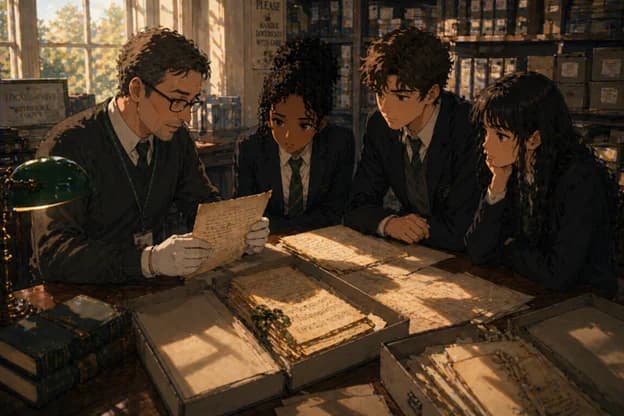
Patricia's Letters
The letters were three drafts, written in the 1990s, from Patricia Voss to an unnamed recipient.
They were clearly drafts: crossed-out phrases, rewritten sentences, marginal notes to herself.
The first letter, dated 1991, explained that she had found the Alderton manuscript in the archive in 1987 and had removed it temporarily because she had discovered it was about to be transferred to a different storage location in a cost-cutting reorganisation, and the new location was unsuitable for the paper's preservation requirements. She had intended to return it once the situation was resolved.
The second letter, dated 1994, explained that she had not returned it because she had then discovered something else: a claim to the manuscript by a party she described as a music publisher who had acquired, through a complex and possibly questionable series of transactions, what they claimed were the rights to Miriam Alderton's unpublished works.
She wrote: I do not believe these rights were legitimately acquired. The transfer of rights from Miriam's estate was arranged decades after her death, through a relative who may not have understood what they were signing. The publisher intends to use the manuscript as the basis for a completion project, hire a composer to finish the piece, and release it commercially as an Alderton work. I believe this is wrong. The manuscript belongs to the archive and to the public, not to a commercial publisher who acquired the rights through an arrangement the original composer could not have consented to.
The third letter, dated 1997, was more tired in tone. She had tried, she wrote, to find a way to challenge the rights claim through official channels and had been unsuccessful. She had consulted a solicitor who had told her the claim was difficult to overturn without significant resources. She had written to the local music society, which had been unhelpful. She had considered donating the manuscript anonymously to a different archive, but feared this would create legal complications.
She wrote: I do not know what to do. I only know that this music should be heard as Miriam wrote it, not as someone else finishes it for commercial purposes. I am keeping it safe until I understand the right course of action.
She had apparently never found the right course of action. She had died in 2002, and the manuscript had stayed in the storage unit for twenty more years.
Nina read the three letters twice. Then she looked at Asha.
"The rights claim," she said. "Is it still active?"
"I don't know," Asha said. "The publisher Patricia mentioned, she called them Meridian Music. I found a company by that name that was active in the 1990s but I can't find current information about them."
Nina thought about this. She thought about a composer who had written nearly there above her last bar of music, and a music teacher who had kept that music safe for fifteen years because she believed it deserved to be heard properly, and a storage unit where it had sat for twenty more years after that.
She thought: the music should be heard. That was what Miriam had wanted and what Patricia had wanted. The question was how to make that happen in a way that was right.
She thought: I need Oscar.
Oscar listened to everything with the focused concentration he brought to complex musical pieces: complete attention, no interruption, building a picture from each piece of information.
When Nina and Asha had both finished, he said: "The rights question is the key. If the publisher's claim is no longer active, or if it was never legitimate, the manuscript can go back to the archive and be properly catalogued and made available."
"How do you establish that?" Asha asked.
"Companies are registered," Oscar said. "If Meridian Music no longer exists, their rights would have either transferred to whoever acquired them in dissolution or lapsed. Music copyright law is complicated but it has rules." He paused. "My dad is a solicitor. Not music law, but he knows people."
Nina looked at him. "Would he help?"
"I'll ask," he said. "But I think the first step is simpler than the legal question. The first step is returning the manuscript to the archive. Patricia removed it to protect it. The thing that she was protecting it from may not exist anymore."
"And if it does?" Asha asked.
"Then we deal with that when we know," Oscar said. "But keeping it in a storage unit is not protecting it. It's just hiding it."
They went to the archive the following Saturday, all three of them, with the manuscript in a protective folder that Nina's mum had provided from her own academic work. They brought the letters too, as documentation.
Mr Davies met them with the composure of someone who had seen researchers arrive with unexpected things before, but his composure shifted slightly when he saw what they had brought.
He looked at the manuscript carefully, with the gloved hands and magnifying glass of someone who knew how to handle fragile historical documents. He read the catalogue reference that corresponded to it on his screen. He looked at the letters from Patricia Voss.
"She was trying to do the right thing," he said. "In the wrong way, but the right thing."
"What happens now?" Nina asked.
"The manuscript is returned to the collection," he said. "Where it should always have been. I will update the catalogue record and ensure it is properly housed." He paused. "The rights question I will refer to our legal team and to the relevant music copyright authorities. It may take time to resolve, but it can be resolved."
"Will it ever be performed?" Asha asked.
Mr Davies looked at her. "That is a question for musicians, not archivists," he said. "Once the manuscript is properly accessible, the decision about what to do with it belongs to the people who understand it."
He looked at Nina when he said this.
Nina looked at the manuscript, now in the archivist's careful hands.
She thought about forty-seven pages of music that had been moving toward something and had not quite arrived. She thought about the two themes she had been given under the practice room door, the way they had resolved into something right once you heard them. She thought about Miriam Alderton writing nearly there above a bar she had not known would be almost her last.
She thought: the music exists. Even unfinished, it exists. And existing was the important thing.