

The Keeper's Name
The heritage organisation that managed the lighthouse had an office in the mainland town, but the lighthouse itself, during August, ran tours three times a week. The guide was a retired fisherman named Donald who knew the island's history comprehensively and was, Lena established within five minutes of the Tuesday morning tour, exactly the right person to ask.
She waited until the other tour visitors, a family from the midlands and an elderly couple, had moved on to the lamp room, and then asked Donald about the keepers who had operated the lighthouse between 1962 and 1978.
Donald looked at her with the sharp assessment of someone deciding how much detail was warranted.
"Research?" he asked.
"I found the logbook," she said. "From that period. It was in the box outside the post office."
Donald's expression shifted. "That's been missing for twenty years," he said. "Where has it been all this time?"
"I don't know," Lena said. "It was in the box yesterday. I thought someone had put it there recently but maybe it had been there a long time under other things."
Donald looked at the logbook she was carrying, which she had brought in case it was useful. He looked at it with recognition.
"There were two keepers during that period," he said. "William Tate from 1962 to 1969, and then Alistair Fenn from 1969 until automation in 1987. The log you have covers 1962 to 1978, so you have the end of Tate's tenure and the first nine years of Fenn's."
"Which one wrote about the grey vessel?" Lena asked.
Donald was quiet for a moment. "You've read the grey vessel entries."
"Yes," Lena said. "Starting in June 1971. That would be Fenn's entries."
"Yes," Donald said. He looked at her steadily. "Alistair Fenn took those entries seriously. He spent several years trying to understand what he was seeing. He spoke to the coastguard, the maritime authority, other keepers along the coast. Nobody else had reported the same thing." He paused. "He was a meticulous man. Not prone to imagination. If he wrote it down, he saw it."
"Is he still alive?" Lena asked.
"He died in 2009," Donald said. "He lived on the island until the end." He paused. "His granddaughter lives here still. Marta Fenn. She helps out at the pub in summer."
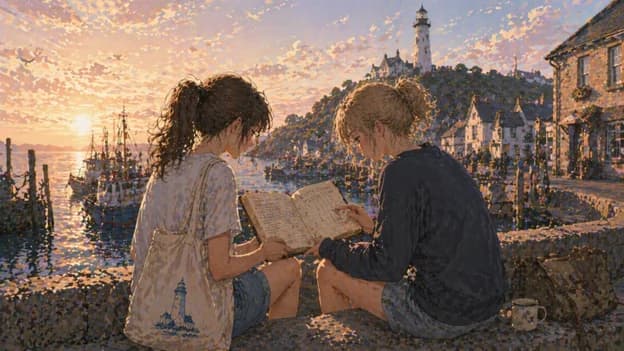
Marta Fenn was nineteen, studying environmental science on the mainland, and home for August. She met Lena at the harbour wall the following morning, looked at the logbook with the expression of someone seeing something they had heard about, and sat down on the wall to read the grey vessel entries.
She read slowly. When she finished she closed the book and held it for a moment.
"He talked about this," she said. "My grandfather. Not often. It was not something he was comfortable discussing, partly because he had no explanation and he liked explanations, and partly because he was worried people would think he was unreliable."
"Did he ever find an explanation?" Lena asked.
"He had a theory," Marta said. "By the end. He told me when I was about twelve, I think he felt safe telling a twelve-year-old because I was less likely to repeat it in a professional context." She looked out at the water. "He thought the grey vessel was a visual echo."
"What does that mean?"
"He'd read about atmospheric optical phenomena," Marta said. "The way light can bend under certain conditions and produce images of things that are far away, or not there at all. Mirages, essentially, but specific to the sea and to particular weather conditions. He thought the grey vessel was an image of a real ship, produced by specific atmospheric conditions, displaced from its actual location." She paused. "He could never find another example of exactly this phenomenon, but it was the explanation that fit best with what he observed."
"The photographs not showing anything," Lena said.
"Yes. Film responds to direct light. A refracted or reflected image might not register on film the same way." Marta shrugged. "It was a theory, not a proof. He was honest about that."
Lena thought about this. It was a satisfying scientific explanation for what might otherwise seem inexplicable. It matched Alistair Fenn's character as she had understood it from the log: someone who looked for empirical explanations and tested them carefully.
"Was there anything else in the grey vessel entries?" Lena asked. "Anything he concluded beyond the optical theory?"
Marta looked at her with a slightly different expression. "You've noticed something," she said.
"There's a final entry about the grey vessel," Lena said. "In November 1978. It's different from the others."
Marta looked at the book. "Show me."
The November 1978 entry read:
Grey vessel seen again this morning, clearest observation to date. The vessel is a steam trawler, I am now certain, of a type in common use approximately forty to sixty years ago. I have made contact with the maritime museum in Bristol and described it. Their archivist has identified it tentatively as a vessel of the Castle class, several of which operated out of West Country ports in the 1920s and 1930s. The closest match to my description is the Maren Castle, registered out of Portbellow, lost with all crew in February 1932 during severe weather off this coast.
If the optical echo theory is correct, this would require that an image of the Maren Castle from 1932 is still present in the atmospheric conditions above this stretch of water, and is occasionally made visible when conditions align. I find this extraordinary but not impossible. Light does not vanish. It disperses and scatters, but it does not cease to exist. The image of that ship, formed in light in February 1932, may simply be still out there, occasionally finding its way back.
I will write to the maritime museum with my full observations. I believe the record should exist somewhere.
Marta read this twice. When she looked up her expression was something Lena recognised: the particular feeling of understanding something for the first time that you had been near to for a long time.
"He never mentioned the Maren Castle to me," she said. "I didn't know he had identified a specific ship."
"Did he write to the maritime museum?" Lena asked.
"I don't know," Marta said. "His papers are at his old house. My parents kept everything."