
What the River Remembered
She spent three weeks writing it up.
She had not written anything this long or this carefully sourced before, and the process taught her things about research and writing simultaneously. She learned that a story was only as good as the evidence behind it, and that evidence was only useful if you presented it clearly enough for someone else to follow your reasoning. She wrote several drafts. She showed each one to her dad, who read them with the attention he gave things he considered worth his time and made specific, useful comments.
She also showed a draft to Mr Fenwick at the library, who had started her on this path. He read it at the reference desk with the small focused movements of someone taking something seriously.
When he finished he looked up and said: "This is very good work."
"Is it accurate?" she asked. "Historically."
"As far as I can check it, yes," he said. "The sources are correctly cited and the conclusions are proportionate to the evidence. You don't claim more than you can support." He paused. "That last part is harder than it sounds."
"I know," she said. "I kept wanting to say Harker definitely did it deliberately and I had to keep pulling back to saying the evidence suggests."
"That's the right instinct," he said. "Historical research is not about certainty. It's about the most accurate account the evidence allows."
She incorporated his comments into the final draft.
She submitted it to the county archive's research contribution programme, which accepted local historical research for addition to the collection. Mr Davies, who she had met during Soren's competition investigation and who had helped her with the river records, received her submission and read it within a week.
He contacted her to say it would be accepted and added to the collection, alongside the Frederick Wray correspondence and the other relevant documents she had cross-referenced. He also passed it to the editor of the local historical society's journal, who emailed Iris to say they would like to publish it in their next issue, edited for length and with some additional context from their own research.
Iris read the email twice.
Then she went downstairs and told her mum and dad, and her dad looked quietly pleased in the way he did when something had worked out properly, and her mum made tea and said she had always known the jumble sale would be worth attending.
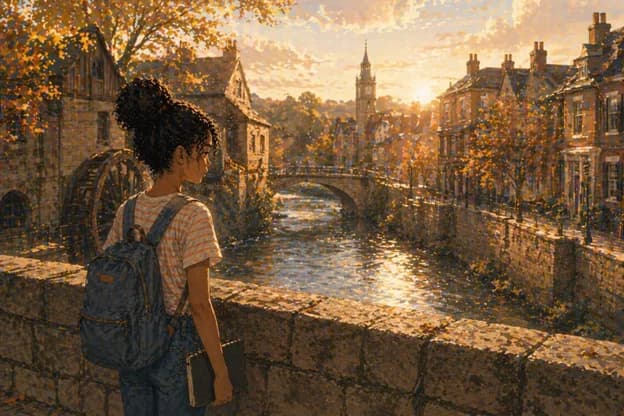
On the Saturday after she heard from the journal, Iris went for a walk along the River Wyne.
She walked the length of it through the town, from where it entered near the old mill to where it left to join the Ashton two miles south. She walked it slowly, looking at it with new attention, knowing what she knew now: that this particular course, so familiar it was essentially invisible, was not the original course. That the river she was looking at had been put here deliberately, for reasons that were partly public benefit and partly private gain. That the land on the other side of Harker Street, where the hotel stood and where the town went about its business, had once been a floodplain and before that a river valley with smallholdings and businesses and water rights going back generations.
She stopped on the bridge at the town centre and looked down at the water.
The river moved steadily below her, indifferent to its own history, carrying the same water it always had in a course that had been chosen for it a hundred and thirty years ago. It did not know it was in the wrong place. It had made the new course entirely its own.
She thought about Frederick Wray's letter, sitting in an archive folder for over a century, and Jonathan Harker's secret note, and the meeting that had or hadn't happened, and the evidence that had left Whitmore in Jonathan Harker's pocket and never come back.
She thought: some mysteries don't resolve. Some threads lead to ends that are not conclusions, just stops. Jonathan Harker's evidence was gone. The smallholders along the old river course had never been compensated. The alderman who had arranged things to his own benefit had died in 1898 and whatever accounting might have come to him had not come in this world.
But the story existed now. It was documented and sourced and would be published. Frederick Wray's letter would be read by people who had never heard of him. Jonathan Harker's note would be seen. The fifty-pence map would be held in the archive as an exhibit.
That was not nothing. That was, in fact, quite a lot.
A woman walking a dog crossed the bridge and nodded at her. A cyclist went past. The ordinary traffic of a Saturday morning in a town that had been here for centuries and would be here for centuries more, built on its own accumulated history, most of it unexamined, occasional pieces of it pulled up into the light by someone who had noticed a discrepancy and followed the question wherever it went.
Iris Okwu, twelve years old, standing on a bridge over a river that was in the wrong place, felt the specific satisfaction of someone who had done something worth doing and knew it.
She took out her notebook.
She wrote: River walk, November. The current course looks permanent and inevitable. It isn't.
Nothing is as permanent as it looks from the outside. Everything was decided by someone, at some point, for some reason. The reason is almost always findable if you look hard enough and ask the right questions.
She looked at that for a moment.
Then she added: The map was right. The river moved. Now people know.
She closed her notebook and walked home along the river, which ran steadily in its chosen course, carrying the town's history in its current, as rivers always did, patient and continuous and entirely, perfectly itself.