

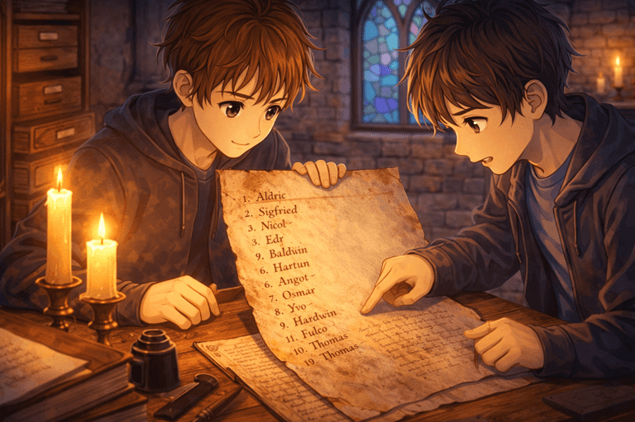
The Builders Names
The name in the document was not a personal name.
Callum found this in the final drawer of the vestry cabinet, in a document he had initially passed over because it appeared to be a simple inventory of church furnishings from the early 1800s. Tucked into the back of it, loose, was a single folded sheet that turned out to be a copy, in a careful Victorian hand, of the original twelfth-century document that Samuel Cross had referenced in his 1801 account. Cross had seen a partial transcription. This was a more complete copy, apparently made from the original before it was lost.
It was in Middle English, with marginal notes in a later hand translating difficult passages. Callum read it slowly, several times, using the marginal notes.
The document was from the master mason who had led the tower's construction. His name was given as Aldric. He had led a team of twelve builders, all of whom were named in the document: twelve names, ordinary medieval names, the names of men who had worked with stone nine hundred years ago.
And Aldric had written, toward the end of the document: We have built this tower to last, and we have put into it the manner of its lasting. The sound that the tower makes in the still autumn air is built from the measurements of our combined work, the height and width we each contributed, translated into the ratios that produce the harmonics. Each of us is in the sound. We do not ask to be remembered by name, only to be heard.
Callum read that last sentence three times.
We do not ask to be remembered by name, only to be heard.
He sat in the vestry for a long time.
He thought: twelve men built a tower and designed it to sing in autumn evenings. They did not carve their names in the stone. They did not write a plaque. They put their measurements, their individual contributions to the structure, into the acoustic ratios of the space. They became the sound.
He thought about the document carefully. The height and width each man had contributed, translated into ratios producing harmonics. Marcus had said it was a chord: multiple frequencies interacting. Twelve men, twelve contributions, twelve components of a sound that the tower had been making, off and on, for nine hundred years.
He thought: each overtone is a person.
He thought: the chord is the team.
He took the document carefully and photographed every page. Then he went to find Marcus.
Marcus read the document in complete silence.
When he finished he looked up with an expression Callum had rarely seen on him: not the focused concentration of someone working through a problem but something quieter, something that was closer to feeling than thinking.
"Each overtone is a person," Callum said.
"Yes," Marcus said. "That's consistent with the mathematics. If you take twelve measurements of varying proportions and translate them into frequency ratios, you would get a chord of approximately the complexity I heard last night." He paused. "It's beautiful, actually. As a piece of acoustic design, it's genuinely beautiful."
"I want to identify them," Callum said. "The twelve people. Their names are in the document."
"They said they didn't ask to be remembered by name," Marcus said.
"I know," Callum said. "But I want to know them by name anyway. I think that's different from demanding to be remembered. They wanted to be heard. I've heard them. Knowing their names is something I want to do, not something they asked for. Those are different things."
Marcus considered this. "That's a reasonable distinction," he said.
"And I want to write it all down," Callum said. "What we've found, how the tower works, who built it. For Reverend Cole, for the church records, for whoever comes after. So that the next person who hears the tower in autumn knows what they're hearing."
"And knows who," Marcus said.
"Yes," Callum said. "And knows who."