

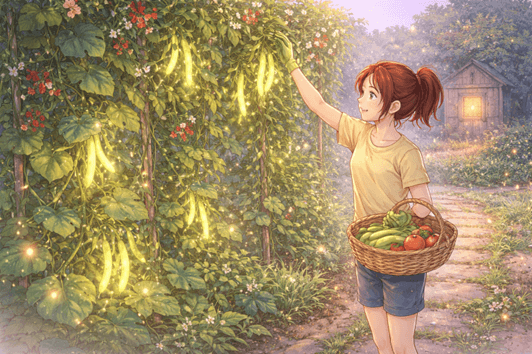
Growing Forward
It was not older. The pear tree was the only constant on Mr Albright's plot, massive and gnarled and probably medieval. Pip had assumed it had been the sole thing outlasting the changes to the land.
But as the 1845 carrots grew, spreading their pre-enclosure scent of massive, open land, the tree appeared younger. Its trunk seemed less deeply grooved, its branches higher and less broken.
Pip stood very still, breathing in the scent of 1845, and then moved her hand away from the carrot plants.
The smell vanished instantly.
The tree looked like its normal, ancient self again.
She knelt quickly, putting her hands flat on the turf-like soil near the carrot shoots.
The tree smoothed over. The ambient light changed subtly. She could hear sheep, lots of them, where the A-road usually hummed. The fence bordering the allotment faded entirely, becoming a low hawthorn hedge.
She stood up.
The hedge vanished. The fence returned. The A-road droned in the distance.
Pip wrote furiously in her notebook: *Contact with the soil of the pre-enclosure carrots changes local perception. It feels like time travel. It isn't. The plant merely overrides the current reality with the sensory input of its original environment.*
She spent August tending the 'historical' patches. She learned to negotiate the various zones of reality in her allotment.
Near the broad beans (1950s), the soil smelled heavily of coal smoke, and she occasionally heard the distant whistle of a steam train rather than a diesel horn. By the calendula (1987), there was a faint aroma of hairspray and leaded petrol, and the light felt slightly flatter, like old television.
By the carrots (1845), the area smelled aggressively of raw, unploughed earth and woodsmoke. If she sat very close to the plants with both hands on the soil, she could not hear modern traffic at all, only wind and occasional shouts from very far away.
It was exhausting but exhilarating work.
But the true strangeness happened in late August, when she finally found a packet right at the bottom of the tin, wrapped in oilcloth.
It contained seeds she couldn't identify. They were large, almost perfectly spherical, and intensely black, like tiny ball bearings. There was a label, tightly written in very modern, almost generic ballpoint pen.
It said: *Amaranth, red-leaf. East Terrace balcony, Block 4. 2042.*
Pip stared at the date.
2042.
She checked the ballpoint ink again. It didn't look old. It looked extremely fresh.
She sat in the shed, turning the packet over in her hands. She thought about Mr Albright. She thought about his will. *The allotment needs someone who asks questions.*
Mr Albright had clearly understood the tin. If he had seeds from 1845, it made sense he would acquire seeds from anywhere.
But 2042?
And where, or what, was Block 4, East Terrace?
Pip made a decision. She selected an unplanted patch near the shed, a spot that currently belonged entirely to the present day, with normal grey-brown soil and no strange smells or echoes of steam trains. She planted the six black spherical seeds carefully, spacing them exactly.
She watered them.
She waited a week.
Then two weeks.
Nothing happened.
September arrived. The broad beans withered, dropping their blackening pods. The carrots survived, maintaining their intense patch of 1845 common land around the pear tree.
But the black seeds from 2042 did nothing.
Pip dug carefully around the area where she had planted one of the black seeds. It lay exactly where she had left it, perfectly round, neither swelling nor rotting. It seemed entirely inert.
She wrote in her notebook: *Seeds from 2042 fail to germinate. The soil conditions must be wrong. Or perhaps you cannot plant a future memory in the past.*
She continued to water them regardless, stubbornly hoping her hypothesis was wrong.