The Book That Was Not There Yesterday
Nora Vasquez had a system for the library.
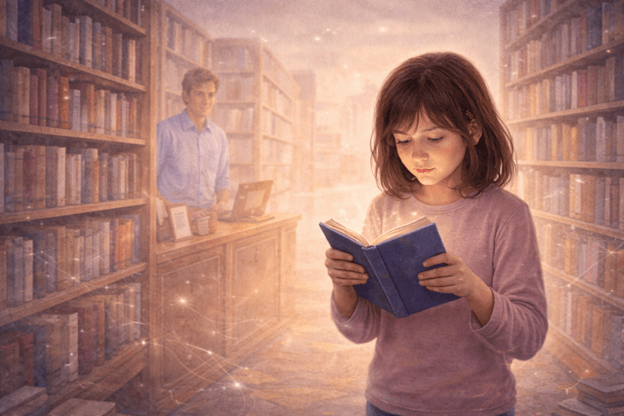
She visited every Saturday morning, arriving at five past nine when the doors opened, and she followed the same route every time: through the main entrance, left past the new arrivals table, straight to the fiction section organised by author surname, then a loop through the history shelves, then upstairs to the reading room if she had something specific to look up, then back to the main desk to check out whatever she had found. She had been following this system for three years, since she was eleven, and it had served her well. She knew the library the way she knew her own bedroom: well enough to notice immediately when something had changed.
The book was on the third shelf of the fiction section, between two authors whose surnames began with V, which was where her own surname would have sat if she had written a novel. It was slim, dark blue, with no image on the cover, just a title in plain silver lettering: The Cartographer's Daughter. There was no author name on the front cover. She checked the spine: also no author name. She turned it over. The back was blank.
She pulled it out and opened it to the title page.
The Cartographer's Daughter. Being a True Account of Certain Events in the Town of Whitfield, Offered for the Consideration of Whoever Finds This Necessary.
No author. No publisher. No date. The paper was slightly yellowed at the edges, the text printed in a font that looked older than most books on the shelf but newer than genuinely antique printing.
She read the first page.
By the end of the first page she had forgotten entirely that she had a route and a system. She sat down on the floor of the fiction section, which she had never done before in three years of library visits, and kept reading.
The book was about a girl named Sylvie whose father was a cartographer, a mapmaker, who worked in a town that sounded, the more she read, increasingly like the town of Whitfield where Nora lived. The streets had different names, the landmarks were shifted slightly, but the shape of the place was unmistakable: the river bend, the market square, the hill to the north with the church at its summit.
The cartographer in the book had been making a map. Not an ordinary map of streets and buildings, but a map of something else, something the book referred to as the deeper geography, the hidden structures beneath the visible town. Paths that had existed before the streets. Boundaries that remained even when the walls that had defined them were long gone. Memory, again, Nora thought, but different from anything she had read before: not stored in a house or land, but structured, deliberate, charted.
She read for an hour and twenty minutes before her phone buzzed with a message from her mum asking where she was. She had not checked out any books. She had not completed her route.
She took the book to the desk.
The librarian, a young man named Tom who she knew by sight, looked at it for a moment. He turned it over, checked the back, looked at the spine.
"I don't think this is one of ours," he said.
Nora looked at him. "It was on the shelf. Between the V authors."
"I mean, I don't have a record of it." He tried scanning the back cover, looking for a barcode. There was none. He looked at the title page, which she had already noted had no publisher information. "I'm not sure how it got on the shelf. We don't usually take donations without processing them."
"Can I borrow it anyway?"
Tom looked at the book, then at Nora, with the expression of someone making a judgement call. "Leave me your details and bring it back when you've finished," he said. "I'll try to work out where it came from in the meantime."
She gave him her details. He wrote them in a notebook rather than the system, because the system had nothing to enter against.
She took the book home and read the rest of it by three o'clock.
By the time she finished, she had filled six pages of her own notebook with observations, questions, and copied passages. The book ended mid-story, not with a conclusion but with a sentence that stopped in the middle of a scene, as though the writer had been interrupted. The final words were: Sylvie spread the map on the table and saw, for the first time, the shape of what her father had been trying to—
That was it. Nothing after. Several blank pages, and then the back cover.
Nora turned back and forth through the ending several times in case she had missed something. She had not. The story simply stopped.
She went to meet her friend Dara at the park at four o'clock, as arranged, and told her everything.
Dara was fourteen, like Nora, and was the best person Nora knew for thinking through problems. She had a quality of attention that meant she never half-listened, always either fully present or honestly absent, no middle ground. She was also, which mattered here, a habitual library visitor who knew the Whitfield library almost as well as Nora did.
"It wasn't there last Saturday?" Dara asked.
"I would have seen it," Nora said. "I know that shelf."
"And no author, no publisher, no barcode."
"Nothing."
Dara was quiet for a moment, thinking. "The town in the book is Whitfield," she said.
"Near enough," Nora said. "The geography is right."
"And the cartographer is making a map of something invisible. Hidden paths, old boundaries." Dara picked up Nora's notebook and read through the copied passages. "The deeper geography," she read aloud. "He says here: the town as it exists in official records is a fraction of the town as it truly exists. Every street has a history of being something else before it was a street. Every boundary has predecessors going back further than anyone has thought to record."
"Yes," Nora said.
"That's a real thing," Dara said. "Historically. Palimpsest is the word for it. When a document is written over but the original text is still faintly visible underneath. Cities are palimpsests. Towns are palimpsests."
"I know what a palimpsest is," Nora said.
"I know you do. I'm saying it because the book is describing a real phenomenon." Dara put the notebook down. "So what do you think it is? The book."
Nora had been thinking about this all afternoon. "I think it was put there for someone to find," she said. "The lack of any publication information, the way it ends mid-sentence. It's not a finished book. It's not a published book. It's more like a message, or part of one."
"From who?"
"That's the question," Nora said.