
The Last Storm of Summer
The last storm of that particular summer came on the first of September, which felt deliberate, a finale. It built through the day and broke just after six in the evening, bigger than most that summer, the lightning coming almost continuously for twenty minutes at its height.
Asha stood at the end of the garden and watched it.
She had not seen William Crane since August. She hadn't expected to. Something had changed after the conversation in the garden, after she had told him about the records. The quality of his absence was different now, she thought, from how it had been before she knew who he was. Less unfinished, somehow.
Still, she found herself looking toward the edge of the garden as the storm peaked.
He was there.
Different this time. Not the focused, absorbed stillness of his usual watching. He was standing more easily, his weight shifted, as though he were watching something he was enjoying rather than studying. He looked more like a sixteen year old boy and less like a phenomenon.
She walked to the end of the garden and stood beside him.
They both watched the storm for a while. Lightning over the western hills, brilliant and branching. Thunder rolling down through the valley. The rain starting, light at first, then heavier.
"Dr Yuen is going to write about your work," Asha said, without looking at him. "She thinks it's genuinely important. She's going to make sure it's known."
She felt, rather than saw, him look at her.
"And your records are going to the county archive," she continued. "They'll be properly catalogued. Anyone who wants to read them can."
The rain was properly in now, cold and heavy. She was getting wet and didn't care even slightly.
"I think you were right, by the way," she said. "About the pre-storm indicators. I've been watching all summer and you're right, you can predict the intensity from the cloud formation if you start watching early enough. I've been testing it." She paused. "I'm going to do what you were going to do. Study it properly. Not for you, I mean for me. But also, a bit, for you."
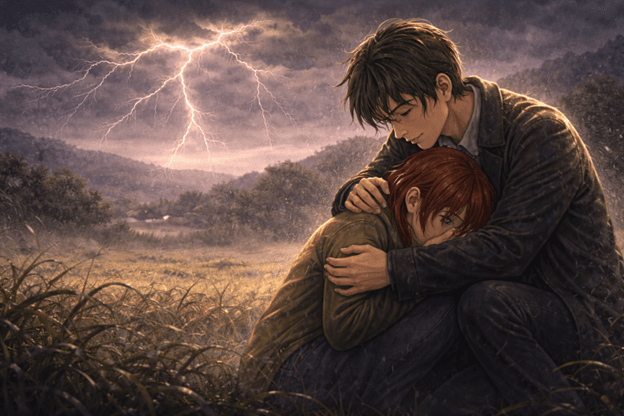
The lightning came again, close and spectacular, splitting the sky in a white tree of light.
She looked sideways.
He was looking at her, not at the storm. His expression was not the serious concentrated look she had grown used to. It was something else, something that was warmer and less focused and considerably more sixteen years old. He looked as though he was about to say something, as though whatever had been preventing him from being heard might, for just a moment, be thin enough to speak through.
She waited.
She heard nothing with her ears. But she felt, very clearly, the impression of two words, as sure as if they had been spoken: thank you.
The next lightning flash was enormous, the biggest of the summer, lighting the entire sky from hill to hill in a brilliant sustained flash that lasted two full seconds and left its shape burned against the back of her eyes.
When she could see again, the end of the garden was empty.
She stood in the rain for another ten minutes, watching the storm pass eastward, away over the village and toward the darker hills beyond. She was wet through, cold, and completely content.
She went inside and changed her clothes and came back down to find her parents in the kitchen, her mum on the phone to Dr Yuen's assistant about the archive arrangements, her dad making pasta. Normal Saturday evening, in a house that sat on the eastern edge of a village in a valley that storms rolled through on their way from the western hills.
At dinner she talked about Dr Yuen's paper, which was already in draft form and which Dr Yuen had said she would send to Asha when it was ready. She talked about the archive. She talked about the observation method she was developing, the one that built on William's work, refining the pre-storm indicators.
Her dad asked whether this was going to result in her standing in more open fields during lightning storms, and she said honestly that she would try very hard not to, and he gave her the look of a parent who knew this was the most truthful answer available and was choosing to accept it.
After dinner she sat at her desk and opened her storm notebook.
She wrote the date and the storm details, the time and direction and duration, the lightning frequency, the pre-storm cloud formation. She wrote everything she had observed that evening, precise and methodical, the way she always did.
At the bottom of the page, she wrote:
Last storm of summer. W.C.'s method applied. Predicted intensity from cloud formation at 16:20, estimated peak at 18:15. Actual peak: 18:17. Margin of error: two minutes.
She looked at that for a moment.
Then she added, in smaller writing below:
He was right. He was right about all of it. And now someone knows.
She closed the notebook and put it on the shelf next to the meteorology books, next to the photographs of William's records, next to the growing stack of papers and notes that were becoming, she realised, something like the beginning of a project. Something she would carry forward, add to, build upon, the way scientific knowledge was always built: one careful observation at a time, one honest record, passed forward through time from the person who first looked to the person who looked next.
Outside, the last of the storm moved away over the hills.
The sky cleared.
The stars came out, cold and very far away, exactly as they always had, exactly as they always would.
Asha Pembridge, thirteen years old, sat at her desk in the village of Crendle and felt the particular satisfaction of someone who had paid close attention and found it was worth the trouble.
She thought it probably always was.