
What William Knew
She went back to the village hall the following day and asked Derek if there were any other historical records about the village that weren't in the main book.
Derek, who had warmed to her considerably, produced a box of miscellaneous documents from a back cupboard with the air of someone who had been waiting for a reason to go through them. They sat at the hall's long table together and sorted through the contents: old meeting minutes, a bundle of letters relating to a dispute about a fence in 1947, a collection of photographs, and, at the bottom of the box, a thin manila folder labelled Crane, W. Weather Records 1910-1914.
Asha's hands were steady when she opened it. She was practised, she thought, at reacting to things without showing too much of the reaction.
Inside were ten sheets of paper, covered in neat, precise handwriting in pencil. Weather records, exactly as described: date, time, cloud type, wind direction, temperature where available, and for storm days, detailed observations of lightning frequency, thunder intervals, and what were clearly attempts to estimate the direction and distance of each strike.
The records were extraordinary. Not just for their methodical precision, though that was impressive enough for a fourteen and fifteen year old, but for the notes that accompanied the raw data. William had been thinking about what he was observing, not just recording it. He had noticed patterns, drawn hypotheses, made connections between conditions and outcomes. One note, dated July 1913, read:
Third consecutive evening of storm from SW direction. Note consistent approach angle, approx 240 degrees magnetic, suggesting stable source condition in hills. Lightning frequency increases sharply in final ten minutes before precipitation. I believe the charge buildup can be predicted from cloud formation alone if observed carefully from approx two hours before.
Another, from August 1913, read:
Stood in the far field this evening to observe the storm from unobstructed angle. The view from inside or adjacent to buildings limits the panoramic observation significantly. Note to self: always observe from open ground when safe to do so.
Asha read that note twice.
When safe to do so. He had known the risk. Of course he had known the risk. He had been studying lightning for years. He knew better than most people what lightning could do.
She thought about that for a long time. A boy of sixteen, brilliant, careful, rigorous in his thinking, who had also been unable to resist standing in an open field to get the best view of a storm. She understood that impulse completely, and the understanding sat uncomfortably in her.
The final entry in the records was dated the fourteenth of August 1914. The day he had died.
Fine storm developing from west. Cloud formation exceptional today, vertical extent greater than any I have recorded this summer. Estimate 40-50 minutes to full development from current position. Will observe from south field.
No further entries.
Asha sat with the folder for a long time after she'd finished reading.
Derek, across the table, had been reading the fence dispute letters with what appeared to be genuine interest. He looked up after a while.
"All right?" he asked.
"Yes," Asha said. "Can I photograph these pages?"
"No reason why not," Derek said. "They've been sitting in that box for decades. Nice that someone's interested."
She photographed every page carefully. Then she thanked Derek and walked home in the thick heat of an August afternoon, thinking about William Crane, who had died the same week he would have received his first university reading list, who had been watching storms from the south field for years, who had apparently not entirely stopped.
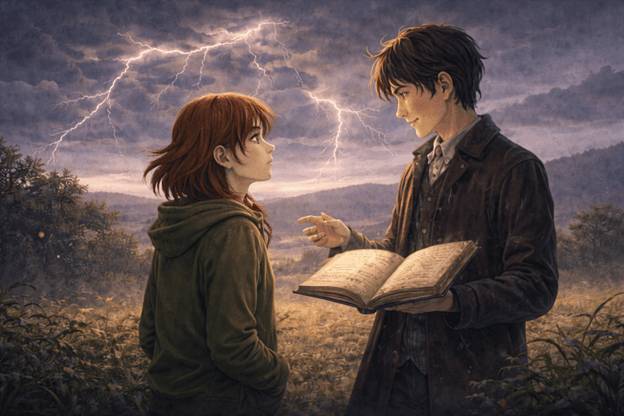
She saw him again that evening. A brief storm, less dramatic than many that summer, rolling through quickly and leaving the air smelling of rain and cut grass. He was there at the garden's edge, and she was there too, having gone out specifically to wait for him, and this time she was close enough and calm enough to watch him properly.
He was looking at the clouds, but he was also, she noticed, moving his lips. Not speaking to her. Working through something. The way she muttered calculations when she was working out a sum, or the way her friend Preethi talked herself through difficult knitting patterns.
He was observing. Still observing, a hundred and eleven years later.
"William," she said.
He turned to her immediately this time, without surprise, as though he had been expecting her.
"I found your weather records," she said. "In the village hall. In a box in the back."
He looked at her with an expression she was starting to be able to read: focused, attentive, processing what she was saying.
"They're extraordinary," she said, and meant it completely. "The observation about predicting lightning frequency from cloud formation, that's real. That's a real thing. They study it now. You worked that out from a field behind a house in 1913 with no instruments except your own eyes."
Something in his expression shifted. Not quite surprise, but something adjacent to it, the look of someone hearing something they had hoped might be true.
"I'm going to make sure they're preserved properly," Asha said. "The folder should be in a proper archive, not a box in a hall cupboard. And I think someone should write about them. About you. What you were working on."
The storm was passing, the thunder receding westward. The light was changing, the yellow-green fading back toward ordinary evening.
William Crane looked at her for a long moment. Then he looked upward, at the retreating clouds, and she could see on his face the same thing she felt when she watched storms: not just interest, not just curiosity, but a kind of joy. The particular joy of someone who found the world genuinely magnificent and could not stop paying attention to it.
The lightning flashed once more, distant now, low on the western horizon.
When she looked back, he was gone.
But for the first time, she didn't feel as though he had vanished. She felt, more precisely, as though he had simply gone to watch from somewhere else.