Lowenna
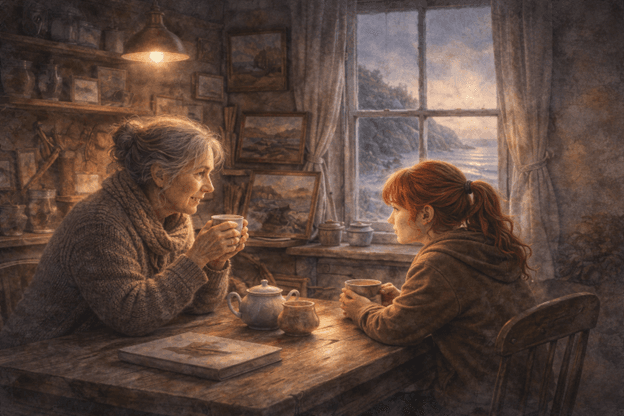
Mrs Tregenna made tea with the efficiency of someone who did most things efficiently and sat across the kitchen table from Juno with her hands wrapped round her mug.
"Lowenna Tregenna," she said. "My great-aunt. She was born in this village in 1901 and she lived here all her life." She paused. "She was a painter. Serious, dedicated, the kind that gets up before dawn to see the light and stays out after dark to see what the dark does to the water. She painted this cove more than anywhere else. She knew it in every weather, every tide, every season."
"She was good," Juno said, thinking of the light in the first painting.
"She was exceptional," Mrs Tregenna said. "There are three of her paintings in galleries now. Not important galleries, but proper ones. She was largely unknown in her lifetime. She sold a few things locally, gave others away. She didn't much care about being known, I think. She cared about painting."
"When did she die?" Juno asked.
Mrs Tregenna looked at her mug. "1962. She was sixty-one. A stroke, sudden, at home. She left behind a great many canvases, most of which I inherited when my mother passed, and which I keep in the loft." She paused. "The ones that appear on the beach are not those canvases."
Juno was very still. "They're new ones?"
"They appear fresh," Mrs Tregenna said. "Wet paint, sometimes, when people find them early enough. Painted that morning." She looked at Juno steadily. "This has been happening, on and off, for about fifteen years. Always early morning, always the cove, always left against that specific rock. Never a signature. No one ever sees who leaves them."
"And you think it's Lowenna."
"I don't know what I think," Mrs Tregenna said, in the tone of someone who had been thinking about it for a long time and arrived at precisely that conclusion. "I know that the style is unmistakably hers. I've compared them to the authenticated canvases I have upstairs. Same hand, same technique, same particular way of treating light on water. I've shown photographs to two gallery people, without explaining the circumstances, and both of them said the same thing: this is Tregenna's work, where did it come from."
"What do you do with them?" Juno asked. "The ones that appear."
"I keep them," Mrs Tregenna said. "I have eleven now. In the loft, with the others."
Juno thought about this. She thought about a painter who had spent her life painting one cove, who had died sixty-two years ago, and who might, possibly, still be painting it.
"Why does it happen on and off?" she asked. "Why not all the time?"
Mrs Tregenna looked at her with what might have been approval. "That's a better question than most people ask," she said. "I've tried to work that out. My best guess is that it happens when someone is there who is genuinely looking. Genuinely paying attention to the cove. Plenty of holiday visitors come through. They look at the sea, they take photographs, they move on. But occasionally someone comes who looks differently. Who sits with it."
Juno thought about herself, up at six every morning, watching the light for forty minutes.
"How long are you here?" Mrs Tregenna asked.
"Another week," Juno said.
Mrs Tregenna nodded. "Come and tell me each morning if there's a painting. Don't move them. Leave them where they are until I come down." She paused. "And keep watching the cove. Whatever you've been doing, keep doing it."