
What the Cove Remembers
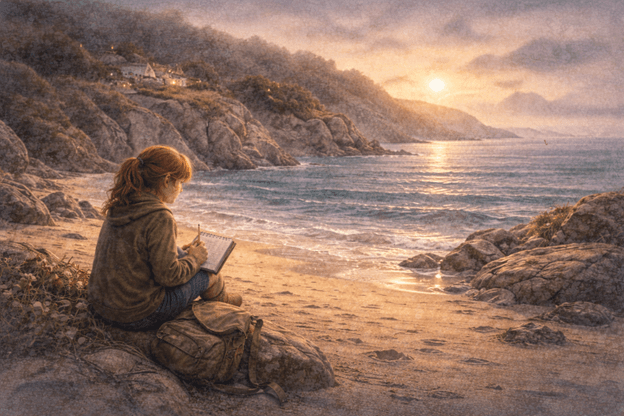
On the second to last day of the holiday, Juno sat on the beach for most of the morning and tried to understand the rest of it.
She had her notebook. She had all her documentation of the seven paintings, her descriptions and photographs. She had what Mrs Tregenna had told her about Lowenna. She had been thinking about it for days and she felt she was close to something, some understanding that kept being just out of reach.
The thing that bothered her was the question Mrs Tregenna had asked: why this one? Why had Lowenna signed the final painting and not the others? And what did it mean that the final painting was the whole cove at once, all angles simultaneously?
She thought about what Mrs Tregenna had said: Lowenna cared about painting, not about being known. She had given paintings away, sold some locally. She had not been interested in a career or a reputation.
What had she been interested in?
Juno looked at the cove. The tide was coming in, the water advancing up the dark sand in smooth successive sheets, each one going a little further than the last. The rock pools at the eastern end were already covered. In an hour the beach would be half gone.
She thought: what does a painter do when they paint the same place, over and over, all their life?
They learn it. They come to know it completely.
But there was more than that, she thought. When you painted something, you were not just recording it, you were also paying attention to it, which was a different thing. You were giving the place your sustained, careful, loving attention. Over and over. For sixty years.
She thought about the first five paintings: specific moments, specific conditions. The particular way light fell on a certain morning. The exact agitation of a surface under a specific wind. These were not general paintings of a general cove. They were precise, specific, this moment and no other moment.
Lowenna had been documenting the cove's life. Every particular instance of it. All the ways it could be.
And the final painting: the whole thing at once. All the angles, all the moments, somehow simultaneous. Not how the cove looked at any one time, but how it was, completely, as a place.
Juno wrote in her notebook: She wasn't painting the cove to show other people what it looked like. She was painting it to hold it. To keep it.
She looked at the water.
And now she's still keeping it.
She thought: what would make a painter keep returning to the same place, even after death? Not unfinished business, exactly. Not a message to deliver or a wrong to right. Just an attachment too strong to release. A place so thoroughly known and loved that the knowing and the loving persisted beyond everything.
She thought: that's not sad. It's the opposite of sad.
She wrote: She's not trapped here. She's choosing to be here. There's a difference.
This felt important. She underlined it twice.
She sat with the turning tide for another hour and then went up to find Mrs Tregenna.
She found her in the garden, doing something efficient with a hedge.
"I think I understand it now," Juno said. "Or most of it."
Mrs Tregenna put down the hedge clippers. "Tell me."
Juno told her. The documentation, the observation, the realisation about what the paintings were for: not communication, not a message, but an act of attention. An act of continuing to do the thing she had always done, which was look at the cove and paint what she saw, because the cove was worth it and the painting was how she knew it.
Mrs Tregenna listened. When Juno finished she was quiet for a while.
"I've been thinking of it wrong," she said finally. "All these years. I've been thinking of the paintings as a kind of haunting. Something unresolved."
"I think it is a haunting," Juno said. "Just not an unhappy one. Not unresolved. Just continued."
"She loved this cove more than anything," Mrs Tregenna said.
"I know," Juno said. "You can see it in every painting."
Mrs Tregenna looked at the cove. She had the expression of someone who had lived next to something all their life and was seeing it slightly differently for the first time.
"The final painting," she said. "You said she signed it because it was finished. Because it was the one she wanted someone to keep."
"Yes," Juno said.
"Keep for what?"
Juno had been thinking about this too. "For showing people," she said. "The others are for her. Studies, records, the ongoing act of paying attention. But the final one, the complete one, that's for someone else. It's the painting she wanted to exist in the world, for other people to see."
Mrs Tregenna was quiet for a long time.
"There's a small gallery in the village," she said at last. "It shows local work. I've always kept Lowenna's authenticated paintings for myself, for family reasons. But perhaps that final one..." She paused. "Perhaps that one should be seen."
"I think so," Juno said. "I think that's exactly what it's for."