
The Box Under the Floorboard
The locked room opened more easily than she'd expected. She'd found an old key ring in a kitchen drawer during the unpacking , her dad had left it on the counter saying he'd no idea what any of the keys were for. One of them, a small brass one with a worn head, fit the lock on the third-floor room perfectly.
The room was small. Smaller than she'd expected from the outside. It had a single window that looked out over the front garden, and the curtains were heavy, dark blue, slightly moth-eaten at the hems. The floor was bare boards, and it was colder in here than in the rest of the house , noticeably colder, the kind of cold that doesn't come just from poor heating but feels somehow intentional.
There was nothing in the room except dust and, in the corner, an old wooden chair with a cracked seat.
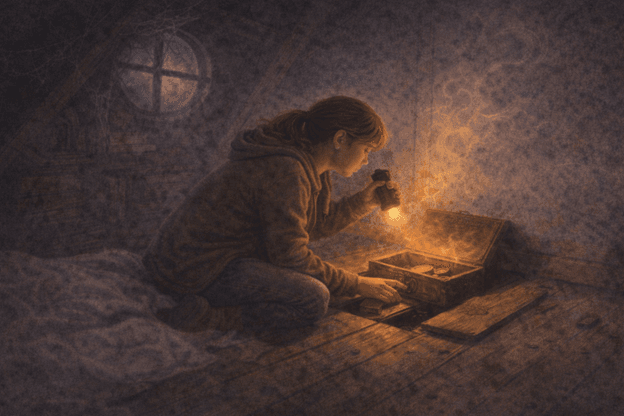
Priya counted from the left: one board, two, three. The third board from the left, below the window. She pressed it with her foot and it shifted slightly , not nailed down. She got her fingers under the edge and lifted.
The box was there. Just as Elara had said.
It was a small thing, dark wood, with a simple clasp. Not locked. She picked it up and sat cross-legged on the floor and opened it.
Inside was a collection of objects, each one small and seemingly ordinary: a button, dark green, with four holes. A fragment of ribbon, deep red, frayed at both ends. A piece of folded paper that turned out to be a charcoal drawing of a tree , not the oak at the front, but a different tree, wider and older-looking. A small glass bottle, empty, with a cork stopper. And beneath all of these, wrapped in a piece of cloth, a small stone disc, about the size of a fifty-pence piece, with markings on it that Priya didn't recognise.
She picked up the stone disc carefully. It was cool in her hand, heavier than it looked. The markings seemed to be carved rather than painted, shallow grooves in a pattern she couldn't immediately identify , circular, with lines radiating outward, and something in the centre that might have been letters or might have been a symbol.
The moment she held it, the whispering started.
Not from the walls, this time. From somewhere closer. She looked up sharply, but she was alone in the room. The sound was coming from all around her at once, soft and enveloping, and this time it was almost comprehensible. She could almost make out words at the edges, almost recognise a phrase before it dissolved back into the general murmur.
She held her breath and concentrated as hard as she had ever concentrated on anything.
And then, for just a moment, she heard three clear words: We are still here.
Her hand was shaking slightly when she put the stone disc back in the box. She made herself breathe slowly, in the way her football coach had taught her before penalty shootouts. In through the nose, out through the mouth, four counts each. She was all right. Nothing had hurt her. She had just heard three words from a wall, and those words were, relatively speaking, quite polite.
She closed the box and went back downstairs to get Elara's journal.
She spent the next two days in an intensity of research that she would later describe to her best friend (via many messages) as "actually the most interesting I have ever been in my life." She cross-referenced the journal with the history book with her own observations. She wrote six pages of notes. She drew a diagram of the house marking the spots where the whispering was loudest, based on Elara's records and her own testing.
What she worked out, piece by piece, was this:
The stone disc was a focus point. Thomas Barrow had described something similar in his records , a "concentrating object," he'd called it, that seemed to amplify the acoustic properties of the site. He hadn't known what it was made of or where it had come from originally, only that it had been found on the land during the digging of the foundations. He'd kept it in the house, and the sounds had been stronger for its presence.
The voices were old. Not ancient-old, necessarily , some of them seemed to be from the relatively recent past, based on the occasional phrase Priya managed to catch when she held the disc in the room. She heard what sounded like a child singing at one point. At another, she distinctly heard someone say the autumn fair is on the green again, which was entirely mundane and somehow made her want to cry.
They were not threatening. They were not malevolent or strange or dark. They were just there , accumulated, layered, patient. Exactly what Thomas Barrow had said. Memories.
But why we are still here? Who had said that, and why?
She was still trying to answer that question on her first day at the new school, which she went through in a mild daze, and on the second day, and on the third. She made a friend, almost by accident , a girl named Sorcha who sat next to her in English and shared her opinion that their teacher assigned too much homework and too little time to actually read the books. Sorcha was tall and freckled and had grown up in Ashford and knew rather a lot about the town.
"Do you know anything about Willow House?" Priya asked, on the second day, in the lunch queue.
Sorcha looked at her with new interest. "You've moved into Willow House?"
"Yes."
"The one on Elm Close?"
"That's the one."
"Wow," Sorcha said. "Yeah. People talk about that house. My nan says it's got a spirit in it, but my nan says everything's got a spirit in it, so that's not super helpful." She took a tray. "What's it like?"
"Strange," Priya said honestly. "But not bad-strange. I'm trying to figure out what it is."
Sorcha looked at her for a moment. "I want to help," she said. "I'm very good at figuring things out."
"I know you've known me for two days."
"I know. But I'm already sure I'm right about this."
Priya laughed, which was the first time she'd laughed since leaving the city. "All right," she said. "Come round on Saturday."