
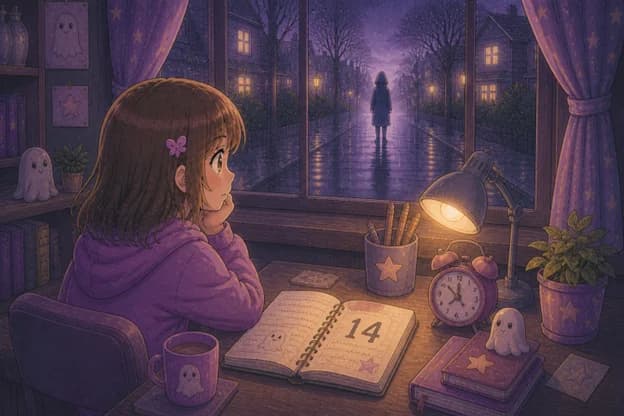
Day Fourteen
Nadia thought about Mrs. P. Aldridge on Sunday. She thought about her sitting down to write a letter to the editor of a local newspaper in 1987, which was something you did when you wanted someone, anyone, to hear something that you could not say to the people around you because they would tell you it was just a person.
She wondered if Mrs. Aldridge had children who remembered it. She wondered if they had talked about it afterward, once it stopped, or if they had all quietly agreed not to.
She thought that she and Callum had not talked about it much either, really. They talked around it. Route changes. Day counts. The texted newspaper photograph. But not about the actual thing itself, what it felt like to walk down a street and see something standing at the end of it that should not be there, that should not be able to do what it did.
She thought about bringing it up.
She thought about not bringing it up.
She did not bring it up. Some things were easier not looked at directly. She thought Mrs. P. Aldridge would understand that.
On day twelve the figure was at the end of Beeches Lane, where it had never been before, a new street, and Nadia wondered if it was running out of places or running out of patience or if she was projecting feelings onto something that did not have feelings, which was the more sensible possibility but somehow not the comforting one.
On day thirteen the figure was at the end of their road again. Nadia and Callum walked toward it this time, close together, not running. They had decided this together that morning over breakfast, in the practical low voices they used for serious things, the way they had once planned how to tell Mum that they had broken her favourite mug. They were going to walk toward it and see and not run.
The figure stepped back as they approached. One step. Two steps. Maintaining the distance.
They kept walking. The figure kept stepping back. A slow procession down the street, Nadia and Callum walking at normal pace, the figure retreating, never turning, never looking away.
At the end of the road the figure stepped sideways, around the corner, and when they reached the corner it was gone.
"Tomorrow," Callum said.
"Tomorrow," Nadia agreed.
Day fourteen was a Thursday. They walked home from school in the grey November light, down Orchard Road, which was where it had started. Nadia's hands were cold inside her gloves. Callum walked slightly ahead, scanning the end of every street before they turned onto it.
The walk home on day fourteen was the quietest walk they had ever taken. No music, no talking, no phones. Just the two of them and the grey afternoon and the sound of their footsteps on the pavement.
Callum walked slightly ahead as he had started doing, checking each junction before they turned. At the corner of Orchard Road he paused, looked, and then nodded and kept walking. At Maple Street the same. At Beeches Lane the same.
Nadia watched the ends of streets. Every one.
Every one was empty.
Orchard Road was empty.
Maple Street was empty.
Beeches Lane was empty. Their road was empty. Their front door was twenty metres ahead and the street was quiet and ordinary and the streetlights were coming on in the dusk and nothing was standing at the end of anything.
They stood in front of their house.
"Is that it?" Callum said. He said it quietly, the way you spoke in a place where something might still be listening.
Nadia looked up and down the road. Empty. Just the ordinary street in the early dark, parked cars and lit windows and the sound of someone's television faintly through a wall.
"I think so," she said.
They went inside. Mum was in the kitchen and called hello and they called hello back and Callum put the kettle on and Nadia sat at the kitchen table and looked at her phone and the library photograph of Mrs. P. Aldridge's letter from 1987.
After two weeks it simply stopped. She had not known why.
Nadia put her phone face down on the table. Outside the kitchen window a car went past, its headlights sweeping across the ceiling. Ordinary. Everything was ordinary.
Nadia did not know why either. She thought that was the part she would keep thinking about, probably for a long time. Not what it had been. Not what it had wanted, if it had wanted anything. But the not knowing why it stopped, which meant not knowing if the stopping was permanent, which meant not knowing if one day on some ordinary afternoon she would turn onto a street and there would be a figure at the end of it.
Standing still.
Facing her.
Callum put a cup of tea in front of her and sat down. He had not said much since they got home. He had the look he sometimes had after something difficult, turned inward and quiet, processing in the way that took him longer than it took her.
"Stop thinking about it," he said eventually.
"I am trying," she said.
"I know," he said. He sat down across from her. Outside the kitchen window the street was dark now, properly dark, and the lamplight fell on the pavement in orange pools and everything beyond the pools was shadow.
Neither of them looked out the window for very long.
But Nadia noticed that Callum, who always sat with his back to the window at dinner, sat facing it that evening.
She did not say anything. She turned her chair slightly too.
Just in case.
***The End***