
The Note In Seat 14C
This was obvious from the moment she found it, folded into a tight square and wedged between the seat cushion and the armrest of seat 14C on the number forty-seven bus. It was not addressed to her. It was not addressed to anyone, which was either because the sender was being discreet or because they assumed the right person would know it was theirs.
Pip was eleven years old and had been described by her teachers as curious, by her parents as relentless, and by her older brother as an absolute menace who could not leave anything alone. All three assessments were accurate.
She sat with it in her hands for a moment. The paper was ordinary lined paper, torn from a notebook. The handwriting was small and even, someone used to writing carefully. The fold was tight and practiced, the kind you made when you did not want the paper to open accidentally.
She unfolded the note.
It said: 14 9 4 7 14 10 19 19 19 3 6 19 4 2 6.
That was all. Fifteen numbers in a row with spaces between them. No greeting, no signature, no context.
Pip looked at the note for a long time. Then she looked around the bus. Seat 14C was a window seat near the back. The bus was half full, the usual mid-morning crowd, nobody paying particular attention to a girl in a window seat reading a folded piece of paper.
She put the note in her pocket and got off at her stop and sat on the wall outside the library and looked at it again.
Fifteen numbers. The highest was nineteen. The lowest was two.
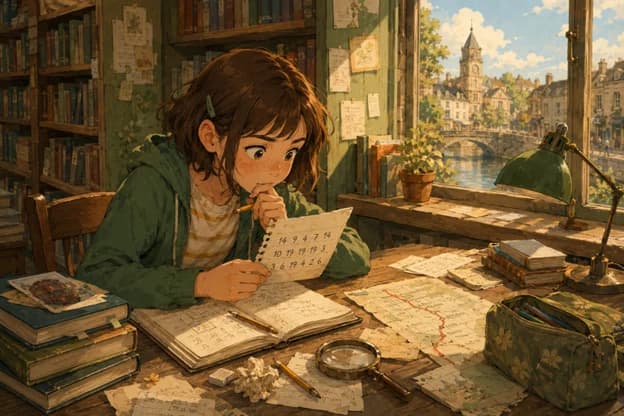
She thought: alphabet. Twenty-six letters. A equals one, B equals two, and so on. She pulled out her pencil and wrote the alphabet in her notebook with numbers underneath.
1=A, 2=B, 3=C, 4=D, 5=E, 6=F, 7=G, 8=H, 9=I, 10=J, 11=K, 12=L, 13=M, 14=N, 15=O, 16=P, 17=Q, 18=R, 19=S, 20=T.
She decoded the note. Systematically, A equals one through Z equals twenty-six, translating each number to its letter in her notebook.
14=N, 9=I, 4=D, 7=G, 14=N, 10=J, 19=S, 19=S, 19=S, 3=C, 6=F, 19=S, 4=D, 2=B, 6=F.
NIDGNJ SSS CF SDBf.
She looked at this result for quite a long time.
NIDGNJ SSS CF SDBf was not a word. It was not several words. It was a sequence of letters that meant nothing.
"Not a simple alphabet code then," she said aloud, to nobody.
The woman walking past with a pushchair gave her a look. Pip ignored it.
She turned the paper over. Nothing on the back. She held it up to the light. No hidden writing. Just the numbers, on one side, in careful handwriting, meaning something to someone who was not her.
She considered, briefly, handing it to the bus driver. She considered, briefly, leaving it where she had found it. Both options lasted approximately three seconds before she dismissed them. The note was a puzzle and Pip did not leave puzzles unsolved as a matter of personal policy.
She spent the rest of the morning in the library, which was where she had been going in the first place, working through cipher options with the kind of focused determination that had once led her to spend four hours untangling a knotted ball of string just to prove it could be done.
Caesar cipher: shift each number by a fixed amount. She tried shifts of one through five. Nothing intelligible.
Reverse alphabet: A equals twenty-six, Z equals one. She decoded. MWSWMQDDDHUDYWU. Also not a word.
She sat back and looked at the ceiling. The library ceiling had a water stain that looked like a badger if you tilted your head. She had looked at it many times before while thinking about difficult things.
She worked for another hour. She tried Polybius squares and rail fence ciphers and number patterns based on prime numbers and multiples of three. She tried reading every other number. She tried treating pairs of numbers as coordinates on a grid.
Nothing worked. Nothing produced words.
She ate her packed lunch at the library table and stared at the numbers and ate her crisps without tasting them, which was how she knew she was genuinely absorbed in something, because normally she paid close attention to crisps.
She looked at the numbers again. 14 9 4 7 14 10 19 19 19 3 6 19 4 2 6.
She had assumed it was a substitution cipher. Letter for number. But what if it was not that kind of code at all? What if the numbers referred to something else? A page and line number. A grid reference. A date.
Or, she thought slowly, what if the key was the seat itself.
She opened her notebook and wrote: Seat 14C. Bus forty-seven. The note was in seat 14C. What if 14C was not just where the note was left but part of the code?
She thought about this for so long that the library assistant came over and asked if she needed help finding anything.
"I need," Pip said, "a bus timetable for the number forty-seven."
The bus stop idea had come from a specific thought: the note had been left on a specific bus. Not dropped, not lost. Wedged deliberately into a specific seat. The seat number was fourteen. The bus number was forty-seven. Both numbers meant something to both the sender and the intended receiver. What if they were the key itself?
She had felt the rightness of it the moment she thought it, the way a good idea felt different from a mediocre one, cleaner, like a key turning smoothly in a lock.
The forty-seven ran every twenty minutes. Its full route had fourteen stops. Pip got the timetable from the library noticeboard and spread it on the table and looked at the stop names.
Stop one: Riverside. Stop two: Bell Lane. Stop three: Church Street. Stop four: The Common. Stop five: Orchard Road. Stop six: Ferry Bridge. Stop seven: Green Lane. Stop eight: Market Square. Stop nine: Institute Road. Stop ten: Junction. Stop eleven: Kelsey Park. Stop twelve: Library. Stop thirteen: Mill Road. Stop fourteen: North End.
She looked at the numbers in the note. 14 9 4 7 14 10 19 19 19 3 6 19 4 2 6.
Stop fourteen was North End. Stop nine was Institute Road. Stop four was The Common. Stop seven was Green Lane. Stop ten was Junction.
N-I-T-G-N-J. Still not a word.
She drummed her pencil on the table. The library assistant looked over. Pip stopped drumming.
What about the other direction? The forty-seven ran both ways. If you reversed the stop numbering, stop one became North End and stop fourteen became Riverside.
She renumbered. New stop one: North End. New stop two: Mill Road. New stop three: Library. New stop four: Kelsey Park. New stop five: Junction. New stop six: Market Square. New stop seven: Green Lane. New stop eight: Ferry Bridge. New stop nine: Orchard Road. New stop ten: The Common. New stop eleven: Church Street. New stop twelve: Bell Lane. New stop thirteen: Riverside.
She applied the new numbers to the code.
14=Riverside? No, she only had thirteen stops. She was one short.
She looked at the timetable again. There was a stop she had missed. Stop zero, technically: the terminus at Dockside, before the route officially started. If Dockside was stop one and North End was stop fifteen--
She renumbered again. This time stop fourteen was North End and stop nineteen was Market Square and stop two was Bell Lane and stop six was Orchard Road.
14=North End. 9=Ferry Bridge. 4=The Common. 7=Green Lane. 14=North End. 10=Junction. 19=Market Square. 19=Market Square. 19=Market Square. 3=Library. 6=Orchard Road. 19=Market Square. 4=The Common. 2=Bell Lane. 6=Orchard Road.
She looked at the initials. NE. FB. TC. GL. NE. J. MS. MS. MS. L. OR. MS. TC. BL. OR.
She stared at this for a full minute.
Then she wrote out the repeating pattern: MS MS MS. Market Square, Market Square, Market Square. Three times in a row. And before it: NE FB TC GL NE J. And after: L OR MS TC BL OR.
She read the groups as phrases. North End, Ferry Bridge, The Common, Green Lane, North End, Junction. Library, Orchard Road, Market Square, The Common, Bell Lane, Orchard Road.
She circled the three Market Squares. Three times the same location meant something. An emphasis. A meeting point. Or a time.
She looked at the timetable. Market Square was stop eight on the outward route and stop seven on the return. The forty-seven stopped there at eight minutes past and twenty-eight minutes past every hour.
She looked at the three in a row. Three stops at Market Square.
Three times. Three instances. Three days, maybe. Or three o'clock.
Three o'clock at Market Square.
She sat with this for a long time. Three o'clock at Market Square. It was either right or it was not. There was only one way to find out.
She also considered that she might be about to sit in a public square at three in the afternoon waiting for a meeting that was not meant for her, for people who did not know she was coming, for reasons she did not yet understand.
She considered this for about four seconds.
Then she got on the bus.
She went back to the bus stop at half past two and rode the forty-seven to Market Square and sat on the bench outside the old post office at five to three and waited.
This was possibly, she thought, a completely ridiculous thing to do. She had found a note on a bus. She had spent her entire morning decoding it. She had arrived at what might be a meeting time and place that was either correct or completely wrong, based on an interpretation that had required reversing a bus route, adding a terminus stop, and treating repeated stop names as emphasis.
She was aware this was a fairly large number of assumptions.
At three o'clock exactly, two people arrived at Market Square from different directions. One was a tall girl of about fourteen with a dark green coat and a canvas bag. The other was a boy of about the same age, slightly out of breath, who had clearly been running.
They stopped when they saw each other. Then they both looked at Pip.
"You are not Marcus," the girl said.
"I am not," Pip agreed.
"How did you--" the boy said, then stopped. "The note. You found the note."
"Seat fourteen C," Pip said. "I was sitting in it."
The two of them exchanged a look. The girl looked at Pip with an expression that was equal parts irritated and reluctant impressed.
"You decoded it," the girl said. "On your own."
"The bus stop cipher was quite clever," Pip said. "I especially liked using the terminus as the offset. Most people would not count a stop that is not on the main timetable."
"That was my idea," the boy said, with the tone of someone who did not often get credit for their ideas.
"It was good," Pip said. "The terminus offset was clever."
"The what?" Obinna said.
"Using Dockside as stop zero so the numbering shifted by one," Pip said. "Most people would not count a stop that is not on the printed timetable. It is good cipher design."
Obinna looked at her for a moment. "Thank you," he said, slightly dazed.
"Where is Marcus?" Pip asked.
Another look between them. Longer this time.
"That," the girl said carefully, "is what we are here to find out."
Their names were Fen and Obinna. Marcus was Fen's older brother, fifteen, who had sent the note to Obinna via the forty-seven bus three days ago and had not been seen since.
The afternoon light was going golden over Market Square and here were the three of them on the bench having a conversation that would have sounded completely strange to anyone nearby.
"Not missing missing," Obinna said quickly, seeing Pip's expression. "He is at home. He is just not talking to anyone. He has locked himself in his room and he does not come out and Fen is worried."
"He sent this note before he stopped talking," Fen said. "I think it is connected. I think whatever is in this note is why he went quiet."
"But you cannot decode it," Pip said.
"We decoded the location and time," Obinna said, slightly defensive. "We got that far."
"But not the rest," Pip said. "The NE FB TC GL NE J before the Market Squares. And the L OR MS TC BL OR after."
Fen stared at her. "You decoded all of it?"
"I think so," Pip said. "The sequence before is the route Marcus took to get somewhere. North End, Ferry Bridge, The Common, Green Lane, North End again, then Junction. A specific journey on the forty-seven. And the sequence after is a return route."
"Where did he go?" Fen asked. Her voice had gone very quiet.
Pip looked at the sequence. The last stop before Market Square was Green Lane, which was near the old industrial estate on the north side of town. A place that had warehouses and a scrapyard and the kind of buildings that looked empty but sometimes were not.
"He went to Green Lane," Pip said. "And then he came back. And then he locked himself in his room."
Fen and Obinna looked at each other for a long moment.
"We need to go to Green Lane," Fen said.
"I am coming," Pip said.
"You do not even know us," Obinna said.
"I decoded your code," Pip said. "I found your meeting place. I have been working on this since this morning. I am absolutely coming."
Obinna looked at Fen. Fen looked at Pip. Pip looked back at her with the expression her brother called the one where there is no point arguing.
"Fine," Fen said. "Bus leaves in four minutes."
Pip watched this exchange with interest. Fen was older and clearly used to being in charge. Obinna was the one who had built the cipher. Marcus was the one who had gone to Green Lane alone and then gone quiet, which suggested he had either found something frightening or something he felt responsible for and did not know what to do with.
She was good at reading situations. Her brother said she was nosy. Her parents said she was perceptive. The difference, she had decided, was mostly a matter of whether the information turned out to be useful.
Right now it was useful.
They ran for the forty-seven. They got on at Market Square, rode to Green Lane, and found Marcus sitting outside a locked warehouse with a notebook on his knees and a look of profound relief on his face when he saw them coming.
"I thought nobody was coming," he said.
"You sent the note to the wrong seat," Obinna said. "Or the right seat, as it turned out."
Marcus looked at Pip. "Who are you?"
"Pip," she said. "I was in seat fourteen C. What is in the warehouse?"
Marcus opened his notebook. "Evidence," he said. "Of something I probably should have reported to an adult three days ago instead of sending coded bus notes about."
"Probably," Pip agreed. "But in the meantime show me."
Marcus showed them: a series of photographs on his phone, taken through a gap in the warehouse boards, of boxes that should not have been there, with markings that should not have been on them, belonging to someone who was not supposed to have them.
"Three days you sat on this," Pip said.
"I was not sure what to do," Marcus said. "I did not want to be wrong."
"You were not wrong," Fen said. She had her arm around him now, the way older sisters did when they forgot they were supposed to be cool about things.
He showed her. She agreed it required an adult. They called Fen's mum, who called the relevant authorities, and the relevant authorities turned out to agree that Marcus had found something worth finding and that Pip had decoded something worth decoding and that seat fourteen C had, on this particular Tuesday, been occupied by exactly the right person.
Fen's mum arrived in eleven minutes and took charge of the situation with the brisk efficiency of a person who had learned not to ask how her children ended up in these situations and to simply deal with them. She looked at Pip once, sharply, and said: are you one of theirs? Pip said: no, I found the note on the bus. Fen's mum looked at her for a long moment and said: of course you did, and took out her phone.
Pip thought about this on the bus home, in seat fourteen C, looking out the window at the stops going by.
Ferry Bridge. The Common. Green Lane.
She thought about Fen, who had been so focused on finding Marcus that she had not eaten anything all afternoon and had, upon seeing her brother alive and well and sitting outside a warehouse with his notebook, immediately started telling him off. She thought about Obinna, who had designed a cipher clever enough that it had taken Pip most of a morning to crack it and who deserved considerably more credit than he generally got. She thought about Marcus, who had sat on something frightening for three days because he had not wanted to be wrong.
She thought that curiosity was mostly a liability and occasionally, on very good days, an asset.
Today had been a very good day.
She opened her notebook to the back page and wrote, in small neat letters: Bus forty-seven. Seat fourteen C. Tuesday. Fen, Obinna, Marcus. Bus stop cipher.
She underlined bus stop cipher twice.
Then she closed the notebook and looked out the window and smiled at nothing in particular, in the private way you smiled when something had gone exactly right.
The End