

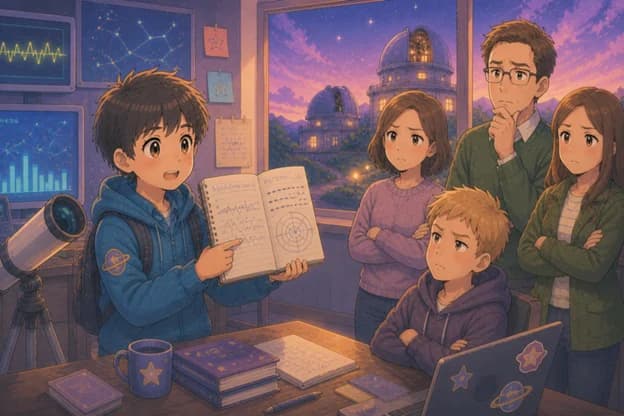
The Part Where Nobody Believed Him
His mother believed him about the signal. She sat at the console for two hours that evening listening to the recording and checking his work and at the end of it she said: "You are right that it is a pattern. You are right that it is repeating. The forty-six interpretation is interesting."
"But?" Nico said, because he could hear the but coming.
"But there are many possible explanations," she said carefully. "Terrestrial interference can create very convincing patterns. There are satellites in unusual orbits. There are natural phenomena we do not fully understand. Before we draw any large conclusions we need to rule out all the small ones."
"I know," Nico said. "But what if we rule them all out and the signal is still there?"
"Then we take it to someone with better equipment," she said. "But Nico, I need you to understand that the chances of this being what the most exciting interpretation suggests are extremely small."
"I know what the chances are," Nico said.
She smiled at him. It was the kind of smile that meant she understood and also that she was worried about him getting his hopes up. He knew that smile very well.
She sent his recordings and his notes to a colleague at the university, a professor named Dr. Vasquez who specialised in radio astronomy. Dr. Vasquez replied three days later with a polite email explaining that the signal was most likely a known type of interference caused by certain atmospheric conditions reflecting signals from telecommunications satellites back toward the ground in unusual ways. She thanked them for their careful observation and said Nico showed real promise.
Nico read the email twice.
Then he went back to the observatory and recorded the signal again.
It was still there. Exactly the same. Short short long short long long short. Gap. Repeat.
He looked up the atmospheric conditions required to produce the kind of interference Dr. Vasquez had described. It required a very specific combination of temperature and humidity at high altitude. He checked the meteorological data for the past three nights.
The conditions had not been right on any of them.
He wrote this up carefully in his green notebook, with all the data attached. He wrote a very polite reply to Dr. Vasquez pointing this out and asking whether there were other possible explanations.
Dr. Vasquez did not reply.
He tried two other astronomers his mother knew, sending them his full notes. One said it was interesting but she was very busy. The other said the forty-six interpretation was creative but almost certainly coincidental.
Nico sat in the observatory on a cold Friday night in November with the signal playing through his headphones and his green notebook open in his lap and felt the particular frustration of knowing something and not being able to make anyone else see it.
He turned to a fresh page in the notebook.
At the top he wrote: Things I know for certain.
Then he started writing. He wrote for a long time, the signal playing steadily through his headphones, the observatory cold and dark around him, the sky outside enormous and full of its usual impossible distances. When he finished the list had eleven items on it. Every single one pointed in the same direction.
He was not wrong about this. He was sure of it in the way you are sure of things you have checked carefully rather than the way you are sure of things you simply believe. Those were different kinds of sure and this was the better kind.