

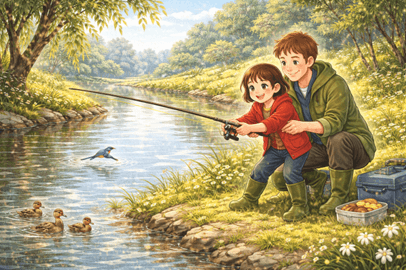
The Fishing Trip That Almost Wasn't
In the village of Heathermoor, where the June mornings
arrived early and golden and the air smelled of cut grass
and wildflowers and the particular sweetness of a proper
English summer getting into its stride, there lived a girl
named Jess. Jess was nine years old, had dark eyes and
short practical hair and a laugh that was slightly too
loud for indoors, which her teachers mentioned
occasionally and she paid no attention to whatsoever. She
liked climbing things, knowing how things worked, and her
dad.
Her dad was called Rob. He was tall and broad shouldered
with kind eyes and large hands that were good at fixing
things. He worked long hours at the garage on the edge of
the village, fixing cars and vans and occasionally a
tractor, coming home in the evenings with oil on his hands
that never quite washed off completely, which Jess had
always thought was rather distinguished. He made excellent
cheese on toast. He was the best person to watch a film
with because he laughed in exactly the right places. He
had coached Jess\'s football team for two seasons,
even though he freely admitted he knew very little about
football tactics and mostly just tried to make sure
everyone had a good time, which Jess thought was actually
the correct approach.
The thing her dad loved most in the world, besides his
family, was fishing.
Not the competitive kind, not the kind where you kept
score and compared catches and cared very much about who
caught the biggest one. Just the quiet kind. The sitting
beside a river on a summer morning with a rod and a flask
of tea and absolutely nowhere else to be kind. He had been
doing it since he was younger than Jess, taught by his own
dad on the same stretch of river that ran through the
water meadows on the edge of Heathermoor.
Every Father\'s Day, Jess tried to give her dad a
good present. Last year she had made him a photo frame out
of lolly sticks and put a picture of the two of them in it
from the previous summer, standing in the garden both
squinting into the sun and laughing at something that
neither of them could remember now. The year before that
she had bought him a book about the history of engines
that he had put on his bedside table and actually read,
which Jess considered the highest possible compliment a
book could receive.
This year she had decided to do something different.
This year she was going to go fishing with him.
Jess had never been fishing. She had watched him go many
times, seen him pack his bag the evening before with the
careful attention he gave to nothing else, checking his
tackle box and his line and his flask and his sandwiches.
She had seen him come back in the early afternoon looking
relaxed in a way he rarely looked any other time, as
though the river had ironed out something in him that the
rest of the week had crumpled.
She had never asked to go because she had never been sure
she would like it. Sitting still for long periods was not
Jess\'s greatest strength. Quiet was something she
appreciated in theory more than practice. And she was not
entirely certain about worms.
But this was Father\'s Day. And the point was not
whether she liked fishing. The point was that her dad
loved it, and spending the morning doing something her dad
loved, beside him, seemed like exactly the right kind of
present.
She told her mum the plan. Her mum smiled in the
particular way she had when something pleased her
genuinely and said it was a wonderful idea and she would
sort out the sandwiches.
Jess did her research. She looked up fishing for beginners
on the library computer and read two articles and watched
a short video. She learned about casting and about sitting
still and about not making sudden movements near the
water. She learned that patience was the most important
quality a fisher could have, which she considered a
significant personal challenge and decided to treat as
something to work on.
She did not tell her dad. It was a surprise.
On Father\'s Day morning she woke up early, earlier
than she usually managed on a weekend, and went downstairs
to find her dad already in the kitchen in his fishing
jacket, filling his flask, clearly planning to go alone as
usual.
He turned when she came in and looked surprised to see her
up.
\"Morning, love,\" he said. \"You\'re
up early.\"
\"Happy Father\'s Day,\" said Jess.
\"I\'m coming fishing with you.\"
Her dad looked at her. Then he looked at the flask. Then
back at her.
\"Really?\" he said, and the way he said it,
quietly, with something careful in it, told Jess that this
was exactly the right present.
\"Really,\" she said. \"I\'ve done
research.\"
He laughed. \"Of course you have. Right then.
You\'ll need wellies and a warm layer, it\'s
cool by the river in the mornings.\"
They walked to the river through the water meadows as the
sun was still low and pale in the east, the grass soaking
their boots with dew, the air full of birdsong that seemed
impossibly loud for so early in the day. Jess\'s dad
carried the rod bag and the tackle box. Jess carried the
rucksack with the sandwiches and the flask and two apples
and a packet of biscuits that her mum had added to the bag
with the instruction that they were not to be eaten before
ten o\'clock, a rule that both of them silently
agreed not to enforce too strictly.
The river was beautiful in the early morning. It was wider
than Jess had expected, slow moving and greenish brown,
reflecting the willows that leaned over it from the far
bank. The surface was very still except for the occasional
ring that appeared and disappeared where something moved
beneath. Dragonflies hovered in the reeds. A grey heron
stood absolutely motionless on a stone downstream, so
still it looked painted.
Her dad chose their spot on a flat grassy bank where the
river curved gently and an old willow tree provided a
little shade. He set up both rods with the practised ease
of someone who had done it ten thousand times, showing
Jess each step quietly and clearly, not rushing, making
sure she understood before moving on.
The worm question arose.
Jess looked at the worm in the small container in the
tackle box. It was pinkish and energetic and extremely
wriggly.
\"You don\'t have to,\" said her dad.
Jess thought about the research she had done and the video
she had watched and the fact that she had come this far.
\"I\'ll do it,\" she said.
She did it. It was as unpleasant as expected and over very
quickly and she felt genuinely proud of herself in a way
that was entirely disproportionate to the size of the
achievement, which was fine.
They settled on the bank. Her dad showed her how to hold
the rod and how to watch the float, the small orange
tipped thing sitting on the surface of the water that
would dip and dart when a fish took the bait. They spoke
in low voices the way you do near rivers, as though the
water requires a certain respect that comes out as
quietness.
The first twenty minutes were peaceful in a way Jess had
not quite anticipated. She had expected to find the
stillness difficult, and there were moments when her legs
wanted to move and her mind went off in several directions
at once. But there was something about the river that
helped. The slow movement of the water. The sound of it
against the reeds. The way the light on the surface
shifted constantly, never the same twice.
She began to notice things she would have missed if she
had been moving. A family of moorhens picking their way
along the far bank. A flash of extraordinary blue that was
a kingfisher, there and gone so fast she almost doubted
it. A water vole swimming strongly upstream, its small
whiskered face just above the surface, completely
unbothered by anything.
\"Dad,\" she whispered.
\"I saw it,\" he said. He was smiling.
At half past eight Jess\'s float dipped. She almost
missed it, her attention having drifted slightly towards a
cloud that looked remarkably like a sleeping elephant.
\"Jess,\" said her dad quietly. \"Your
float.\"
She looked. The orange tip was under the surface. Her
hands tightened on the rod.
\"Lift it gently,\" said her dad.
\"Steady.\"
She lifted. She felt a resistance on the line, a living
pulling weight, and her breath caught. She reeled in
slowly the way he had shown her, keeping the line taut,
and brought the fish to the surface.
It was a small roach, silver sided and bright eyed,
flipping in the morning light. It was the most beautiful
small fish Jess had ever seen, which admittedly was not a
category she had thought much about before but felt very
certain about now.
Her dad helped her hold it gently in the water while she
took the hook out carefully, and then they both watched it
dart away into the green depths and disappear.
\"That was amazing,\" said Jess, and she meant
it completely.
Her dad looked at her with the expression that she always
thought of as his proudest look, the one that reached his
eyes before his mouth caught up.
\"You\'re a natural,\" he said.
They ate their sandwiches at ten o\'clock, or
possibly slightly before, sitting side by side on the bank
with their boots off and their feet in the cool grass. Her
mum had made cheese and pickle for her dad and ham for
Jess and had wrapped them in foil and cut them diagonally
without being asked, which Jess noted and appreciated.
Her dad poured tea from the flask into the two small cups
that nested in the lid and they sat drinking it in the
comfortable silence of two people who do not need to fill
every moment with words.
The heron downstream had not moved in two hours. Jess had
begun to wonder if it was real.
\"Dad,\" she said.
\"Mm.\"
\"Is that heron actually alive?\"
Her dad looked at it for a long moment. Then the heron, as
if it had heard and decided to settle the question, turned
its head slowly, stepped off its stone with tremendous
dignity, spread its enormous wings and lifted away
upstream in long slow wingbeats, clearing the willows and
disappearing into the blue of the morning.
Jess and her dad both watched it go.
\"Alive,\" said her dad.
\"Extremely,\" said Jess.
They stayed until noon. Jess\'s dad caught two more
fish and returned them both. Jess had one more bite that
got away before she could react, which was frustrating for
approximately thirty seconds and then became a good story.
They ate the apples and had the biscuits at eleven and
talked about all sorts of things in the easy, wandering
way that happens when there is plenty of time and nowhere
to rush to.
Her dad talked about fishing with his own dad when he was
young, on this same river, in this same meadow. He talked
about the things his dad had taught him, not just about
fishing but about waiting and watching and finding the
quiet in things. He talked about it simply and without
sadness though his dad had been gone for many years, the
way you talk about good things that happened and are glad
they happened.
Jess listened to all of it.
On the walk home through the water meadows, the sun
properly warm now and the dew long gone from the grass,
her dad put his arm around her shoulders as they walked.
\"Thank you for coming,\" he said. \"Best
Father\'s Day present I\'ve ever had.\"
Jess thought about the lolly stick photo frame and the
engine book and felt pleased to have topped them both.
\"I might come again,\" she said. \"If
that\'s all right.\"
\"Whenever you like,\" said her dad. \"The
river\'s not going anywhere.\"
That evening Jess sat in the garden after supper while her
dad fell asleep in the armchair indoors, which happened
every Father\'s Day, and watched the long June light
fade very slowly from the sky.
She thought about the silver roach in her hands and the
flash of blue that was a kingfisher and the heron lifting
away on its wide wings and the river going on quietly
underneath all of it.
She thought she might like fishing after all.
Not every week. But sometimes. On summer mornings when the
world was still and the river was green and slow and her
dad was beside her with a flask of tea and nowhere else to
be.
She went inside when the stars came out, quietly so as not
to wake him, and climbed the stairs to bed.
Outside, the June night was warm and soft and full of the
small sounds of summer.
Heathermoor slept.
*The End.*