

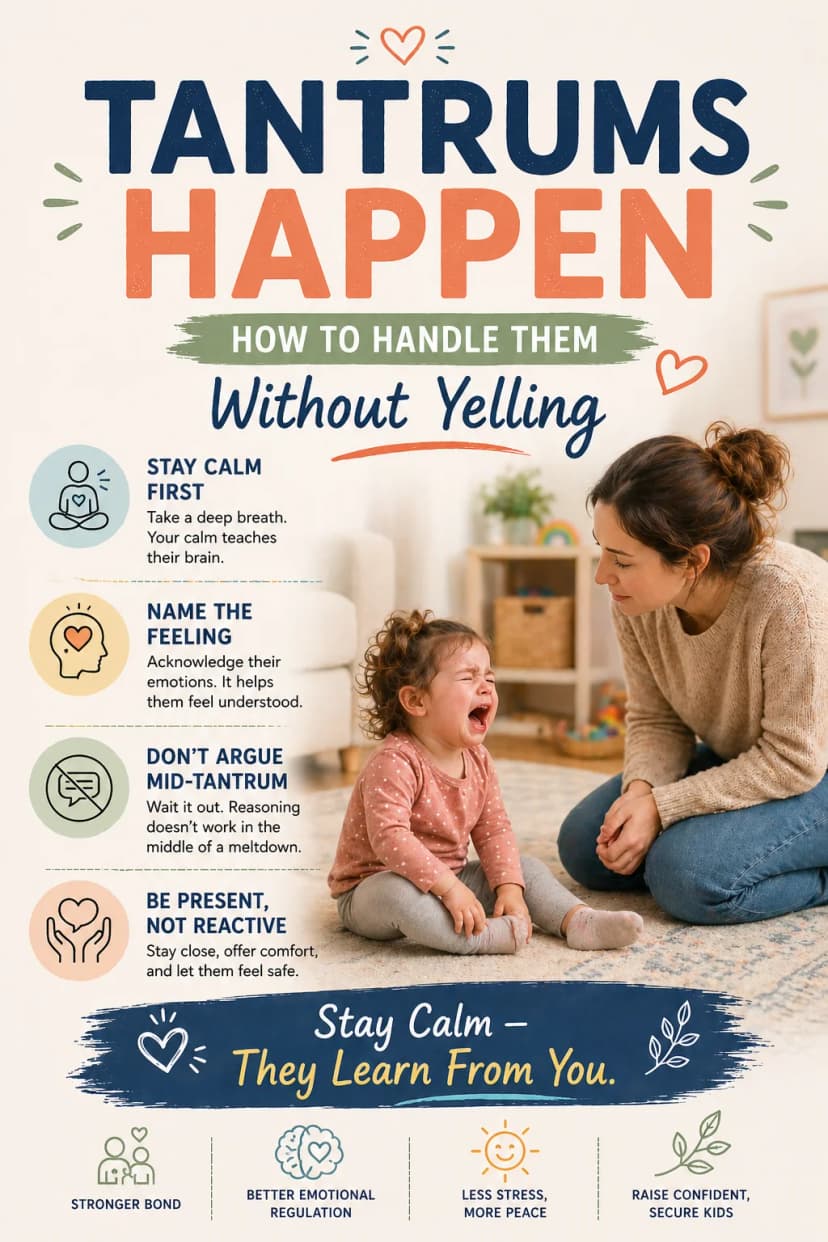
How to Handle Tantrums Without Yelling
How to Handle Tantrums Without Yelling: A Calm Parent's Guide
You are in the middle of a supermarket. Your child wants the biscuits. You say no. And then, before you have even finished the word, the floor is their stage and every nearby stranger is their audience. The screaming starts. The kicking starts. And somewhere deep inside your chest, a familiar heat starts rising too.
If you have been there, you are not alone. Tantrums are one of the most universally challenging parts of raising young children, and the instinct to raise your voice back is not a sign that you are failing. It is a sign that you are human. But what most parents come to discover, often through exhausted trial and error, is that yelling does not actually help. It feels like it should. It does not.
This guide is for parents who want to get through tantrums without the shouting, the shame, or the fallout that follows. Not because staying calm is easy, but because it genuinely works better for your child and for you.
Why Tantrums Happen (And Why They Are Actually Normal)
Before you can respond to a tantrum well, it helps to understand what is actually happening in your child's brain when one hits. Young children, particularly those between the ages of one and four, are not throwing tantrums to manipulate you or ruin your afternoon. They are experiencing a very real neurological event.
The prefrontal cortex, the part of the brain responsible for emotional regulation, rational thinking, and impulse control, is not fully developed until a person's mid-twenties. Toddlers and young children are essentially running on the emotional, reactive part of their brain most of the time. When they feel overwhelmed, frustrated, hungry, tired, or overstimulated, they simply do not yet have the wiring to manage those feelings internally.
What comes out instead is a tantrum. It is not defiance. It is a nervous system that has been pushed past its capacity. Understanding this does not make the moment easier in the heat of it, but it does make it less personal. Your child is not attacking you. They are drowning in their own big feelings and have no idea how to swim.
Why Yelling Makes It Worse
Raising your voice during a tantrum triggers your child's threat response. Their already-flooded nervous system receives the message that they are in danger, and the emotional escalation intensifies rather than subsides. You may get a brief moment of shocked silence, but what follows is usually louder, longer, and harder to come back from.
There is also the question of what you are modelling. Children learn how to handle overwhelming emotions primarily by watching the adults around them. When you stay regulated during their dysregulation, you are not being passive. You are actively teaching them, in real time, that strong feelings can be survived without chaos.
That said, nobody expects perfection. If you yell sometimes, you are a normal parent, not a bad one. The goal is not to never lose your temper. The goal is to have more tools available so yelling becomes the exception rather than the routine.
What Actually Works: Six Strategies That Help
- Regulate Yourself First
This sounds impossible in the moment, but it is the foundation of everything else. Before you say a word or make a move, take one slow breath out. Not in, out. A long exhale activates your parasympathetic nervous system and begins to bring your own stress response down. Even three seconds of deliberate breathing makes a measurable difference to how you respond next.
If you are dysregulated, you cannot co-regulate your child. The calm has to start with you.
- Lower Yourself Physically
Getting down to your child's eye level communicates safety rather than threat. Standing over a screaming child, particularly with a tense posture, reads as confrontational to their nervous system. Crouching down, keeping your face as neutral and soft as you can manage, sends the opposite signal. You are not here to fight them. You are here.
- Name the Feeling Without Negotiating
During a full meltdown, your child cannot process logic or reason. Their brain is not in a state to hear explanations, consequences, or compromises. What they can sometimes receive is a simple acknowledgement of what they are feeling.
Something like: \"You are really upset right now. You wanted those biscuits and I said no, and that feels awful.\" You are not agreeing with their behaviour. You are not changing your answer. You are simply reflecting the feeling back, which helps a flooded brain begin to calm.
Save the explaining, the teaching, and the boundary-reinforcing for after the storm has passed. Mid-tantrum is not a teachable moment. It is a survival moment.
- Give the Tantrum Space to Run Its Course
One of the most counterintuitive things about tantrums is that trying too hard to stop them can prolong them. If your child is safe, sometimes the most effective thing you can do is simply stay nearby and let them feel what they feel without intervening. Sit quietly. Be a calm presence. Let them know you are there without making demands of them.
Tantrums, even intense ones, typically peak and begin to wind down within a few minutes once the child realises the emotional escalation is not achieving anything and that you are still there, steady and present.
- Offer Connection, Not Correction
Once you can see the peak beginning to pass, a hug or a gentle touch can do more than any words. Many children, once the worst of it is over, are flooded with a different feeling: shame, exhaustion, or the need for reassurance that they are still loved even after that display. Meeting that need with warmth rather than a lecture speeds recovery for both of you.
\"I've got you. That was hard, wasn't it.\" That is enough for now.
- Debrief When Everyone Is Calm
Later, when the moment has fully passed and both of you are settled, is when you can have a brief, age-appropriate conversation about what happened. Not a lecture, not a punishment review, just a simple check-in. \"Earlier you got really upset when I said no to the biscuits. What do you think we could do differently next time?\" Even young children benefit from this kind of gentle reflection, and it builds the emotional vocabulary they will eventually use to manage these feelings on their own.
After the Storm: Taking Care of Yourself Too
Tantrums are not just exhausting for children. They are exhausting for parents. The sustained effort of staying calm when every instinct is telling you to escalate takes real energy, and it is completely normal to feel depleted, frustrated, or even tearful afterwards.
Give yourself the same grace you gave your child. You did not have to be perfect. You just had to get through it without making it worse. If you managed that, even partially, that counts as a win.
And if you did lose your cool today, the repair is simple. A genuine, brief apology to your child, \"I raised my voice and I shouldn't have. I'm sorry,\" models something equally important: that making a mistake does not mean the relationship is broken, and that we can always come back to each other.
Frequently Asked Questions
At what age do tantrums usually stop?
Most children experience peak tantrum frequency between the ages of one and three, with intensity often peaking around age two. By four or five, many children have developed enough language and emotional awareness to express frustration more verbally. That said, every child develops at their own pace, and occasional tantrums in older children are also completely normal, particularly during times of stress or change.
Should I ignore a tantrum or respond to it?
Complete ignoring is generally not recommended, as it can leave a child feeling abandoned at an already overwhelming moment. A better approach is to stay present without giving the tantrum extra attention or trying to reason through it. Being nearby and calm, without escalating or negotiating, is usually the most effective position.
Is it okay to give in during a tantrum to make it stop?
Giving in occasionally is not the end of the world, but it does teach children that tantrums are an effective strategy for getting what they want. Where you can, hold your original boundary, while staying warm and regulated. Over time, a consistent response of \"I hear you, and the answer is still no\" paired with genuine emotional attunement tends to reduce frequency more effectively than giving in.
The Bottom Line
Handling tantrums without yelling is less about being a naturally calm person and more about having a plan before the moment hits. Know what you will do with your breath, your body, and your voice. Know that the goal is not to stop the feeling but to be a safe container for it until it passes. And know that every time you manage to stay regulated when your child cannot, you are building something in them that will last far longer than the tantrum itself.
It is not easy. But it is worth it. And you are already doing better than you think.