The Alderton Manuscript
The composer's name was Miriam Alderton.
She had been born in Whitmore in 1889 and had died in 1943. She had studied music in London and then in Vienna, which was unusual for a woman of her generation, and had spent most of her adult life composing and teaching. She had published a small number of works during her lifetime, mostly songs and chamber pieces, which had been moderately performed and then largely forgotten in the way of most music by women composers of her era.
What had not been published or performed, as far as anyone knew, was her final and largest work: a piece for string orchestra that she had apparently been composing in the last years of her life and which she had described, in a letter from 1941, as the work she had been moving toward for thirty years.
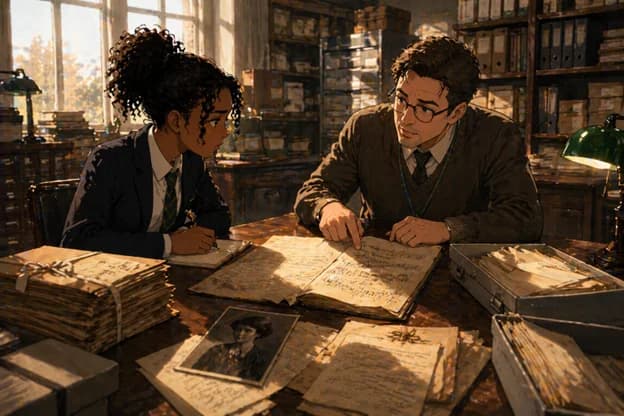
"She died before completing it," Mr Yeboah said. "In 1943. Her papers went to a family member, her sister's son, who held them for several decades and then donated them to the local archive in the 1980s. The archive catalogued what they received. The catalogue listed the Alderton manuscript as: Partial score, string orchestra. Incomplete. 47 pages. "
"Forty-seven pages of an unfinished piece," Nina said.
"Yes. I found out about it four years ago, when I was researching local musical history. I went to the archive and asked to see the manuscript." He paused. "The archive could not find it."
Nina looked at him. "What do you mean?"
"The catalogue listed it. The record said it had been received in the 1980s. But when the archivist looked for the physical document, it was not in the location it should have been. It was not in any adjacent location. The file that should have held it held other Alderton papers, letters and programmes and the published scores, but not the manuscript itself."
"It was missing," Nina said.
"According to the archive, yes," Mr Yeboah said. "They suggested it might have been misfiled, that it might turn up, that these things happened with large collections. I followed up twice in subsequent years. It had not turned up."
Nina looked at the two notes on his desk. "And now someone is leaving fragments of it under my practice room door."
"That appears to be what is happening," Mr Yeboah said.
"Why me specifically?"
He looked at her steadily. "I don't know. Do you have any connection to Miriam Alderton? Any family connection to the name, or to the donation of her papers?"
Nina thought about it. Her family were from Nigeria originally. She had no connection to Whitmore before her parents had moved here eight years ago. The name Alderton meant nothing to her.
"No," she said.
"Then either someone has chosen you for another reason," Mr Yeboah said, "or someone knows something about you that we don't."
She went to the archive on Saturday.
The county archive was becoming, she thought, a place she should probably get a regular visitor's card for. The archivist on duty was Mr Davies, who she had not met before but who had the immediate helpfulness of someone who found researchers of any age equally interesting.
She asked about the Alderton papers and the missing manuscript.
He pulled up the catalogue record on his screen and looked at it with the slightly pained expression of something that had been a source of professional embarrassment for a number of years.
"The manuscript was received in 1985," he said. "Logged by a previous archivist, a man named Mr Hobbs who retired in 1992. It was allocated a reference number and a location in the collection. At some point between 1985 and when it was first requested in 2019, it disappeared from that location."
"Could it have been borrowed?" Nina asked.
"Archival materials are signed out," he said. "The sign-out record for that reference number shows no borrowings."
"Could someone have taken it without signing out?"
He looked uncomfortable. "The archive's security has improved significantly since the 1980s,"
he said. "In that era, access to the stacks was less controlled. It is theoretically possible that someone removed the manuscript informally."
"Who had access in the 1980s?"
"Researchers, by application. Staff. Volunteers who helped with cataloguing." He paused. "It was a less formal time."
Nina wrote this down. "Is there any record of who requested access to the Alderton papers in that period?"
He checked. The records were incomplete for that era, he said, but he found one relevant entry: a request to access the Alderton papers in 1987, two years after the donation, made by a researcher whose name was recorded as Dr P. Voss, affiliation listed as the Whitmore Conservatoire.
"The Conservatoire closed in 1995," Mr Davies said. "I don't know what happened to their records."
"Is Dr Voss's first name recorded anywhere?"
He checked again. "P. Voss. No first name in the record." He paused. "The Conservatoire might have employment records held somewhere. The local music society perhaps, they absorbed some of the Conservatoire's functions."
Nina wrote down everything and thanked him.
She was on her way out when Mr Davies called after her: "Miss Okafor. One more thing." She turned. "The other Alderton papers that are here, the letters and programmes, the published scores. Someone else requested access to those last month. A student from your school, I believe, judging by the uniform." He checked his records. "The name given was A. Prentiss."
Nina did not recognise the name. But she wrote it down.