

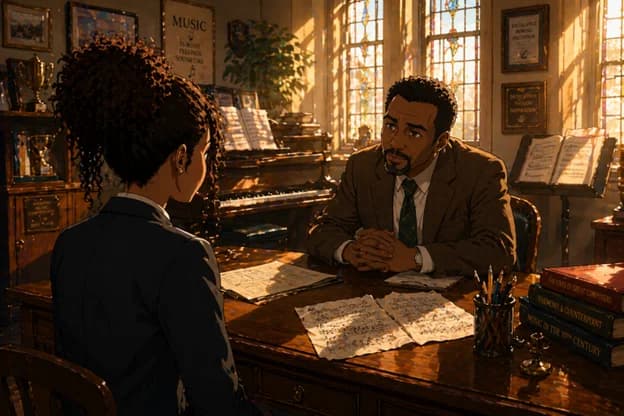
The Music Room After Hours
The note had been slipped under the practice room door sometime between Tuesday afternoon and Wednesday morning, which narrowed it down to an overnight window of approximately sixteen hours and precisely zero witnesses.
Nina Okafor found it at seven forty-five on Wednesday, arriving early for her before-school practice session as she did every Wednesday and Friday. She played violin to a standard that required serious practice time, which meant getting to school before most other people, which meant she was familiar with the particular quality of the building in the early morning: the specific silence of a large institution not yet awake, the light coming in at low angles through the east-facing windows of the music corridor, the smell of floor polish that you never noticed once the day got going.
The note was on plain paper, folded once. She picked it up and unfolded it.
It contained two lines of music notation, handwritten in pencil. No clef, no time signature, no key signature. Just two lines of notes, careful and precise, written by someone who knew how to write music by hand. Below the notes, also in pencil: Do you know what this is?
No name. Nothing else.
Nina looked at the two lines of music for a while. She was good enough to hear music from notation without playing it, to construct the sound in her head from the written symbols. She did this now, reading through the two lines slowly.
It was a melody. Short, incomplete, ending mid-phrase in a way that felt unfinished rather than concluded. It was also, she thought, distinctly unusual. The intervals were odd, not wrong exactly but unexpected, the kind of harmonic choices that took a moment to resolve in her inner ear.
She did not recognise it.
She set the note on the music stand, opened her violin case, and played the two lines.
The sound in the small practice room was immediate and clear. She played it twice, then a third time, listening carefully. Beautiful, she thought. Strange and beautiful. The unusual intervals resolved into something that sounded right once you heard it, the way optical illusions snapped into place once you found the angle.
She did not know whose music it was.
She took a photograph of the note on her phone, put it in her bag, and began her practice.
She spent most of it thinking about the two lines of melody and who had put them under her door and why.
She told her friend Oscar at morning break.
Oscar was fourteen, like Nina, and played piano at a level that had recently crossed the line from talented amateur to something that required a different word. He also had a comprehensive memory for music he had heard, which Nina valued now.
She showed him the note. He looked at it carefully, then said: "Play it."
She didn't have her violin. She hummed it instead, accurately, because she had been hearing it in her head all morning.
Oscar listened with the focused internal expression of someone searching a large and well-organised catalogue. Then he said: "I don't know it. But I know the style."
"What style?"
"Late Romantic. British, I think, rather than European. The harmonic language is specifically that combination of late nineteenth century Romanticism with something more folk-influenced.
There are composers who wrote in that idiom." He thought for a moment. "It's not Elgar. Not Delius. Someone less well-known." He handed the note back. "Where did it come from?"
"Someone put it under the practice room door," Nina said. "No name. Just the music and a question."
"Someone who wanted to know if you recognised it," Oscar said.
"Or wanted to know if I was worth telling something to," Nina said.
Oscar looked at her. "Those are different things."
"Yes," Nina said. "I think it's the second one."
"Why?"
"Because they wrote it in pencil," she said. "Not printed. Handwritten. That's a choice. And they chose a specific practice room. Mine. The one I use every Wednesday morning." She paused.
"They knew my routine."
"Someone at school," Oscar said.
"Or someone who has been paying attention to school," Nina said.
She went back to the practice room at lunchtime and found a second note.
Same paper, same handwriting. This time a single line of music, longer than the first, and below it: This is the second theme. The first note I left was the opening. They belong together.
And below that, for the first time, a name: Ask Mr Yeboah about the Alderton manuscript.
Nina read this twice. Then she photographed it and went to find Mr Yeboah.
Mr Yeboah was the school's head of music, a compact and energetic man in his forties who wore the expression of someone perpetually interested in what was about to happen. He had been at the school for six years and was the reason Nina's playing had improved as significantly as it had: he had the rare quality of a teacher who knew exactly how to push a student without pushing them over.
She showed him the two notes. He read them carefully. His expression changed.
"Where did you find these?" he asked, in a tone that was careful in a way his tone was not usually careful.
"Under the practice room door," she said. "Wednesday morning and lunch today."
He looked at the music on both notes. He looked for a long time without speaking.
"Do you know what it is?" she asked.
He set the notes down on his desk. He sat back in his chair and looked at the ceiling for a moment, which was something Nina had never seen him do before, and she had spent a lot of time in this room.
"The Alderton manuscript," he said. "Yes. I know what it is."
"What is it?"
He looked at her steadily. "How much do you want to know?"
"Everything," she said immediately.
He almost smiled. "Sit down," he said. "This will take a while."