

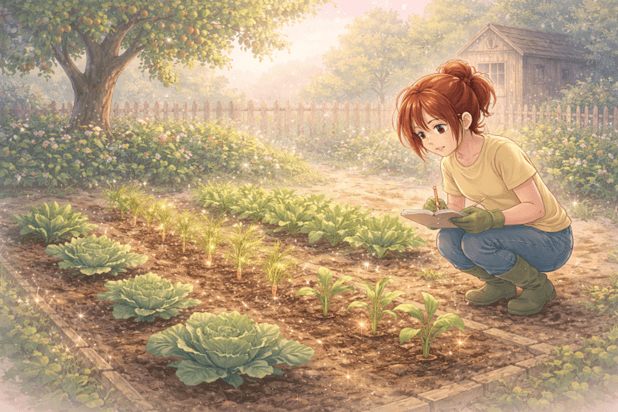
What Seeds Remember
The ground was heavy and wet. She had brought a fork from her house the next day, not wishing to disrupt Mr Albright's shed too much yet, and plunged it into the earth.
The soil was dark, nearly black, and friable in a way that spoke of decades of manure and compost. Pip turned a square foot of it over. The dark earth fell apart slightly, but there was a resistance in it, a texture that felt entirely unlike the soil in her own small back garden, which was yellow-grey and stubborn.
As she turned the fork head, checking the composition of the earth, she felt a slight *cling* against the tines.
She bent down to pull what was probably a stone out of the turned earth. It was hard to see against the dark background. She brushed the dirt away with her gloved thumb.
It was not a stone. It was a clay pipe bowl, the stem broken off centuries ago.
She washed it under the small standpipe near the shed. It was a small bowl shape, stamped with a maker's mark she could not read, slightly porous, smelling faintly and anciently of earth and fire.
Pip put it in her notebook. She thought: *This soil has people in it.*
She went back to digging, turning over a large patch near the centre of the plot that she was marking for broad beans.
Three days later, she found a half-penny coin dating from 1892, a piece of blue-and-white willow pattern china that felt inexplicably heavy, and a thimble.
She began to think of the ground not as dirt to grow things in, but as a surface that was storing time. This was what allotment ground was, she reasoned. You added compost and manure, which decayed into earth. You added your work, your muscle memory, the objects you brought with you. In doing so, the ground absorbed the history of the people working it, year after year, layer upon layer. You did not own it so much as add yourself to its memory.
She took the packet marked: *Broad bean. Good keeper. From the Alderton plot, before it was built over.*
She laid out six broad bean seeds in a neat row. They were wrinkled, pale buff colour. The handwriting was old; she estimated maybe forty years since Alderton's plot was built over, wherever that had been. She wondered if seeds retained memory too.
The next week, she planted *Calendula, from Mrs Hooper's garden, 1987*, and *Sweet peas, original stock from the rectory garden, 1962. Third generation*. She watered the soil and watched the dark surface soak up the moisture.
Pip wrote in her notebook: *Planted broad beans, calendula, sweet peas. The seeds are older than I am. They have slept in the tin longer than I have been alive. They remember conditions that haven't existed for decades.*
The broad beans broke the surface ten days later.
They pushed up strong, pale green shoots, resilient and uncompromising. Pip watched them with satisfaction. The next row of beans, commercial stock she had bought just in case the old seeds failed, had barely broken the soil.
The *Alderton* beans grew aggressively, their leaves broad and distinct. They seemed different from normal beans—their structure a bit bushier, less determined to climb immediately, content to spread out, solid and heavy and thick-stemmed.
In mid-July, strange things began to appear in the soil near the beans.
Not objects this time, but things she didn't recognise as soil. When she went down to hoe the row, she found tiny fragments of what looked like crushed sea shells mixed into the earth, reflecting the sun. She found fragments of charcoal at the exact depth the roots were growing. The soil felt... different. Looser, somehow, despite her not adding anything to it for weeks.
She pulled a weed from near the tallest bean plant.
The root of the weed brought up a clump of earth that distinctly smelled of coal smoke.
Pip sat back on her heels.
She smelled the soil again. It was a sharp, slightly sulfurous smell of domestic coal fires—the kind of smell that hadn't been common in the town since the Clean Air Act forty years ago.
She looked at the broad bean plant. It was thick and lush and aggressively green.
She thought: *The seeds aren't just remembering how to grow. They're making the soil remember the garden they came from.*