
The Seed Tin and the Strange Soil
The allotment had belonged to their neighbour Mr Albright for thirty-one years before he passed away in the spring, and it sat at the end of Rowan Street behind a low wooden fence that had been repaired so many times it was now approximately forty percent original wood and sixty percent patches, like a ship of Theseus made of fence planks.
Pip Calloway was thirteen and had known Mr Albright her whole life, in the way you knew people who existed at the edges of your daily experience: the wave over the fence, the occasional gift of vegetables too large and numerous to use, the specific smell of pipe tobacco that meant he was in his garden. She had liked him without knowing him deeply, which was a kind of liking that felt, after he was gone, both sufficient and insufficient at the same time.
He had left the allotment to her in his will.
Not to her parents, not to the family. To Pip specifically, by name, with a note attached that her parents had shown her with the expressions of people who were trying to be supportive while also being quite confused.
The note said: For Pip, who always wanted to know what things were. The allotment needs someone who asks questions. The tools are in the shed. The seed tin is on the third shelf. Start with the seed tin.
Her parents had offered to help clear the plot and decide what to do with it. Pip had said she wanted to try it herself first, which was not something she had expected to say but felt immediately correct once she had said it.
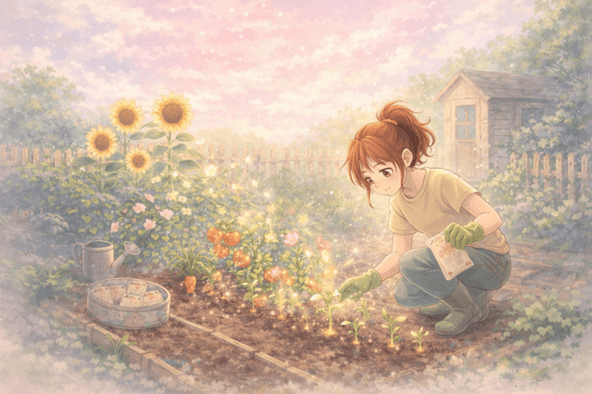
She went on the first Saturday of June, by herself, with a pair of gardening gloves her mum pressed on her and a notebook she had brought on her own initiative.
The allotment was a long rectangular plot, roughly twenty metres by eight, with a small wooden shed at the far end. It had been well-tended until recently: the beds were defined by low wooden boards, the paths between them were clear, and although things had been allowed to grow somewhat since spring, the underlying structure of the garden was evident and orderly. Mr Albright had grown vegetables primarily, with a strip along the south-facing fence dedicated to flowers that attracted pollinators. There was a pear tree in the far corner that was ancient and enormous and had clearly been there long before the allotment.
Pip went to the shed.
It was small inside, smelling of earth and wood and the ghost of pipe tobacco. Tools hung on the walls in a neat arrangement, each one on its own hook with a small label below in Mr Albright's handwriting. On the shelving unit along the back wall, the third shelf contained three items: a bag of general purpose compost, a ball of garden twine, and a tin.
The tin was old, a biscuit tin with a faded pattern of roses on the lid. She opened it.
It was full of seed packets. Dozens of them, in several layers, each one a small envelope of paper or card, most handmade rather than shop-bought, folded and sealed and labelled in ink. Some of the labels were in Mr Albright's handwriting. Others were in different hands, older-looking, some of the ink faded to near-illegibility.
She took out the first packet. It was labelled, in Mr Albright's hand: Calendula, from Mrs Hooper's garden, 1987.
The next: Sweet peas, original stock from the rectory garden, 1962. Third generation.
The next, in a different hand altogether, older ink, slightly water-stained: Broad bean. Good keeper. From the Alderton plot, before it was built over.
She picked up another, older still, the paper of the envelope slightly brittle: Runner bean, climbing. Thomas's strain. Do not lose.
The handwriting on this one was the oldest she could see, careful and upright, the letters formed differently from modern handwriting.
She sat on the floor of the shed with the tin in her lap and went through every packet. There were forty-seven of them. They spanned, she estimated from the handwriting styles and paper ages, somewhere between thirty years and perhaps a hundred and fifty. Each one was labelled with the plant type and an origin, a place or a person the seed had come from.
She thought: this is not just a seed tin. This is a collection. An inheritance.
She wrote in her notebook: Seed tin. 47 packets. Multiple generations of handwriting. Seeds saved from specific gardens, specific people, specific places, some of which no longer exist. Mr Albright saved these seeds. But he didn't start the collection.
She looked at the tin for a long time.
Then she went outside and started pulling weeds, because the plot was not going to tend itself and she thought better when her hands were busy.