
The Town Hall and the Stopped Watch
The Whitmore Antiques Fair was exactly as Mara had expected: a large hall full of tables covered in objects from other people's histories, and a collection of adults moving between them with the focused expressions of people searching for something specific. It smelled of old paper and polish and the particular mustiness of things that had been stored for a long time.
Her mum moved immediately toward the jewellery stalls. Mara and Jonah exchanged a look and drifted in a different direction.
The Town Hall was beautiful, Mara thought. Old, Victorian, with high ceilings and tall windows that let the November light fall in long pale columns across the floor. The main hall was where the fair was set up, but there were other rooms visible through open doors: a smaller meeting room, an office with dark wood panelling, a corridor leading toward the back of the building.
"That's a corridor," Jonah said quietly, nodding toward it.
"I can see that," Mara said.
It wasn't the corridor from her dream. The one in her dream had been narrower, with a different floor, darker. She studied the visible part of the building, looking for architectural features that matched. The main hall was wrong. The meeting room was wrong. The corridor was possibly right but she couldn't see far enough down it.
She checked her phone: 10:17 AM. Just under six hours until 4:04 PM.
She put her phone away and looked around the hall.
And then she saw the table.
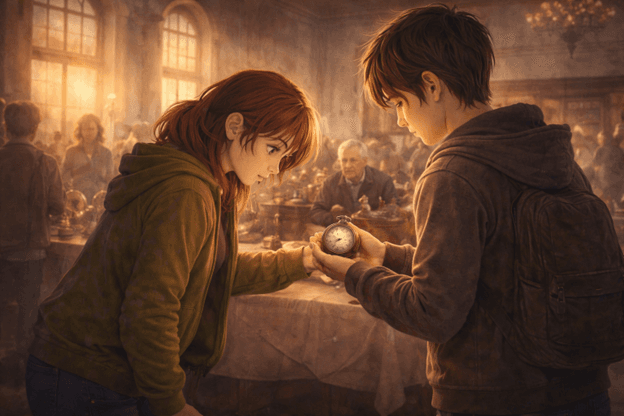
It was in the far corner, smaller than most, covered in a plain white cloth. The man behind it was elderly, with white hair and the air of someone who was not particularly trying to sell anything. The objects on his table were all clocks and watches: pocket watches, wristwatches, table clocks, a long brass carriage clock with ornate handles. Every one of them was stopped.
Mara walked over. Jonah followed.
"These are all stopped," she said, not as an accusation, just as an observation.
The man looked up. His eyes were sharp, dark brown, interested. "Yes," he said.
"Is that intentional?"
"Quite intentional." He looked at her steadily. "Are you interested in clocks, or in stopped clocks specifically?"
"The second one," Mara said, feeling her way through the conversation carefully. "Actually, I recently came into possession of a clock that stops at the same time every time I wind it."
The man was quiet for a moment. He looked at Jonah and then back at Mara. "What time does it stop at?"
"Four minutes past four," she said. And then, because it felt relevant: "It was sent to me by a woman named Edith Calloway."
The man's expression changed. Not dramatically, but definitively, the way a person's face changed when they heard a name they hadn't expected and hadn't heard in a long time. He sat back in his chair and folded his hands.
"You'd better sit down," he said, and produced two folding chairs from behind his table with the preparedness of someone who had been expecting visitors.
His name was Arthur Whitby, and he had known Edith Calloway for thirty years, he said. She had visited his shop every year, and every year they had discussed the clocks, and the clockmaker's mark, and the question of what exactly the clocks were and what they did.
"She sent you the mantelpiece clock," he said. He wasn't asking.
"Yes."
"Did she say what it showed?"
"She said it told the truth," Mara said. "And she said to pay attention to what it showed and not to dismiss it as impossible."
Arthur nodded slowly. "Did she say anything else?"
Mara hesitated. "She said my great-grandmother told her I was the one who asked the right questions."
Arthur looked at her for a long moment. Then he reached under the table and brought out a box. Wooden, dark, with brass hinges. Not identical to hers but clearly from the same hand, the same maker.
"Every clock with that mark does something different," he said. "They all stop. But they don't all stop at the same time, and they don't all tell the same kind of truth. Mine," he opened the box to reveal a small brass pocket watch, "shows me what the weather will be in three days' time. Without fail. I've kept records for twelve years." He closed the box. "Edith's showed her when people were lying to her. The hands would spin when someone said something untrue in her presence. She found it extremely useful as a teacher." He paused. "Yours stops at four minutes past four."
"Every time," Mara confirmed.
"And you're here, today, at an antiques fair in a building you've presumably not visited before." He said this without surprise.
"I had a dream," Mara said, feeling slightly self-conscious about it.
Arthur did not smile in a dismissive way. He nodded. "The clocks communicate in different ways," he said. "Edith's communicated through the hands. Mine communicates through a sound, a specific tick pattern, every morning, which I have learned to interpret as weather conditions. Yours, it seems, communicates through the stopping and possibly through other means as well." He paused. "It stopped at four minutes past four. Today is the fourth day since you received it."
Mara looked at Jonah. Jonah's expression said: I told you.
"So today, at four minutes past four," Mara said slowly.
"I should think so," Arthur said. "What happens, specifically, I couldn't say. That's not how they work. They don't give instructions. They draw attention. They say: look here. At this time. In this place. What you do with what you see is entirely up to you."