
Four Minutes Past Four
They had most of the day.
Mara's mum was happy to stay at the fair for hours. Mara and Jonah explored the Town Hall systematically, which they did by being politely interested in everything and asking questions of everyone, a strategy that Jonah said was simply good practice and Mara said was essentially eavesdropping with extra steps.
They found the corridor.
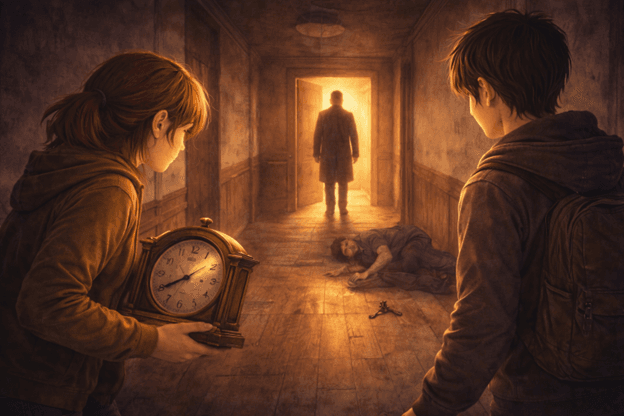
It was on the first floor, reached by a staircase at the back of the building that wound upward in a tight spiral. The corridor was exactly as in her dream: narrow, with a darker floor, older than the main hall, the wallpaper a faded geometric pattern in green and cream. It ran along the back of the building and ended at a door that was, currently, closed.
There were four doors along the corridor. One was a storage cupboard, one was a small bathroom, and two were offices, both locked and both with signs indicating they were used by the Town Hall administration.
The door at the end had no sign.
"That's the door," Mara said.
"From your dream?"
"Yes."
In her dream it had been standing open. Now it was closed. She tried the handle. Locked.
"Right," Jonah said. "So we need a reason to be up here and a reason to be through that door at four minutes past four."
"We also need to not be trespassing," Mara said.
"Those goals may or may not be compatible," Jonah said thoughtfully.
They went back downstairs and Mara approached the woman on the information desk, who turned out to be named Glenys and who was, Mara quickly established, extremely proud of the building's history and very willing to discuss it.
The room at the end of the first-floor corridor, Glenys explained with considerable enthusiasm, was the original council chamber, predating the main hall. It had been built in 1847 and had been used for meetings until a larger chamber was constructed in 1923. Since then it had been used for storage, and more recently it had been empty. The Town Council had been discussing what to do with it for several years. There had been a proposal to convert it into a heritage room, displaying documents and objects from the building's history.
"The problem," Glenys said, leaning forward slightly, "is that there's a dispute about some of the objects. A family has come forward claiming that several items that were donated to the council in 1978 were not the donating family's to give. They say the items belonged to a relative who didn't consent to the donation."
"What kind of items?" Mara asked.
"Documents, mostly. Some personal effects. The family member whose items they are said to be has a granddaughter who's been trying to get them back for years." Glenys shook her head. "But the council is very slow about these things."
"Who is the family?" Mara asked, keeping her voice casual.
Glenys thought about it. "Adeyemi, I believe. Or something similar. African name, I think."
Mara went very still.
Jonah looked at her sharply.
"Adeyemi," Mara said. "Is the granddaughter's name by any chance connected to Adaeze Okonkwo? Who was also known as Adaeze Adeyemi before she married?"
Glenys blinked. "I honestly don't know the details. You'd have to speak to the archivist. She's here today, actually, setting up the heritage display in the main hall. Older woman, dark red scarf."
Mara was already turning away. Jonah caught up with her in three steps.
"Your great-grandmother," he said quietly.
"Adaeze Adeyemi Okonkwo," Mara said. "That's her full name. My mum's mentioned it. I didn't put it together." She stopped walking. "Edith Calloway knew her. They were friends for thirty years. Edith sent me the clock because she knew I was her great-granddaughter." She looked at Jonah. "The clock didn't just bring me here at random. It brought me here because there's something here that belongs to my family."
Jonah absorbed this carefully. "And the clock knew that."
"The clock drew attention," Mara said, echoing Arthur's words. "It said: look here. At this time. In this place."
They found the archivist in ten minutes.
Her name was Dr Farida Hussain, and she had been trying to resolve the Adeyemi-Okonkwo document dispute for three years. When Mara introduced herself, Dr Hussain went very still for a moment and then said, with great composure, "I think we need to go upstairs."
She had a key to the room at the end of the corridor.
It was larger inside than the corridor suggested. A proper council chamber, with a long table and chairs covered in dust sheets, and tall windows that looked out over the town's rooftops. Along the far wall were shelves, and on the shelves were boxes, each one labelled in faded handwriting.
Dr Hussain led them to the third shelf. She pulled out a box with a label that read Adeyemi donation 1978 and set it on the table.
Inside were documents. Letters, certificates, a small leather diary, several photographs. The photographs were the ones that made Mara's breath catch: a woman in perhaps her forties, strong-faced, beautifully dressed, looking directly at the camera with an expression of complete composure. On the back of the first photograph, in the same cramped handwriting as Edith Calloway's note: Adaeze, Whitmore, 1963.
Her great-grandmother. Whom she had never met because she had died when Mara was two years old. Whom she knew only from other people's descriptions.
Mara picked up the photograph carefully.
"The documents were donated without permission by Adaeze's brother-in-law after she died," Dr Hussain said quietly. "Her daughter, your grandmother, contested it but was told at the time that the donation had been correctly processed and nothing could be done. The council has since acknowledged the donation was irregular, but the formal process to return the items has been stalled for three years in legal red tape."
She checked her watch.
It was four minutes past four.
"I have been trying to find a direct descendant who could sign a formal claim form," Dr Hussain continued, pulling a folder from her bag, "because without that signature, the legal process cannot begin. Your grandmother passed away two years ago, I'm told. But a grandchild of Adaeze would qualify." She placed the form on the table and looked at Mara. "If you're willing."
Mara put down the photograph. She looked at the box, at the documents, at the face of her great-grandmother looking back at her from 1963 with that expression of complete composure.
She picked up the pen.