
The Blacksmith's Apprentice
The master blacksmith had one rule above all others: do not touch the sword commission.
Tom had been apprentice to Master Aldric for eleven months and had learned the rule the hard way, on his third day, when he had reached out to feel the edge of a half-finished blade and had earned a sharp knock on the knuckles and a lecture that lasted nearly as long as the working day. The sword was for Lord Havelock of the northern keep. It had been ordered eight months ago. It was due at the autumn tournament in four days. And it was the most important piece of work Master Aldric had ever undertaken.
It was the year 1247, late September, and the forge smelled of coal smoke and hot iron the way it always did, and the sword lay on the workbench under a cloth as though it were sleeping.
Tom was twelve years old, the son of a wool merchant who had apprenticed him to the forge because Tom had shown, from the age of six, a fascination with how things were made and a particular affinity for fire that his mother called worrying and his father called useful. He had calluses on both hands now, and could work the bellows for three hours without stopping, and knew the difference between iron and steel by the weight and the ring when you struck it.
What he could not do, as yet, was finish the sword.
He had learned about steel from Master Aldric's explanations rather than a book, because Tom could not yet read well, and the explanations had been given between hammer blows and during the long slow waits for metal to reach the right temperature. Steel was iron with a precise amount of carbon, Aldric had said. Too little and it was soft. Too much and it was brittle. The right amount and it was hard and flexible both, a thing that seemed contradictory until you held good steel in your hand and understood that the contradiction was exactly the point.
Tom thought about this sometimes while he worked. The contradiction that was exactly the point.
Master Aldric had collapsed on the Tuesday morning, four days before the tournament. Tom had been at the bellows when it happened. He had seen the master stop mid-motion, set down his hammer with unusual care, and sit down on the stool by the anvil. He had not said anything for a moment. Then he had said: fetch the physician. Tom had run.
Not dramatically, not suddenly, but in the slow deliberate way of a man who had been ignoring a fever for a week and had finally run out of the stubbornness required to stay upright. The physician had come, had looked grave, had said complete rest, and Master Aldric had looked at Tom from the bed and said the sword, and Tom had said I will manage it, and Master Aldric had closed his eyes, and Tom had gone back to the forge and stood looking at the sword and understood, for the first time in eleven months, exactly how much he did not know.
* * *
The blade was finished. That much he was certain of. Master Aldric had completed the forging and the rough grinding before the fever had taken hold, and the blade was clean and true and had the particular singing quality that good steel had when you tapped it, a sound like a bell struck once in an empty church.
What remained was the finishing. The fine grinding. The polishing to a brightness that would reflect a face back at you without distortion. The fitting of the guard and the grip, which had been commissioned from a craftsman in the village and sat waiting on the workbench, wrapped in cloth. And finally the edge, ground to a sharpness that could split a hair, which was the test Lord Havelock's man would apply when he came to collect it.
Tom had watched Master Aldric do all of these things on other blades. He had handed tools, maintained fires, fetched water, cleaned stone. He had never done any of it himself.
He stood in the forge doorway for a moment and looked at the village going about its morning. A cart passed with a load of timber. Two women argued cheerfully over a fence. A dog investigated something in the gutter. All of it ordinary, all of it continuing as though nothing particular was happening in the forge today.
He tied his apron, built up the fire to the right heat, and began.
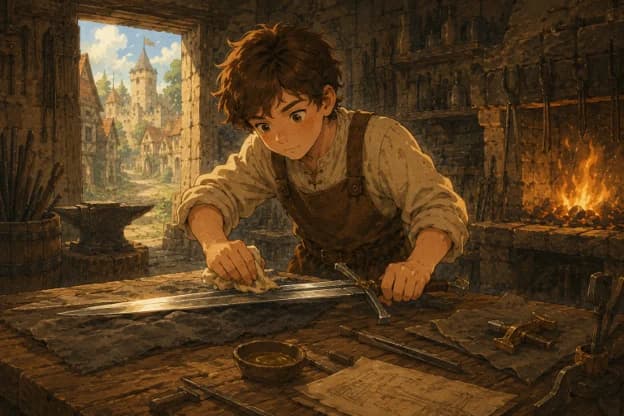
The first two hours were careful and slow. He worked the grinding stone with the blade at the angle Master Aldric had shown him, checking constantly, running his thumb carefully along the flat to feel for unevenness. His arms ached. The stone was heavy and the motion required a consistency he had not known he lacked until he was doing it alone, without the master's eye on him, without the ability to stop and ask.
He stopped twice and looked at what he was doing and corrected his angle. The third time he stopped, his arms were trembling slightly from the sustained effort, and he set the stone down and shook his hands out and rolled his shoulders and breathed for a moment before picking it up again. Master Aldric never seemed to need to stop. Tom stopped when he needed to. He thought that was probably the honest approach.
By midday he had the blade smooth to his satisfaction. He held it to the light from the forge door and turned it slowly. The surface was good. Not perfect, not the liquid mirror finish Master Aldric achieved, but good. Honest work.
He said this to himself, out loud, because the forge was empty and he needed to hear it: honest work.
Then he began the polishing.
* * *
The grip gave him trouble on the second day.
It had been made to Master Aldric's measurements and should have fitted the tang of the blade without difficulty. It did not. There was a looseness at the pommel end, a slight rotation when he twisted it, that felt wrong in the hand and would feel wrong to anyone who held the finished sword. Lord Havelock's man would notice it. He might not say anything. But he would notice.
Tom sat on the workbench staring at the grip for a long time.
He could send to the craftsman and ask for a new one. But there was not time for a new one. He could pad the fitting with something. Leather, perhaps, cut thin and fitted tight. He had seen this done on older work, repaired handles, worn grips rebuilt. It was not the preferred method. But it was a method.
He thought about sending for help. There were other craftsmen in the village, older men who might know what to do. But they were not Master Aldric's apprentice. They had not spent eleven months learning this particular forge, these particular tools, this particular master's way of doing things. Whatever happened with this sword, Tom thought, it should happen here.
He spent the afternoon cutting and fitting thin strips of leather, winding them tight, testing the fit after each layer. The rotation decreased. Then disappeared. He twisted the grip hard and it held. He twisted it again. It held.
He sat back and looked at what he had done and tried to decide whether it was a solution or a compromise. He thought it was both, which was perhaps the most honest answer.
That evening he sat with Master Aldric for a while. The master's fever had broken but he was still weak, still ordered to rest, his large hands folded on the blanket with the particular stillness of hands that were usually working.
"The grip," Tom said. "It did not fit properly. I used leather shims."
Master Aldric was quiet for a moment. "Show me your hands," he said.
Tom held out his hands. Master Aldric looked at them without touching them, at the new calluses, the small cuts and burns that were the ordinary marks of forge work.
"Leather shims," Master Aldric said. "Wound tight?"
"Yes."
"It will hold," Master Aldric said. "I have done the same more than once." He looked at the ceiling. "The blade?"
"Smooth. Not your standard. But honest."
"Honest is enough," Master Aldric said. "Finish the edge tomorrow. Do not rush it."
"I will not," Tom said.
He went back to the forge in the early dark and banked the fire for the night, and stood for a moment in the smell of iron and coal, and felt something he could not entirely name, something that was partly exhaustion and partly something else, something that sat in the chest differently.
* * *
He had also learned that the forge had a rhythm, the same as any craft, and that the rhythm was the hardest thing to teach. Master Aldric moved through his work without hesitation, each action following the previous with the economy of someone who had done the same thing ten thousand times. Tom moved more carefully, checking more often, correcting more frequently. He was slower. But slowness, Master Aldric had said once, was not the enemy. Carelessness was.
On the second evening, after the grip was done, Tom ate his supper alone in the forge cottage and thought about what the sword would be used for. Tournaments were not war, exactly, but they were not entirely unlike it either. Men rode at each other with lances. Swords were drawn in the melee. Things happened quickly and the quality of a weapon could be the difference between a good outcome and a bad one.
He thought about this with a seriousness that surprised him. He had made a thing that was going to be used. That was different from making a thing to be looked at.
The edge took all of the third day.
He woke on the third morning before dawn, which was unusual for him, and lay in his pallet in the forge cottage listening to the village sounds in the dark. A dog somewhere. Wind in the thatch. The distant sound of the mill beginning its day. He thought about the edge and what Master Aldric had said about the angle being in the hand and not the eye, and he lay there rehearsing the motion with his arm on the blanket, the same motion over and over, until the sky began to grey.
Tom had been told about edge work, had watched it done, had understood it in the way you understood something observed but not yet performed. The reality of it was different. The angle had to be precise and consistent along the full length of the blade. Too steep and the edge would be thick and dull. Too shallow and it would be sharp but fragile, likely to chip under use. Master Aldric said the right angle was in the hand, not the eye, which Tom had thought was a mystical statement until he was doing it and found that it was simply true.
The angle, he discovered, was genuinely in the hand. He could not see it. He had to feel it, feel the resistance of the stone against the steel, the way the metal gave or resisted, the difference between sliding across the surface and biting into it correctly. When he had the right angle the work felt different, smoother, more purposeful. When he lost it he could feel that too, a wrongness, a drag.
His first pass was uneven. He could feel it. He checked the blade and saw the variation in the bevel and redid the section, carefully, slowly, matching the angle he had found in the good parts. He did this three times over the course of the morning, correcting and refining.
By afternoon the edge was running true.
He had, during those four days, talked to the sword more than he would admit to anyone. Not full conversations, not instructions or explanations, just the occasional word when something went well or went wrong. Good, when the bevel came out true. Careful, to himself as much as to the blade. Come on, during a difficult section of the edge work that refused to settle.
Master Aldric probably did not do this. Or possibly he did and had simply never mentioned it. Tom decided he would not ask.
He tested it first with a strip of cloth, which parted cleanly. Then with a piece of leather, which divided without dragging. Then, the traditional test, a hair from his own head, held taut between two fingers and drawn slowly across the edge.
It split.
Tom set the blade down on the workbench and stood for a moment with his hands at his sides.
The forge was very quiet. Outside a cart went past on the lane. A crow called from somewhere above the roofline and fell silent. The fire crackled low in the forge and the light through the door was the flat pale light of a September afternoon.
He had done it. Not the way Master Aldric would have done it. Not perfectly. Not with Master Aldric's sureness or his speed or his economy of motion. But the sword was finished and the sword was good and in one more day Lord Havelock's man would come and collect it and Tom would have to stand there and answer for the work without the master beside him.
He held the sword up one last time and looked at it in the forge light, the blade bright, the grip tight under his hand.
It was not Master Aldric's work. It was not as good as Master Aldric's work. But it was his own work, shaped by everything Master Aldric had taught him, but his own. He thought there was a difference and that the difference mattered.
He thought about this. He thought it was probably the most frightening thing he had faced in eleven months of apprenticeship. He thought he was going to do it anyway.
* * *
Lord Havelock's man was called Garrett, a broad, quiet person with the careful eyes of someone whose profession involved the assessment of weapons. He arrived at the forge on the fourth morning, examined the sword without hurry, turned it in the light, sighted down the blade, tried the balance, and finally drew it slowly across the strip of leather he carried for the purpose.
Tom stood very still and said nothing.
Garrett set the sword on the workbench and looked at Tom. "Where is Master Aldric?"
"Ill," Tom said. "Fever. He is recovering. I finished the sword."
Garrett looked at him. He was not unfriendly. He was simply assessing, the way he had assessed the sword, with the same careful attention.
"You are the apprentice," Garrett said.
"Yes."
"How long?"
"Eleven months."
Garrett looked at the sword again. He picked it up and tried the grip, twisted it once, firm, and it held without movement.
"The blade is well finished," Garrett said. "The edge is correct. The balance is good." He set it down. "The grip has been shimmed."
"Yes," Tom said. "It did not fit true. I used leather, wound tight. It will not work loose."
Garrett looked at him for a long moment. Then he nodded, once, the kind of nod that meant something specific in the world of craftspeople and their assessors, the nod that said: this is acceptable, this is honest, this will do.
"Tell Master Aldric," Garrett said, wrapping the sword in its oilcloth, "that Lord Havelock will send word after the tournament."
He left. Tom stood in the forge doorway and watched him go down the lane toward the road, the sword under his arm, until he was out of sight.
Then he went to tell Master Aldric.
The master was sitting up in bed when Tom came in, which was an improvement on the previous days, and he listened without speaking while Tom told him what Garrett had said. When Tom finished, Master Aldric was quiet for a moment.
"Shimmed grip," Master Aldric said. "Correct edge. Well finished." He looked at Tom. "You told him about the shims."
"Yes," Tom said.
"You did not have to," Master Aldric said.
"He would have found it himself," Tom said. "And I would rather he heard it from me."
Master Aldric said nothing for a moment. Then he said: "Go and clean the forge. We have work tomorrow."
He stood in the lane outside the forge for a moment, breathing the cold autumn air. He had not realised how tired he was until this moment. Four days of work he had not known how to do, done anyway. His hands were steady. His back ached. He was twelve years old and had just delivered his first commission.
Tom went. He cleaned the forge with the particular thoroughness he had learned in eleven months, the ashes banked, the tools racked, the stone swept clean. Outside the autumn light was going gold over the village rooftops and somewhere in the distance a church bell was ringing for evening.
He thought about the way Garrett had handled the sword, the economy of his examination, the same quality of unhurried attention that Master Aldric brought to his own assessments. He thought there was a whole world of people who knew how to look at things properly, to see what was genuinely there rather than what they wanted to see or feared to find, and that belonging to that world required more than eleven months of work, but that eleven months was perhaps enough to begin.
He thought that tomorrow he would be an apprentice again. He thought that was exactly right.
He thought he had earned it.
He thought, more quietly, that Master Aldric had known he would. That was perhaps why the master had said I will manage it before Tom had finished saying the words. Not because he had no choice. Because he already knew.
The End