

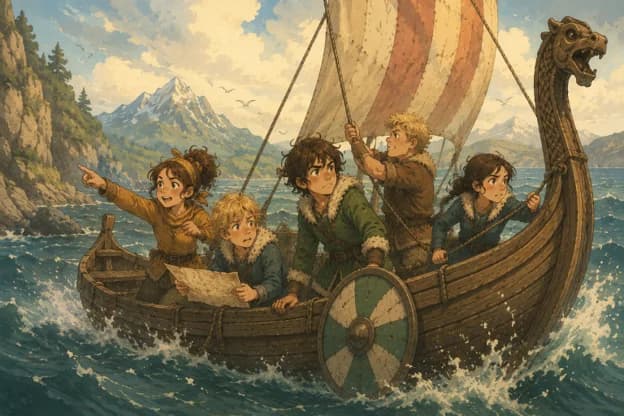
The Worst Crew In The North
The longship was called the Sea Serpent and it had, by general agreement among the experienced sailors of Kjelvik, never been crewed by a group less suited to sailing it.
It was a bright cold morning in the spring of 866, the kind of morning that made everything look possible from the shore, and there were five of them. Leif, who was thirteen and had been on boats exactly twice, both times in a harbour, neither time at sea. Astrid, also thirteen, who had read more sagas than anyone in the village and had strong opinions about everything, including the correct way to sail a longship, which she had never attempted. Bjorn, twelve, who was large for his age and enormously strong and had managed, in the process of loading supplies, to fall into the harbour once and knock over a barrel of salt fish, which had taken forty minutes to retrieve. Magnus, eleven, who had been sick over the side before they even left the harbour mouth, which was either a record or a bad omen depending on who you asked. And Sigrid, eleven also, who was the only one of them who had actually sailed before and who had spent the morning looking at the other four with an expression that suggested she was reconsidering most of her life choices.
The voyage had been Leif's idea. The idea had sounded considerably better on land.
He had proposed it in the longhouse three weeks earlier and his father had looked at him for a long time and then said: if you can find a crew and load the ship yourselves I will not stop you. He had said it in the tone of a man who did not expect this to happen. Leif had taken this as permission.
"We are going to trade goods with the settlement at Haraldsfjord," Leif said, from the steering oar, attempting to sound like a person who knew what he was doing with a steering oar. "It is two days' sail. The wind is good. We will be back before the week is out."
"You are holding the oar wrong," Sigrid said.
"I am holding it fine."
"You are going to tire your arm out in an hour."
"I have strong arms."
"You have average arms," Astrid said, from where she was examining the rigging with the air of someone who had read extensively about rigging and was now finding the reality somewhat different from the descriptions. "Move your grip lower. And stop pulling against the wind, you are fighting it instead of using it."
"I know how to use the wind," Leif said.
"Then why are we going sideways?" Bjorn asked.
They were, in fact, going slightly sideways. Leif adjusted. The ship lurched. Magnus, who had recovered slightly from his earlier illness, made a sound that suggested he had not recovered as much as he thought.
"This," Sigrid said quietly, to nobody in particular, "is going to be a long two days."
* * *
The first hour had established several important facts. One: the sail required constant adjustment and nobody except Sigrid knew instinctively when it needed adjusting. Two: Bjorn, despite falling into the harbour during loading, was the most naturally useful person on the ship once actually underway, because he was strong enough to haul ropes that the others struggled with. Three: Astrid's extensive reading about sailing was largely accurate in theory and mostly useless in practice until she could match the theory to the physical reality, which she was doing faster than anyone else. Four: Magnus's stomach was more settled at sea than in the harbour, which he claimed was because the motion was more regular but which Bjorn said was because there was nobody to watch him be sick.
By midday they had sorted out the basic mechanics of the situation, which was to say Sigrid had taken the steering oar and explained to Leif, with great patience and only occasional exasperation, what she was doing and why, and Leif had listened and watched and asked reasonable questions and was beginning to understand that sailing was considerably more complicated than the sagas suggested.
The sagas, Astrid pointed out, tended to gloss over the parts where you spent three hours working out how to trim the sail correctly.
"The sagas are about great deeds," Leif said. "Not sail trimming."
"Great deeds require sail trimming to get to them," Astrid said. "That is a gap in the literature."
"I could write a saga about sail trimming," Bjorn offered.
"Please do not," said Magnus.
Bjorn, who was stronger than the rest of them combined and had turned out to be genuinely useful at the physical work of sailing, things that required lifting or hauling or holding things in place against wind and wave, had also turned out to have an unexpected interest in storytelling. He had been composing what he called the Saga of the Sea Serpent in his head since they left the harbour and had already shared several stanzas with the crew, none of whom had asked for them.
"I have written four stanzas already," Bjorn said.
"In three hours?" Leif said.
"Inspiration struck," Bjorn said. "The sea is inspiring."
"The sea is cold and wet and we keep going slightly sideways," Magnus said.
"Which is very inspiring," Bjorn said. "Listen to this one. Brave Leif steered the ship. The ship went sideways. Brave Leif reconsidered."
"That is three lines," Leif said.
"It is a short saga," Bjorn said. "A very accurate short saga."
It was the year 865, or thereabouts, in the kingdom of Norway, and the sea was grey-green and the wind was steady from the northwest and the coast of Norway was a dark line to the east. It was cold in the way that open water was cold, a different cold from the cold on land, and Sigrid had told them all to keep their cloaks on even when the work made them warm because the sea could take the heat out of you faster than you realised and a cold sailor was a stupid sailor.
"Is that a real saying?" Magnus asked.
"I just made it up," Sigrid said. "But it is true."
* * *
The first night at sea was different from any night on land. The ship moved constantly, small shifts and rolls that meant you never quite forgot where you were. The stars were very bright and very close-seeming and Astrid, who had a theory about navigation by stars and had been reading about it, was lying on her back in the bow looking upward with great concentration.
"I could navigate by those," she said.
"You could navigate by those if you had spent the last ten years learning to," Sigrid said. "Go to sleep."
The trouble, when it came, came on the second morning in the form of fog.
Not the thin coastal mist that burned off by midmorning but proper sea fog, thick and white and directionless, the kind that made it impossible to see the bow from the stern and swallowed all sound strangely so that the creak of the ship seemed to come from every direction at once.
They had been making good progress. They were, by Sigrid's estimation, within half a day's sail of Haraldsfjord. And then the fog had come in from the west and the coast had disappeared and the sun had disappeared and the wind had dropped to almost nothing, which was the final insult.
"This is fine," Leif said.
Nobody agreed with this.
"We wait," Sigrid said. "Fog lifts. We do not move until it does."
"What if it does not lift?" Magnus said.
"It lifts," Sigrid said. "Always."
"What if this is the one time it does not?"
"Magnus."
"I am just raising the possibility."
"The possibility is not helpful," Sigrid said. "Sit down and eat something."
They sat. The fog pressed in on all sides. Somewhere to the east there was the sound of water on rocks, distant and muffled.
"Is that rocks?" Magnus said.
"Yes," Sigrid said.
"Should we be worried?"
"Not if we stay still. The anchor is holding."
"When did we anchor?" Leif said.
"Twenty minutes ago," Sigrid said. "While you were eating."
Leif had not noticed. He decided not to mention that.
They sat in the fog and ate dried fish and flatbread and Bjorn composed three more stanzas of the Saga of the Sea Serpent, all of which involved fog and what he called the great mystery of direction. Astrid had a compass, which she had borrowed from her father, and was attempting to navigate by it with varying success.
"The compass says north is that way," she said, pointing.
"Good," Leif said. "Where is Haraldsfjord?"
"Southeast of our last known position."
"And where is our last known position?"
Astrid was quiet for a moment. "Somewhere in the sea," she said.
"That is a large area," Bjorn said helpfully.
"Thank you, Bjorn."
"The fog is clearing a little to the east," Sigrid said. "There. Do you see the darker line?"
They all looked. There was indeed a darker line to the east, barely visible through the white.
"Coast," Sigrid said. "We row toward it, slowly, and we work out where we are."
"We could be anywhere," Magnus said.
"We are in Norway," Sigrid said. "We have not gone far enough to be anywhere else. Row."
* * *
The coast turned out to be a small inlet they did not recognise, with a cluster of three houses on the shore and a jetty with two fishing boats tied to it. A man stood on the jetty watching them come in with the expression of someone who had seen unexpected visitors before and was reserving judgement.
"Hail," Leif called out, in his best authoritative voice, which was better than it had been two days ago. "We seek Haraldsfjord. Can you tell us our position?"
The man looked at the five of them. He looked at the ship. He looked at the five of them again.
"How old are you?" he said.
"Thirteen," Leif said. "The youngest is eleven. We are a trading crew."
The man's expression moved through several stages. "Haraldsfjord," he said finally, "is four hours north. You overshot it in the fog. You are at Solviken."
"We overshot it," Astrid said, with the tone of someone making a mental note. "Four hours."
"By how much?" Leif asked.
"Not far," the man said. "An hour, maybe two. The fog pushed you south." He paused. "You managed the fog alone? Five children?"
"We waited it out," Sigrid said. "Then we rowed for the coast."
The man looked at Sigrid for a moment. "That is the correct thing to do," he said. "Many experienced sailors panic in fog. You waited."
"Sigrid told us to," Magnus said.
"Then Sigrid knows sailing," the man said.
He fed them hot soup from a pot on the shore, which was one of the better things that had happened in two days. They sat on the jetty with their boots off and ate two bowls each in the comfortable silence of people who had managed something difficult and did not need to say so.
"Sigrid knows sailing," they all agreed, with the enthusiasm of people who had been waiting two days to say it.
Sigrid looked at the jetty planking with the expression of someone trying very hard not to smile.
* * *
The first stanza of the Saga of the Sea Serpent went as follows, as Bjorn recited it while hauling a rope:
Hear now of the Sea Serpent, finest of ships. Hear of her crew, five strong. Hear of brave Leif who steered sideways into the harbour mouth and did not mention it again. Hear of Astrid who knew all things from books and was learning the rest. Hear of Bjorn who fell in the harbour but carried it well. Hear of Magnus whose stomach was an adventure. Hear of Sigrid who knew what she was doing.
"That is very accurate," Magnus said. "I do not like it."
"Sagas must be true," Bjorn said. "That is the rule."
"Who made that rule?"
"Every skald who ever lived," Bjorn said.
The trading post at Haraldsfjord smelled of fish and timber and woodsmoke and something spiced that nobody could identify. Astrid spent ten minutes trying to identify it before Leif told her they were there to trade, not to investigate the local cuisine.
"These are not mutually exclusive," Astrid said.
"They are when we have an hour before the merchants close their stalls," Leif said.
Astrid made a note to investigate the spice later and went to look at the cloth merchant.
They reached Haraldsfjord in the late afternoon, four hours north, the fog long gone and the sky open and pale blue above the mountains. The settlement was larger than Kjelvik, a proper trading post with a market along the waterfront and ships of several kinds tied at the long jetty.
They sold their goods, which were wool and amber and three carved wooden pieces Astrid's mother had sent, and bought what they had been sent to buy, which was iron fittings and dried spices and a bolt of dyed cloth. The trading took two hours and went reasonably well, which meant nobody cheated them badly and Leif only made one obviously poor decision, which Astrid corrected by the simple method of stepping on his foot when he was about to agree to a price.
"Ow," Leif said.
"Counter-offer," Astrid said quietly.
He counter-offered. The merchant looked annoyed and then agreed. They got a better price.
Astrid said nothing further about this but walked away from the stall with the expression of someone who had made a point and was content to let it rest there.
"You stepped on my foot," Leif said, as they walked away.
"You were going to lose us a third of the margin," Astrid said.
"I was building a relationship with the merchant."
"You were being friendly at the wrong moment. Friendliness comes after the price is agreed, not during."
"I am writing this down," Bjorn said. "The Saga of the Sea Serpent now has a trading chapter."
"Please never show anyone that saga," Magnus said.
"It is going to be very long," Bjorn said. "And very accurate."
They sailed home the next morning with a following wind that Sigrid said was exactly what you wanted and that made the return journey half the time of the outward one. The coast slid by and the sun was out and Bjorn finished the saga and read it aloud from stem to stern, all fourteen stanzas, and it was genuinely quite funny, which surprised everyone except Bjorn.
The return sail had a moment, about halfway home, when a seal surfaced alongside the ship and looked at them with large dark eyes and then dove again without ceremony. Everyone stopped what they were doing to watch it.
"A good omen," Bjorn said.
"There are no omens in seals," Astrid said. "It is just an animal.""
"Everything can be an omen if you approach it correctly," Bjorn said.
"That is not how omens work."
"I am putting it in the saga as a good omen," Bjorn said. "The saga needs a good omen. We had fog and Magnus being sick. The saga needs balance."
Astrid considered this. "Fine," she said. "One seal. Good omen. Noted."
The Saga of the Sea Serpent, when Bjorn finally read it in full on the return voyage, turned out to be fourteen stanzas long and covered: the departure from Kjelvik, the sideways sailing, the salt fish barrel incident during loading which Bjorn had apparently been saving for maximum comedic effect, the compass consultation, the fog, the anchor no one noticed, the rocks, the soup at Solviken, the man who was surprised by their ages, Astrid stepping on Leif's foot during the trading, the seal, and the return. The final stanza was about Sigrid and was the only one that was not funny at all, being instead straightforwardly about someone who knew what they were doing and did it quietly and without fuss.
Sigrid did not say anything when Bjorn read that stanza. But she listened to it twice.
Kjelvik appeared on the horizon in the early afternoon. Leif was at the steering oar and he held the course straight, the way Sigrid had taught him, using the wind instead of fighting it, and brought the Sea Serpent into the harbour with the kind of control that suggested he had been doing this for years rather than days.
"Not bad," Sigrid said.
"Highest praise," Astrid said.
"I will take it," Leif said.
On the jetty their families were waiting. Leif's father looked at the ship and then at Leif and then at the ship again and then said: how was it?
Leif thought about everything that had happened and distilled it into the most accurate summary he could manage.
"Good," Leif said. "We overshot Haraldsfjord in the fog. Sigrid navigated. Bjorn wrote a saga. Magnus was sick twice. Astrid stopped me making a bad trade. We got everything on the list."
His father looked at the five of them for a long moment.
"Come and eat," he said. "You can tell me everything."
Bjorn was already unrolling the saga. He had, somehow, produced a second copy during the voyage, written on a piece of bark with a charred stick, which he presented to Leif's father with the gravity of someone presenting a significant historical document.
Leif's father sat down on a crate, prepared for this to take a while, and Leif stood at the stern of the Sea Serpent watching the harbour and the village and thinking that the world looked slightly different than it had three days ago. Not bigger, exactly. Just more detailed. More real.
He thought he would go again next summer.
He thought next time he would know where to put his hands on the steering oar before Sigrid told him.
He thought he might ask Bjorn to leave the salt fish barrel incident out of the next saga. He thought Bjorn would absolutely not do this.
The End