

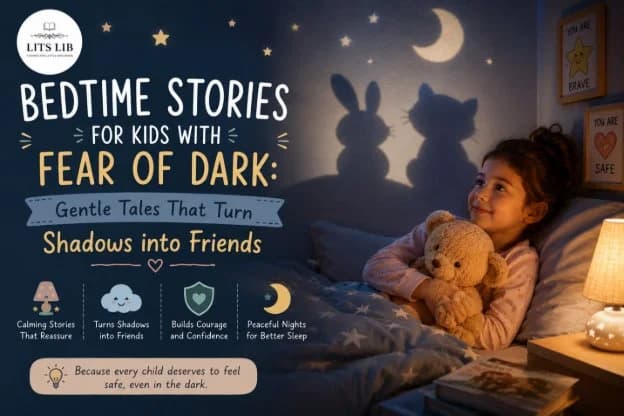
Bedtime Stories for Kids with Fear of Dark: Gentle Tales
For a lot of children, fear of the dark isn't really about darkness. It's about what they think might be in it. The shapes on the wall. The shadow that looks wrong. The feeling that something is there even when they know nothing is. This is one of the most common childhood fears, and it tends to be at its worst at bedtime, exactly when parents need their child to feel safe enough to close their eyes.
Telling a child the dark is nothing to be scared of rarely works, because to them it genuinely doesn't feel like nothing. What tends to work better is helping them build a different relationship with the dark altogether, one where it isn't threatening, just unfamiliar. Stories are one of the most natural ways to do this.
A good bedtime story for a child with fear of the dark doesn't pretend the scary feeling isn't real. It takes the dark seriously, lets the character feel nervous about it, and then gently shows that what seemed frightening was actually something else entirely. That shift, from dread to curiosity to comfort, is exactly what a child needs to carry into their own dark bedroom.
Why Fear of the Dark Is So Common in Children
Fear of the dark typically peaks between the ages of four and eight, which is no coincidence. Children this age have rich enough imaginations to populate the darkness with vivid, scary things, but not quite enough experience yet to consistently talk themselves out of it. A shadow on the wall becomes a monster. A sound outside becomes something prowling. The brain fills in what the eyes can't confirm.
This is completely normal development, not a sign that something is wrong. But it does mean that bedtime can become genuinely stressful for both the child and the parent. A few things tend to make it worse:
- Overtiredness, which lowers a child's emotional regulation and makes fears feel bigger
- Inconsistent bedtime routines, which remove the predictability that helps children feel safe
- Screens before bed, which can leave a child's mind overstimulated and harder to settle
- Conversations that dismiss the fear rather than acknowledge it first
The last one matters more than parents often realise. A child who feels heard about their fear is much easier to reassure than one who feels like their fear is being brushed aside.
What Makes a Bedtime Story Work for a Child Who Fears the Dark
Not every story is the right fit here. A story that's too straightforwardly scary will make things worse. One that's too cheerful and dismissive of the dark won't feel real to a child who genuinely finds it frightening. The sweet spot is a story where:
- The main character feels something recognisably like what the child feels: nervous, unsure, a little hesitant to look at the dark corners
- The dark itself turns out to hold something surprising and friendly rather than something threatening
- The character moves through the fear by being curious and brave rather than by having the fear magically removed
- The ending is warm and settled, ideally with the character going to sleep feeling safe and even a little fond of the night
The Night of the Talking Shadows does all of this. Leo is seven years old, curious and clever, but even he freezes when he hears a whisper coming from the dark park at night. His first instinct is to run. What keeps him is his curiosity, and what he finds in the darkness isn't what he expected at all.
The Story: Friendly Shadows in a Dark Park
In The Night of the Talking Shadows, Leo decides to take a shortcut through a park that the other children avoid after dark. There are rumours about it, moving shadows, creaking swings, whispers from the corners. Most kids hurry past with their heads down. Leo steps in.
What he finds are Nightwhisker and Hopshadow, two talking shadows that take the form of a cat and a bunny. They're not threatening. They're lonely. The park feels empty when children avoid it, and the shadows simply want someone to play games with, riddles, a maze, a courage test across a dark pond.
The clever thing about this story for children who fear the dark is that Leo's fear doesn't disappear immediately. His heart beats faster at the pond. His stomach twists. But he breathes, whispers to himself that he's brave, and moves forward anyway. By the end, the dark park has become somewhere he actively wants to return to. The shadows that felt threatening are now his friends.
That's exactly the emotional journey you want a child to take before they close their eyes. The dark hasn't changed, but their relationship with it has.
How to Use This Kind of Story at Bedtime
Reading a story like this works best when you lean into a few small things:
- Use a calm, slightly slower reading voice even during the tense moments, it models the regulation you want your child to feel
- Pause at Leo's brave moments and let them land: 'I am brave. I will not stop.' A child hears that as something they can say too
- After reading, leave a small nightlight on if needed, but try framing it as something the shadows might like rather than protection from them
- If your child wants to talk about it afterwards, ask what they think Nightwhisker and Hopshadow do when no one is in the park. Giving the shadows a friendly inner life in your child's imagination does more than any reassurance
Repetition helps too. A child who has heard this story a few times starts to carry Nightwhisker and Hopshadow with them into their own dark room. The shadows on their wall aren't threatening things anymore, they might just be friendly ones having a quiet festival of their own.
Why Child-Friendly Horror Stories Have Real Value
There's a reason fairy tales have always included darkness, witches, wolves, things that go wrong before they go right. A story that never presents anything genuinely unsettling doesn't give a child much to work with when they encounter the real feeling of being scared. A story that introduces mild fear in a safe context, within a book, with a trusted adult nearby, and with a resolution that ends warmly, actually builds the emotional muscle a child needs.
This is what makes a story like The Night of the Talking Shadows more useful for a child who fears the dark than a story that simply tells them everything is fine. Leo is scared. He moves through it. He comes out the other side feeling proud and calm. That's a template a child can apply to their own dark bedroom without even realising they're doing it.
Tips for Parents of Children Who Fear the Dark
- Acknowledge the fear directly: 'I know the dark feels scary sometimes' goes further than 'there's nothing to be scared of'
- Keep the bedtime routine consistent so the child's body and mind know what's coming
- A small nightlight is fine and doesn't reinforce the fear the way some parents worry it might
- Let your child name the shadows in their room if they want to, it turns something threatening into something familiar
- Stories like this one, read regularly, do quiet work that direct reassurance often can't
FAQ – Bedtime Stories for Kids with Fear of Dark
Q1: At what age is fear of the dark most common?
Typically between four and eight, though it can appear earlier or linger longer depending on the child. It's one of the most common childhood fears and usually eases naturally over time.
Q2: Should I use a nightlight?
Yes, if it helps your child settle. A small, warm nightlight doesn't reinforce the fear, it simply lowers the intensity so your child can actually relax enough to sleep and absorb the reassurance you're offering.
Q3: Is a mildly spooky story okay for a child who's already scared of the dark?
Yes, as long as the story resolves warmly. A story where the scary thing turns out to be friendly, like the talking shadows here, actively reframes what dark and shadow mean to a child. That's more useful than avoiding the topic altogether.
Q4: My child keeps asking me to check under the bed. Does this story help with that?
It can. When the unknown dark places in a story turn out to hold curious, friendly things rather than threatening ones, children often start extending that logic to their own room. It won't work overnight, but repeated exposure to this kind of story shifts things gradually.
Conclusion
Fear of the dark is one of the most common things parents deal with at bedtime, and one of the most frustrating, because the usual approach of simple reassurance rarely lands. What tends to work better is helping a child build a different relationship with the dark over time, and stories are one of the quietest, most effective ways to do that.
The Night of the Talking Shadows The Night of the Talking Shadows is a story we'd genuinely recommend for this. Leo walks into a dark, whispered-about park, feels the fear, and finds something unexpected on the other side of it. He goes to sleep at the end dreaming of glowing swings and playful shadows, not lying awake afraid of them.
Read it a few nights in a row if you can. The shadows in your child's room might start to seem a little friendlier too.