

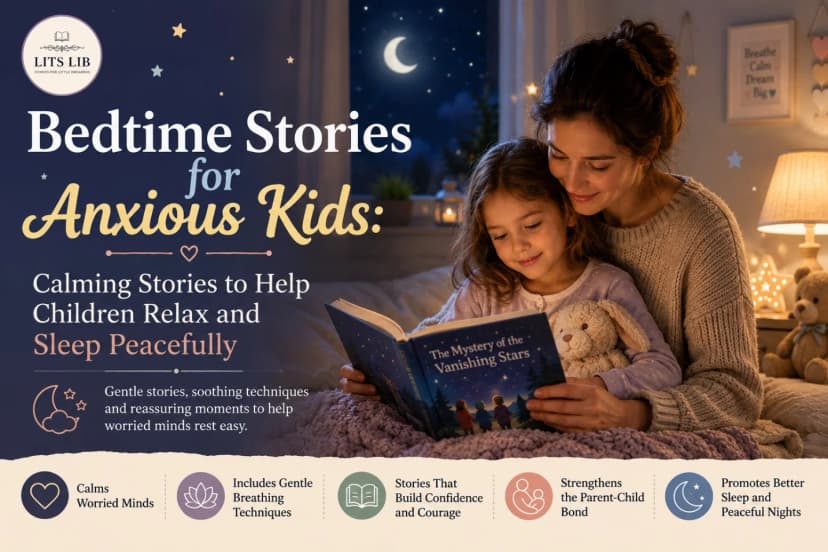
Bedtime Stories for Anxious Kids: Tales That Comfort
Most parents know the feeling. The lights are off, the house is quiet, and that's exactly when your child's mind seems to wake up. A question about a noise downstairs. A worry about tomorrow. A fear that wasn't there an hour ago but is suddenly very real now that everything has gone still. Anxiety in children is far more common than people tend to assume, and bedtime, with its lack of distractions, is often when it shows up the most.
This is where the right kind of bedtime story can actually help. Not just any story, but one written with a worried child in mind, where the character feels something real, gets a little scared, and finds their way back to calm. That last part matters more than people realise. A story that simply distracts a child for ten minutes does less long term good than one that shows them, gently, how to handle the worry itself.
In this post we'll talk about why anxious children need a slightly different kind of bedtime story, what actually helps in the moment, and we'll share one of our own that does this particularly well.
Why Anxious Kids Need a Different Kind of Story
Children with anxiety tend to experience nighttime differently than other kids. The same dark room that feels cosy to one child can feel enormous and unfamiliar to another. A few common patterns parents describe:
- Overthinking small things that wouldn't have bothered them during the day
- A racing heart or restless body even when they say they're tired
- Trouble settling without a parent nearby
- Needing extra reassurance, sometimes the same reassurance, more than once
None of this means something is wrong. It just means bedtime needs a bit more support for these children than "goodnight, see you in the morning". A calming story, read the same gentle way each night, can become one of the most reliable tools a parent has.
What Calming Stories for Anxious Kids Actually Do
A good calming story isn't just soothing in tone. The best ones quietly model a coping skill inside the story itself, so a child absorbs it without realising they're learning anything at all. Slow breathing, a steady voice nearby, picturing somewhere safe, these things work just as well coming from a fictional character as they do from a parent, sometimes better, because the child isn't being told what to do, they're watching someone else figure it out.
This is something we tried to build into The Mystery of the Vanishing Stars, one of our stories for slightly older children. Three friends notice the stars disappearing one by one, and there's a real moment of fear in it, hearts racing, a shadowy fog creature blocking their path. But the way they get past it isn't through fighting or running. They stop, close their eyes, take a few slow breaths together, and focus on calm, happy thoughts until the fear in front of them actually softens and clears. It's a small, simple idea, but it lands well with kids, because it shows that calm is something you can choose to do, not just something that happens to you.
Why This Approach Works So Well at Bedtime
There's a reason breathing and visualisation come up again and again in children's anxiety resources, they're genuinely effective, and a child can use them with no equipment and no adult required, once they've practised a little. Hearing the technique inside a story, rather than as an instruction from a parent, tends to make it stick better.
- Slow breathing calms the body's stress response in a way kids can actually feel
- Picturing something happy or safe gives an anxious mind somewhere to go other than the worry
- Doing it together, in the story and in real life, reinforces that they're not facing it alone
- A predictable, repeatable technique gives a child something to reach for the next time they feel uneasy, not just at bedtime
The friends in The Mystery of the Vanishing Stars don't get rid of their fear by being fearless. They get past it by doing something small and repeatable, which is exactly the kind of thing a child can copy the next time they're lying awake feeling unsettled.
Tips for Parents of Anxious Kids at Bedtime
A few small, consistent habits tend to help more than any single trick:
- Keep the room calm and dim in the lead-up to bed, not just at lights out
- Practise slow breathing together before sleep, even on calm nights, so it's familiar when they need it
- Offer plain reassurance rather than over-explaining: "you are safe, I am here" goes further than a long explanation
- Read calming stories most nights rather than only on hard nights, so the routine itself becomes a comfort
- Keep screens out of the last half hour before bed
Consistency does more here than any one perfect bedtime. An anxious child settles fastest when they know exactly what's coming next, the same routine, the same calm voice, the same kind of story.
Using Stories Like This as a Practical Tool
After reading, it can help to talk through it for a minute. What did the characters do when they got scared? Could your child try the same slow breaths next time they feel worried? You don't need to turn it into a lesson, a couple of simple questions is plenty. Many parents find that The Mystery of the Vanishing Stars becomes a quiet shorthand in the house, a phrase like "remember the stars" can be enough to remind a child to breathe slowly when they're anxious about something else entirely, a test at school, a new place, a loud noise.
FAQ -- Bedtime Stories for Anxious Kids
Q1: Do bedtime stories really help anxious kids?
Yes, particularly stories that show a character using a calming technique rather than simply having their fear disappear on its own. Children pick up the technique without it feeling like a lesson.
Q2: What kind of stories work best for anxiety?
Gentle, slow-paced stories where a character feels a believable worry and is supported through it, ideally with a simple, repeatable coping skill like breathing or picturing somewhere calm.
Q3: How often should I read these kinds of stories?
Most nights works better than occasionally. Repetition is part of what makes them effective, a familiar story is more calming than a new one.
Q4: My child is a bit older, will a story like this still help?
Yes. This particular story was written with slightly older children in mind, around six to eight, since the characters and the fear they face feel a little more grown up than a typical toddler story.
Conclusion
Helping an anxious child settle at night isn't about removing every worry, that's not realistic for any of us. It's about giving them something small and steady to hold onto when the worry shows up anyway.
The Mystery of the Vanishing Stars The Mystery of the Vanishing Stars is one of the stories we'd point you to for exactly that. It doesn't pretend fear isn't real, it just shows three children getting through it together, one slow breath at a time.
Make a calming story part of the routine, most nights if you can manage it, and over time you may notice your child reaching for those same slow breaths on their own, not just at bedtime, but whenever the world starts to feel a little too big.