

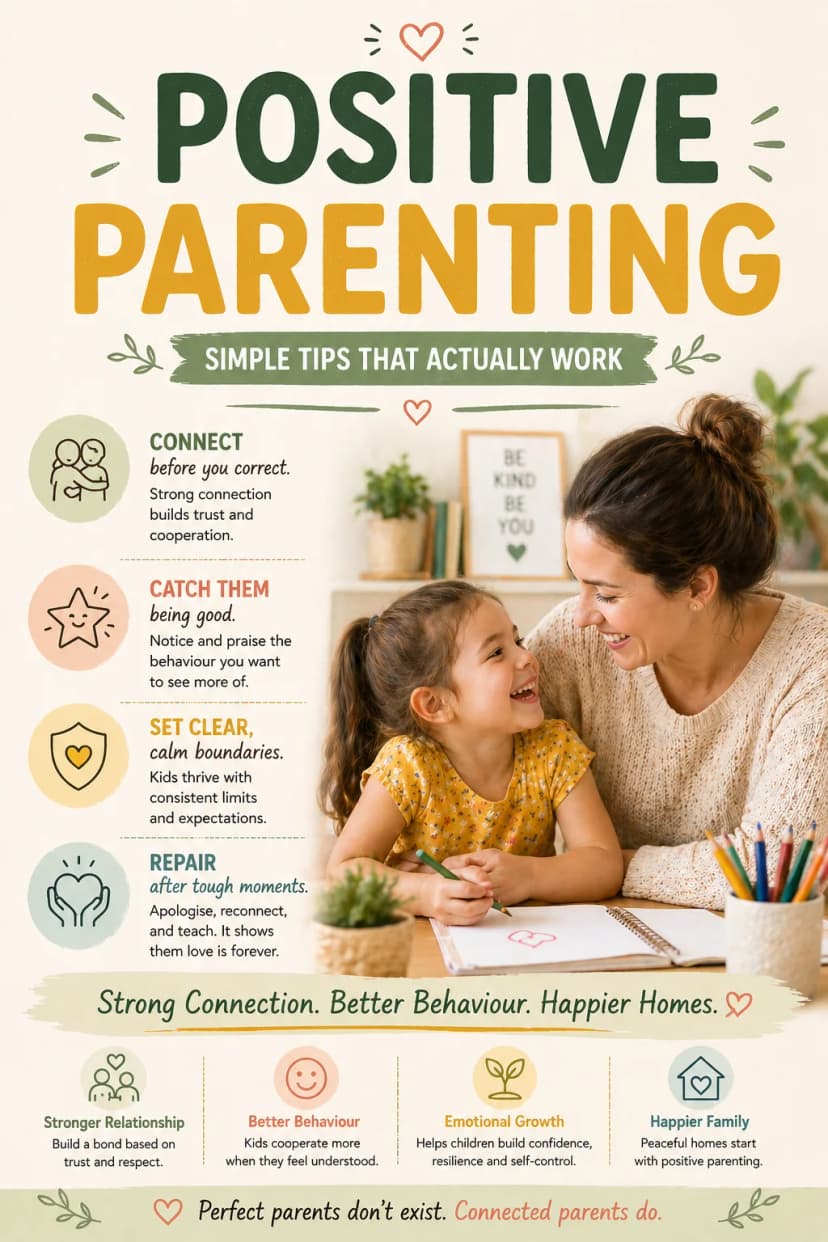
Positive Parenting Tips That Actually Work
There is no shortage of parenting advice. There are books, podcasts, social media accounts, well-meaning relatives, and the occasional stranger in a supermarket who will tell you exactly what you are doing wrong and precisely how to fix it. The noise can be overwhelming, and a lot of it is contradictory. Respond to every need. Let them figure it out. Hold firm. Be flexible. It can feel like no matter what you choose, someone has a study saying it is wrong.
Positive parenting cuts through much of this noise because it is not a set of rigid instructions. It is a way of orienting yourself toward your child, a set of values and habits that, applied consistently over time, build something genuinely durable: a relationship your child trusts, a sense of self they can stand on, and the kind of cooperation that comes from connection rather than fear.
This guide covers what positive parenting actually means, the evidence behind it, and ten practical tips that make a real difference in real families, on ordinary days, when you are tired and the homework is not done and someone is crying about something and you are doing your best. Because that is when parenting actually happens. Not in the ideal scenarios. In the messy, imperfect, trying-your-best ones.
What Positive Parenting Actually Means
Positive parenting is not the same as permissive parenting, and this distinction matters enormously because the two are frequently conflated. Permissive parenting involves high warmth with low limits, and research consistently shows this produces children who struggle with frustration, authority, and self-regulation. Positive parenting combines high warmth with high expectations and consistent, loving limits. It is demanding of parents precisely because it refuses the shortcuts of fear and punishment while still insisting on structure and accountability.
At its core, positive parenting rests on three commitments. The first is leading with connection, understanding that the relationship between parent and child is the medium through which everything else is transmitted, and that investing in that relationship is not indulgence but the most strategically effective thing a parent can do. The second is addressing behaviour through understanding rather than reaction, looking at what a behaviour is communicating rather than simply responding to its surface. The third is modelling what you want to see, understanding that children learn far more from watching how you handle the world than from anything you explicitly teach them.
None of this requires perfection. Positive parenting is not a standard you achieve or fail. It is a direction you consistently point yourself in, and the consistency of the direction matters far more than the perfection of any individual moment.
Why the Research Supports This Approach
The evidence base for positive, authoritative parenting is one of the most robust in developmental psychology. Decades of research, across cultures, socioeconomic groups, and family structures, consistently finds that children raised with warmth, clear expectations, and reasoning rather than purely punitive discipline demonstrate better outcomes across almost every measure that matters.
These children show stronger academic performance, higher self-esteem, better emotional regulation, more robust social skills, and lower rates of anxiety, depression, and externalising behaviour problems in adolescence. They are more likely to have secure relationships in adulthood. They are more likely to seek help when they need it and less likely to rely on external validation or compliance for their sense of self.
The mechanism is not mysterious. Children who are treated with consistent warmth and respect learn that they are worthy of warmth and respect. Children who are given reasons for rules and whose perspectives are taken seriously develop the capacity to reason and to consider others' perspectives themselves. Children whose big feelings are met with regulation rather than punishment or dismissal learn to regulate those feelings over time. The input shapes the output, and positive parenting is one of the most thoroughly validated inputs available.
Ten Positive Parenting Tips That Make a Real Difference
1\. Catch them being good
Most parental attention, across most households, is triggered by behaviour that needs correcting. A child who is playing quietly, helping without being asked, handling disappointment well, or managing a sibling interaction generously often does so without comment. But attention is the most powerful reinforcer available to parents, and what receives attention tends to increase. When you consistently notice and name the behaviour you want to see, \"I just noticed how patiently you waited for your turn, that was really kind,\" you are not just praising in the moment. You are shaping the child's understanding of who they are and what they are capable of.
The praise works best when it is specific rather than generic. \"Good boy\" tells a child very little. \"You kept trying with that puzzle even when it was tricky and you figured it out\" tells them something about their persistence, their capability, and what you value. That kind of specific acknowledgement is genuinely formative rather than simply pleasant.
2\. Say what you want, not what you do not want
The brain processes positive and negative instructions differently, and children are particularly prone to hearing the action rather than the prohibition. \"Do not run\" conjures running. \"Walk please\" conjures walking. \"Stop hitting your sister\" conjures hitting. \"Keep your hands to yourself\" conjures a different physical image entirely.
Shifting from prohibitive to instructive language takes deliberate practice because the prohibitive version is instinctive. But over time, telling children what to do rather than what not to do produces noticeably better compliance, reduces conflict, and creates a household tone that feels more collaborative and less adversarial. It also forces you to get clear about what you actually want, which is a useful discipline in itself.
3\. Connect before you correct
A child who is emotionally activated cannot receive correction or reason effectively. Their brain is in a state of high arousal and the rational, reasoning prefrontal cortex is largely offline. Attempting to correct, discipline, or teach in this state is effort spent on a door that is not open.
The most effective sequence is connection first: acknowledge the feeling, get down to their level, and make brief contact with their emotional experience before attempting any correction. \"I can see you are really frustrated\" takes five seconds and changes everything that follows. Once a child feels understood, the nervous system begins to settle and genuine communication becomes possible. This is not permissiveness. It is sequencing. The correction still comes. It just comes when the child can actually receive it.
4\. Give focused attention in small, consistent doses
Many parents assume that more time equals more connection. Research on parental presence suggests the relationship is more nuanced. Fifteen minutes of genuinely focused, child-led interaction, where you are fully present, following their lead, not on your phone, not half-watching something, not mentally composing tomorrow's to-do list, does more for the parent-child relationship than two hours of parallel presence in the same room.
Brief, consistent doses of real attention also reduce attention-seeking behaviour across the day. A child who has had a parent's full presence, even briefly, is a child whose connection need has been met. A child who has been physically present with a parent all day but has not had genuine attention tends to escalate in search of it. Counterintuitively, giving more focused attention often means dealing with less disruptive behaviour seeking it.
5\. Maintain predictable routines
Routines are not about rigidity. They are about predictability, and predictability is one of the primary ways children's nervous systems register safety. A child who knows what is coming next, what happens after dinner, what the bedtime sequence looks like, what Saturday mornings feel like, is a child who does not need to be anxious about those things. That freed-up cognitive and emotional resource goes into everything else: learning, relationships, regulation.
Routines also reduce the daily decision and negotiation load for parents enormously. Bedtime is bedtime because it is always bedtime at this time, not because you have assessed the situation and decided tonight it applies. Structure removes argument because there is nothing to argue about. The routine is simply what happens, and children who have grown up within predictable structures tend to accept them with far less resistance than those for whom each day is a new negotiation.
6\. Mean what you say and say what you mean
Credibility is the foundation of parental authority. A child who has learned that warnings and consequences are often empty, that the third and fourth chance will probably arrive, that the stated consequence will likely not be enforced, has learned that the words do not mean much. Restoring that credibility once it has been lost takes consistent, sustained effort.
The positive parenting version of this is not about being harsh. It is about being reliable. Do not state a consequence you are not prepared to follow through on. Do not make a promise you cannot keep. Do not threaten something that you know, in the moment, you will not actually do. Children calibrate their behaviour and their trust based on how accurately your words predict reality. Reliability, in both warmth and limit-holding, is the foundation on which everything else in positive parenting is built.
7\. Let natural consequences do some of the teaching
The world is an extraordinarily effective teacher when parents allow it to be. A child who refuses to wear a coat and is cold learns something real about coats and weather. A child who does not eat dinner and is hungry an hour later learns something real about the relationship between eating and hunger. A child who does not look after a toy and it breaks learns something real about the care of things they value.
Parents often intervene to prevent natural consequences out of love and the desire to protect. But preventing natural consequences also prevents learning. Wherever the consequence is safe and proportionate, allowing it to happen, without excessive I-told-you-so commentary, teaches lessons that no lecture can match. The experience lands in a way that words simply do not. Your role afterwards is to be warm and present, not triumphant.
8\. Build emotional intelligence deliberately
Emotional intelligence, the capacity to identify, understand, and manage one's own feelings and relate to the feelings of others, does not develop automatically. It develops through consistent, patient exposure to emotion-coaching by the adults in a child's life. This means naming feelings accurately, both yours and theirs. It means wondering aloud about what might be going on for someone else. It means treating emotional experience as something worth paying attention to rather than suppressing or dismissing.
Simple, daily practices build this over time: talking about the feelings in stories and films, asking children what they think a character might be feeling and why. Checking in at the end of the day with an open, genuine question rather than a closed factual one: not \"Did you have a good day?\" but \"What was the hardest part of today?\" or \"Did anything feel tricky?\" These invitations, asked consistently without pressure to respond, build the habit of emotional reflection that is one of the strongest predictors of long-term wellbeing.
9\. Repair quickly and genuinely after difficult moments
Every parent loses their temper, says something they regret, or handles a moment in a way they are not proud of. What separates positive parenting from idealistic parenting is not the absence of these moments. It is what happens next. A genuine, brief, age-appropriate repair, an honest acknowledgement of what happened and what you wish you had done differently, does several things at once.
It models accountability without self-destruction. It shows the child that relationships can survive difficulty and come back to closeness. It demonstrates that adults make mistakes and that making a mistake does not make you a bad person. And it repairs the relational rupture before it has time to calcify into distance. The child who grows up with a parent who repairs consistently learns that love is not conditional on perfect behaviour, from either side of the relationship. That is an extraordinarily valuable thing to know.
10\. Take care of yourself as a non-negotiable, not an afterthought
You cannot regulate a child's nervous system from a dysregulated one. You cannot model calm under pressure if you are chronically depleted. You cannot be consistently warm, patient, and present if you are running on empty and have been for months. Parental wellbeing is not separate from child wellbeing. It is foundational to it.
This does not mean elaborate self-care routines or the luxury of extensive personal time, which many parents simply do not have. It means sleep wherever possible. It means asking for help rather than martyring yourself to the belief that you should be able to manage everything alone. It means having one or two things in your life that refuel you, however small, and protecting them with the same determination you bring to your children's routines. A parent who is genuinely sustained is a better parent, full stop. That is not selfish. It is the whole point.
Mistakes That Undermine Positive Parenting (And How to Course-Correct)
The most common mistake parents make when trying to parent more positively is being inconsistent under pressure. The approach works beautifully on calm days and collapses at exactly the moments it is most needed: when you are exhausted, when there is time pressure, when the behaviour is particularly challenging. This is understandable. It is also the pattern that teaches children the most useful lesson about how limits actually work, specifically that they bend under sufficient pressure. The antidote is preparation: knowing in advance what your non-negotiables are and having a plan for how you will hold them when you are stretched.
Another common mistake is explaining too much and following through too little. Positive parenting involves reasoning and explanation, but this can tip into extended verbal processing that becomes another form of negotiation. Explanations should be brief and offered once, not repeated at increasing length and volume. After the brief explanation, the boundary holds and the consequence follows without further discussion. Words lose authority when they go on too long.
A third mistake is treating positive parenting as something that should produce quick visible results and abandoning it when it does not. The returns on positive parenting are real but they are cumulative and long-term. The child who is six months into a more positive home environment may still have tantrums, still resist bedtime, still push limits. The difference is subtle at first: slightly faster recovery, slightly stronger underlying connection, slightly more willingness to come to you with things. The full dividend takes years to collect. This is a long investment, and it is worth making.
What You Are Building for the Long Term
Positive parenting is, in the most fundamental sense, a relationship investment. Every moment of genuine connection, every repair after a rupture, every time you chose understanding over reaction, every limit held with warmth rather than anger, is a deposit into the relationship your child will carry into the rest of their life.
The teenager who still talks to their parents, who brings their problems home rather than managing them alone or finding other places to take them, is not the product of luck. They are almost invariably the product of years of being genuinely listened to, respected, and connected to. The foundation was built in the ordinary moments of early childhood: the way a tantrum was handled, the repair after a bad day, the consistent warmth that said you are safe with me, even when things are hard.
You will not always see the evidence of this work in real time. Some of the most important things you do as a parent will go unacknowledged for years, or permanently. That is the nature of the investment. You are not building for the approval of the seven-year-old. You are building for the adult they will become and the relationship you will have with them when they get there.
Frequently Asked Questions
Is positive parenting just another word for gentle parenting?
The terms overlap significantly and are often used interchangeably, but they have slightly different emphases. Gentle parenting, as popularised by Sarah Ockwell-Smith, has a specific theoretical framework built on empathy, respect, understanding, and boundaries, with a strong emphasis on child developmental stages. Positive parenting is a broader umbrella term used across a range of therapeutic and educational contexts to describe any approach that prioritises warmth, connection, and proactive strategies over punitive discipline. Both are grounded in the same body of developmental research and share the core principle that the relationship between parent and child is the most powerful tool available.
My parents did not parent positively and I turned out fine. Why does it matter?
This is a genuinely common and understandable response, and it deserves a honest answer. Many people who were raised with authoritarian or intermittently harsh parenting do turn out fine in many respects. Human beings are resilient. But research also shows that the parenting we receive shapes our stress response, our attachment patterns, our emotional regulation capacity, and our sense of self-worth in ways that often persist into adulthood even when we appear to function well. Choosing to parent differently is not a rejection of your own parents or a statement that your upbringing caused irreparable damage. It is a decision to give your children the benefits that research has repeatedly identified, because those benefits are real and worth giving.
How do I stay positive when my child is being genuinely difficult?
The honest answer is that you will not always manage it, and that is completely normal. The goal is not to feel positive in difficult moments. Difficult moments are difficult for good reasons. The goal is to have strategies that work well enough often enough that your baseline approach is positive even when individual moments are not. The repair, as always, handles the rest. A child who experiences you as someone who is consistently warm, who takes their inner world seriously, and who comes back to connection after difficulty will be substantially unaffected by the moments when you fall short. The pattern is what matters. Not every peak.
Can positive parenting work with a child who has additional needs?
Yes, and it is often particularly valuable for children with additional needs, precisely because those children frequently have more complex emotional regulation challenges, more intense sensory or social experiences, and a greater need for the kind of consistent, understanding, and attuned parenting that positive parenting provides. Adaptations are often needed: the strategies may need to be adjusted for developmental age rather than chronological age, the level of external structure and routine support may need to be higher, and additional professional guidance is often beneficial. But the underlying principles of connection, warmth, and understanding are, if anything, more important for children whose needs are complex rather than less.
The Bottom Line
Positive parenting is not about being a perfect parent. There is no such thing, and the pursuit of perfection is one of the fastest routes to the kind of exhausted resentment that makes good parenting harder rather than easier. It is about being a good enough parent, reliably and consistently, across the ordinary days that make up the vast majority of childhood.
Good enough means connected more often than not. Warm more often than cold. Consistent more often than arbitrary. Present more often than absent. Repairing after the moments when you fall short. Showing your children, through the accumulated evidence of years, that they are loved not for their behaviour but for who they are, and that you are someone they can bring their whole selves to.
That is the project. It is long. It is imperfect. It is interrupted constantly by reality, exhaustion, and the demands of a life that does not pause for good parenting moments. And it is, without question, worth every bit of effort you bring to it.