

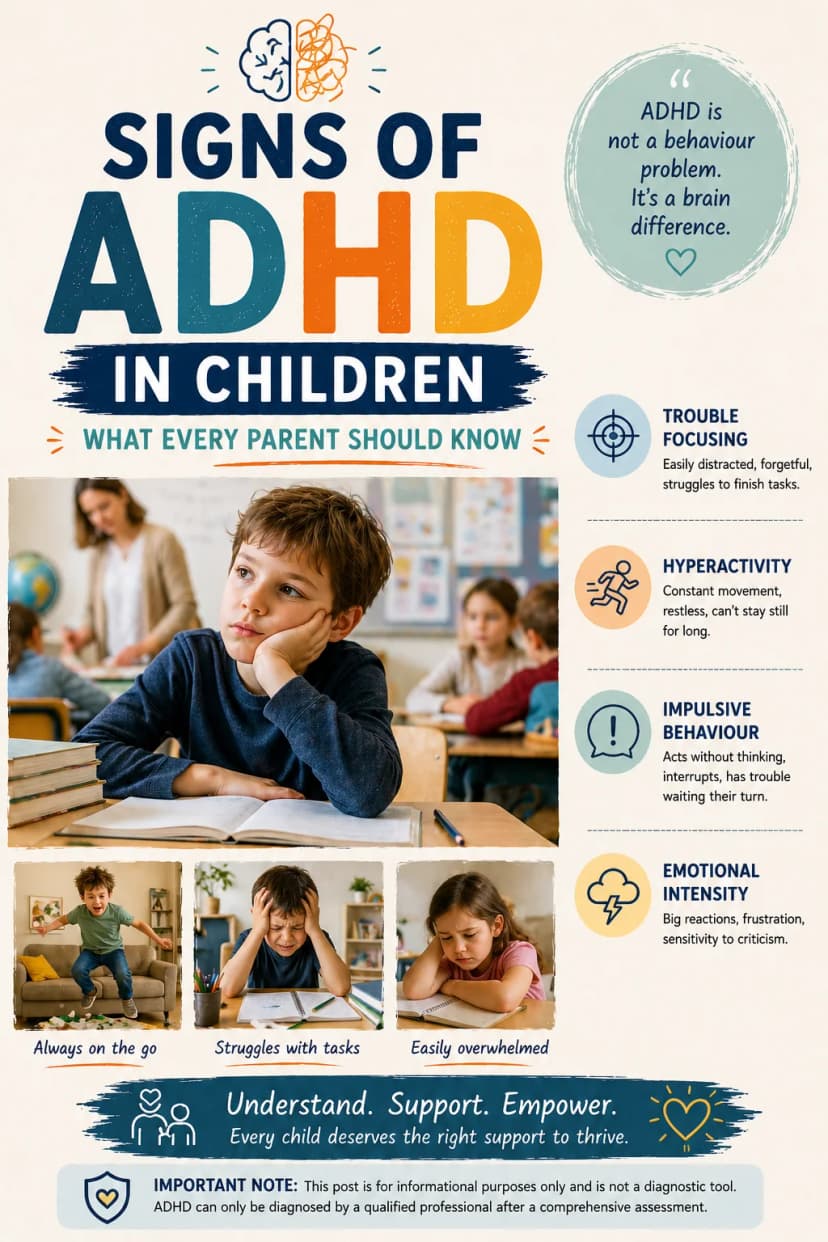
Signs of ADHD in Children Every Parent Should Know
The teacher's email arrives on a Tuesday. Your child, it says, is struggling to stay on task. They call out without raising their hand. They have lost their reading book for the third time this term. At home, you recognise every word of it: the half-finished projects, the explosive frustration over homework, the way they can spend three hours absorbed in building something intricate but cannot sit through a ten-minute meal without bouncing off the walls.
For many parents, the question arrives quietly at first and then with increasing urgency: could this be ADHD? It is a question worth taking seriously, not because a label changes who your child is, but because understanding what is driving their difficulties can be the difference between years of struggle and years of the right support.
This guide is for parents who want to understand what ADHD actually looks like in children, how it differs from ordinary high energy or daydreaming, how it presents differently across ages and genders, and what to do if you think a professional assessment might be warranted. It is not a diagnostic tool. ADHD can only be diagnosed by a qualified professional following a thorough assessment. What this guide can do is give you a clearer picture and the language to have an informed conversation with your GP.
What ADHD Actually Is
Attention Deficit Hyperactivity Disorder is a neurodevelopmental condition, meaning it originates in the way the brain develops and functions rather than in behaviour choices or parenting. It affects the brain's executive function system, which manages attention regulation, impulse control, working memory, planning, and emotional regulation. Children with ADHD are not choosing to be inattentive, impulsive, or emotionally reactive. Their brains are wired differently in ways that make these things genuinely harder for them than for neurotypical peers.
ADHD is one of the most common neurodevelopmental conditions in childhood, affecting an estimated five to seven percent of children globally. It is significantly more heritable than most people realise, with genetics accounting for around seventy to eighty percent of the risk. If a parent or close relative has ADHD, a child's likelihood of having it is considerably higher than in the general population.
It is also worth knowing that ADHD is not caused by bad parenting, too much screen time, sugar, or a lack of discipline. These are persistent myths that cause enormous harm by directing blame at parents and children rather than at the neurological differences that are actually responsible.
The Three Presentations of ADHD
ADHD is currently understood to present in three distinct ways, and the presentation significantly affects which signs are most visible. This matters because the hyperactive child bouncing off classroom walls tends to be identified relatively quickly, while the quietly inattentive child sitting at the back of the room, lost in their own thoughts and missing half of every lesson, can go undiagnosed for years.
Predominantly Inattentive Presentation
This presentation is characterised by significant difficulties with sustained attention, organisation, and following through on tasks, without the prominent hyperactivity and impulsivity of the other presentations. Children with inattentive ADHD are often described as dreamy, forgetful, or easily distracted. They may appear to listen but not retain what was said. They lose things constantly. They start tasks and do not finish them. They struggle with anything that requires sustained mental effort, particularly when the task is not intrinsically interesting to them.
This presentation is more common in girls and is significantly underdiagnosed because it does not disrupt classrooms. A child who is sitting quietly and staring out of the window causes no visible problem. The problem only becomes apparent in their academic results, their increasing sense of inadequacy, and, in many cases, the anxiety and low self-esteem that accumulates from years of trying hard and still falling short.
Predominantly Hyperactive-Impulsive Presentation
This presentation is characterised by physical restlessness, difficulty remaining still or quiet, and impulsive behaviour including acting before thinking, difficulty waiting, and frequent interruption of others. These children are often in motion, even when seated. They call out answers before questions are finished. They run when they should walk, climb when they should sit, and speak when they should listen. Their behaviour is driven by neurological urgency rather than defiance, though it is frequently misread as the latter.
Combined Presentation
The combined presentation, which involves significant signs of both inattention and hyperactivity-impulsivity, is the most common in diagnosed children. Most children with ADHD show features of both domains, even if one is more prominent than the other, and presentations can shift over time. Hyperactivity in particular tends to become less physically obvious in adolescence, though the internal restlessness it reflects typically remains.
What the Signs Actually Look Like in Daily Life
The diagnostic criteria for ADHD are clinical descriptions. What follows is what those criteria look like at the breakfast table, in the classroom, on the football pitch, and at bedtime.
Signs Related to Attention and Focus
A child with attention difficulties may frequently fail to follow through on instructions even when they genuinely intend to. They start a task, get sidetracked, and cannot find their way back to it without external support. Homework that should take twenty minutes takes two hours, not because the work is too hard but because staying on it requires sustained effort that their brain does not naturally sustain. They lose everyday items constantly: shoes, bags, water bottles, sports kit, library books, pencils. They are easily distracted by environmental sounds or thoughts that would not register for another child. When someone speaks to them at length, they often absorb the first and last thing said and lose what came between.
It is important to note that inattention in ADHD is not consistent. These same children can hyperfocus on things that genuinely engage them, spending hours absorbed in a video game, a creative project, or a topic they find fascinating. This is not inconsistency of character. It is a feature of the ADHD brain, which regulates attention through interest and urgency rather than through intention and will. The hyperfocus is not evidence that they could attend to everything if they tried harder. It is evidence that their attention system works differently from the one neurotypical children rely on.
Signs Related to Hyperactivity and Impulsivity
Physical hyperactivity is the most visible ADHD sign and the one most parents picture when they think of the condition. Younger children with hyperactive features are often described as always on the go, as if driven by a motor. They climb on furniture, cannot sit through meals, run rather than walk, and struggle enormously with any situation that requires sustained stillness, church services, long car journeys, waiting rooms, restaurants.
Impulsivity shows up as acting without thinking through consequences, grabbing things from other children, interrupting conversations and lessons, saying whatever comes to mind regardless of context, and taking risks without apparent awareness of danger. These children are not being deliberately rude or unkind. Their impulse control system simply does not engage quickly enough to pause the action before it happens.
In social situations, impulsivity often creates significant difficulties. A child who calls out, interrupts, or takes over games without meaning to can quickly develop a reputation among peers that is hard to shift. The social difficulties that follow, the exclusions, the reputation for being difficult, frequently become a more urgent concern than the ADHD itself.
Emotional Signs That Are Often Overlooked
Emotional dysregulation is not listed in the formal diagnostic criteria for ADHD, but it is one of the most consistently reported experiences by children with the condition and their families. Children with ADHD often feel emotions more intensely and shift between them more rapidly than neurotypical peers. They can go from fine to devastated in seconds over something that seems minor from the outside. They find it very hard to let things go, ruminating on perceived injustices or upsets long after others have moved on. They struggle with losing at games, with transitions, with things not going to plan, and with waiting for things they want.
Low frustration tolerance is closely tied to this. A child with ADHD who encounters an obstacle on a task they are already finding difficult does not have the regulatory buffer to absorb the frustration and continue. The result is often an explosion that seems disproportionate but is, from inside their experience, entirely consistent with how overwhelmed they feel.
How ADHD Looks Different Across Ages and Genders
ADHD does not look the same at four as it does at fourteen. In preschool children, the signs can be difficult to distinguish from typical toddler behaviour: high energy, impulsivity, and short attention spans are developmentally normal at this age. What tends to differentiate ADHD is degree. The preschool child whose hyperactivity and impulsivity are dramatically more intense and persistent than all peers in their setting, who cannot sit for group time at all, who is a physical safety concern to themselves or others, may warrant early assessment.
In primary school years, ADHD typically becomes more visible as the demands of the classroom increase. The expectation to sit still, follow multi-step instructions, manage belongings, and sustain attention across a school day creates a gap between what the child can do and what is expected of them that becomes increasingly difficult to mask. This is often when teachers first raise concerns.
In adolescence, hyperactivity often internalises. The teenage child with ADHD may appear less physically restless but describes a feeling of inner restlessness, a constant racing or buzzing that makes it hard to settle. The executive function demands of secondary school, longer assignments, multiple subjects, self-directed study, and increasingly complex social navigation, create new challenges even in children who appeared to manage reasonably well in primary school.
Gender differences in ADHD presentation are significant and have contributed to substantial under-identification of girls and women. Boys with ADHD are more likely to present with the hyperactive-impulsive features that are disruptive in classroom settings and therefore more likely to come to clinical attention earlier. Girls with ADHD are more likely to present with the inattentive profile, to mask their difficulties through social effort and people-pleasing, and to internalise their struggles as anxiety, low self-esteem, or a sense of fundamental inadequacy. Many girls are not diagnosed until adulthood, by which point years of unrecognised struggle have taken a significant toll.
What Is Not ADHD
Not every energetic, distractible, or impulsive child has ADHD. Childhood naturally involves periods of high energy, limited impulse control, and variable attention, and these are not in themselves cause for concern. What distinguishes ADHD is the degree, the persistence, and the functional impact: the signs are present across multiple settings, they are significantly more pronounced than in typically developing peers of the same age, they have been present for at least six months, and they are causing real difficulties in the child's daily life.
Several other conditions can produce signs that overlap with ADHD. Anxiety, for instance, can create difficulties with concentration and restlessness that look superficially similar. Sleep deprivation produces inattention and emotional dysregulation. Sensory processing differences, learning disabilities such as dyslexia, and giftedness can all create profiles that include some ADHD-like features. This is part of why a thorough professional assessment, rather than a checklist, is necessary for an accurate diagnosis.
It is also worth noting that ADHD frequently co-occurs with other conditions. Anxiety, dyslexia, dyspraxia, autism spectrum disorder, and mood difficulties are all more common in children with ADHD than in the general population. A proper assessment takes this complexity into account.
When and How to Seek a Professional Assessment
If you recognise a significant number of the signs described in this guide, and particularly if those signs are present across both home and school settings, are persistent over time, and are causing genuine difficulty in your child's life, it is worth speaking to your GP. You do not need a teacher's referral, though school observations and reports will form part of any assessment. You do not need your child to be failing academically, though many are. You need to have a genuine, sustained concern about your child's functioning, and that concern is enough to begin a conversation.
In the UK, the referral pathway typically runs through your GP to a community paediatrician or CAMHS (Child and Adolescent Mental Health Services), though some areas have specific neurodevelopmental assessment pathways. Waiting times on the NHS are significant in most regions, sometimes running to a year or more. Some families choose to pursue private assessment if they are in a position to do so, which can significantly reduce waiting time. A private diagnosis is generally accepted for school support purposes, though it is worth checking locally.
While waiting for assessment, it is worth requesting a meeting with your child's school. Schools are required to make reasonable adjustments for children with identified needs even before a formal diagnosis, and there is much that can be done in the classroom in terms of seating, task structure, movement breaks, and homework support that can make a meaningful difference while you wait for the formal process to progress.
What Happens After a Diagnosis
A diagnosis of ADHD opens doors rather than closing them. It gives your child access to school support under the SEND framework, potential eligibility for exam accommodations in secondary school and beyond, and a framework for understanding themselves that replaces the narrative of laziness or difficulty with a more accurate and compassionate one.
Treatment for ADHD in children is typically multimodal, meaning it involves a combination of approaches rather than a single solution. Behavioural strategies and parent coaching are usually the first line of support for younger children. For children aged five and over where behavioural approaches alone are insufficient, medication may be considered. ADHD medication, when appropriately prescribed and monitored, is among the most effective treatments in child psychiatry and has a strong evidence base. It is not appropriate for every child, and the decision is always made in partnership with the family, but it is worth approaching it with an open mind rather than reflexive concern.
Equally important is the work done to help children understand their own neurology. Children who grow up knowing that their brain works differently rather than defectively, that their ADHD comes with genuine strengths alongside its challenges, that they are not broken or bad, tend to manage significantly better across their lives than those who receive only the message that they need to try harder.
Frequently Asked Questions
Can girls have ADHD?
Yes, absolutely. ADHD affects girls and boys in roughly equal numbers, though girls are diagnosed significantly less often and later because their presentation tends to be less disruptive and therefore less visible to the adults around them. If you have a daughter who seems to struggle quietly, who is working hard but not achieving, who is anxious or emotionally dysregulated in ways that seem out of proportion, and who you suspect may be masking difficulties at school, it is worth raising ADHD as a possibility with your GP regardless of the gender-based assumptions that still pervade public awareness of the condition.
My child can concentrate for hours on video games. Surely that means they don't have ADHD? {#my-child-can-concentrate-for-hours-on-video-games.-surely-that-means-they-dont-have-adhd}
This is one of the most common misconceptions about ADHD. The ability to hyperfocus on highly stimulating, rewarding activities is actually a characteristic feature of the ADHD brain rather than evidence against it. The ADHD attention system is driven by dopamine, and activities like video games deliver consistent, rapid dopamine feedback in a way that worksheets and reading comprehension exercises do not. The ability to sustain attention on something intrinsically rewarding does not mean the child can sustain attention on demand. These are neurologically different processes.
Is ADHD overdiagnosed?
This is a common concern, and the research picture is nuanced. There are regions and socioeconomic contexts where ADHD diagnosis rates are higher than population prevalence would suggest, which may reflect over-identification in some settings. However, in the UK and across much of Europe, the evidence suggests that ADHD is more likely to be underdiagnosed than overdiagnosed, particularly in girls, in children from lower-income backgrounds who have less access to assessment services, and in children whose ADHD presents in less disruptive ways. The answer to the question of whether ADHD is overdiagnosed is not a simple yes or no: it depends significantly on which populations you are looking at.
Will my child grow out of ADHD?
ADHD is not a childhood condition that children simply outgrow. Research now consistently shows that the majority of children with ADHD continue to experience significant symptoms in adulthood, even if the outward presentation changes. Hyperactivity tends to become less physically apparent in adolescence and adulthood, but the underlying attention regulation difficulties, impulsivity, and emotional dysregulation typically persist in some form. With the right support, understanding, and strategies, many adults with ADHD manage very effectively. But the goal should be equipping children for a lifetime with their neurology rather than waiting for them to outgrow it.
The Bottom Line
If something has been nagging at you about your child, a persistent sense that their struggles are more than just a phase, that they are trying harder than people realise and still falling short, that the standard advice is not working for them in the way it works for other children, then that instinct is worth following. You know your child better than any checklist does.
A professional assessment is not a verdict. It is a process of understanding. And for children who do receive an ADHD diagnosis, that understanding often arrives as something closer to relief than grief: finally, a framework that explains what they have been experiencing, and the beginning of support that is actually designed for how their brain works.
Start with your GP. Take notes about what you are observing. Ask the school for their perspective in writing. And remember that seeking answers for your child is one of the most important things a parent can do.