
What the Clock Was Keeping
She signed the form at four minutes past four. She noticed the time as she did it and said nothing, because some things didn't need to be pointed out to be true.
Dr Hussain was efficient and warm and promised that the formal return process would now be considerably simpler. She photographed the form, kept the original, and gave Mara her card along with a carefully packaged set of photocopies of all the documents to take home in the meantime. The originals would follow within weeks, she said, once the paperwork completed its final bureaucratic journey.
Mara's mum, found at a jewellery stall with a pair of earrings she was deciding about, was shown the photographs and took approximately four seconds to start crying. She sat down on a nearby chair and held the photograph of Adaeze for a long time, and Mara stood next to her and held her hand, and Jonah stood nearby with the tactful invisibility of a good friend.
"Where did you find these?" her mum asked eventually.
Mara explained about Dr Hussain and the donation dispute, simplifying the part about the clock to "I was following up on something from the letter that came with Edith Calloway's package." This was accurate as far as it went.
Her mum looked at her. "You investigated this."
"A bit," Mara said.
"At an antiques fair."
"I had help," Mara said, gesturing at Jonah, who nodded helpfully.
Her mum looked between them, then back at the photograph of Adaeze. "Your great-grandmother would have liked you both," she said. "She liked people who paid attention."
In the car on the way home, Jonah leaned over and said quietly, "Are you going to tell her about the clock?"
"Eventually," Mara said. "When I understand it better."
"Fair enough." He looked out of the window. "That was extraordinary, by the way. In case you needed someone to say that."
"I did, a bit," Mara admitted. "Thank you."
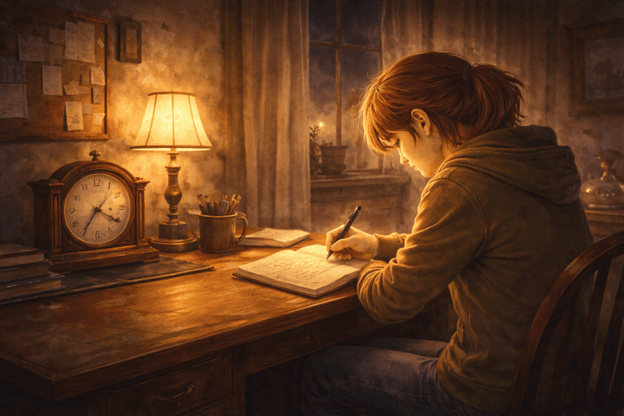
She went home and went straight to her room and looked at the clock on her desk. It was stopped, as always, at four minutes past four. The hands had not moved. She wound it, as she had wound it every day, and listened to it tick.
It ticked for a while. Then it stopped.
But this time, the position of the hands was different.
She looked closely. The hour hand was no longer pointing at four. It had moved, just slightly, to a new position. The minute hand was in a new position too. She checked the angle with her protractor.
Different numbers. A different time. A different message.
She sat back and looked at it, and felt something that was equal parts wonder and responsibility, a complicated, serious feeling that she thought was probably what growing up felt like when it happened gradually instead of all at once.
"All right," she said, to the clock, to Edith Calloway, to her great-grandmother Adaeze who had apparently been the kind of person worth finding one's way toward. "I'm paying attention."
She opened her notebook to a new page.
She wrote the new time at the top: the hour, the minute, the fractional degree of the hand.
Then she started thinking.
The clock ticked softly in the lamplight, keeping its own kind of time, telling its own kind of truth, patient and exact, waiting for her to ask the right questions.
She had, everyone seemed to agree, always been good at that.
Outside, Whitmore went about its Saturday evening, lights coming on in windows, people returning from their days, the ordinary business of ordinary lives. Inside, a girl and a clock sat together in a circle of lamplight, and between them they held a conversation that had no words but was, nonetheless, entirely clear.
There was more to find. She knew that now, the way you knew things that had moved from suspicion to certainty without stopping at proof along the way.
She would find it.
After all, she had the right tool for the job, ticking away on her desk, stopped at a new time, pointing toward a new somewhere.
She just had to pay attention.